
Service AI represents a fundamental shift in how local service businesses manage their revenue operations. Rather than treating artificial intelligence as a standalone technology, service AI integrates directly into the revenue layer, identifying inefficiencies, automating critical touchpoints, and recovering lost opportunities that traditional systems miss. For local service businesses facing tight margins and operational complexity, this technology delivers measurable returns by working continuously in the background while teams focus on core service delivery.
Understanding Service AI in Revenue Operations
Service AI differs fundamentally from generic automation tools or chatbot interfaces. It operates as an intelligent system that observes revenue patterns, detects anomalies, and executes corrective actions across the entire customer lifecycle.
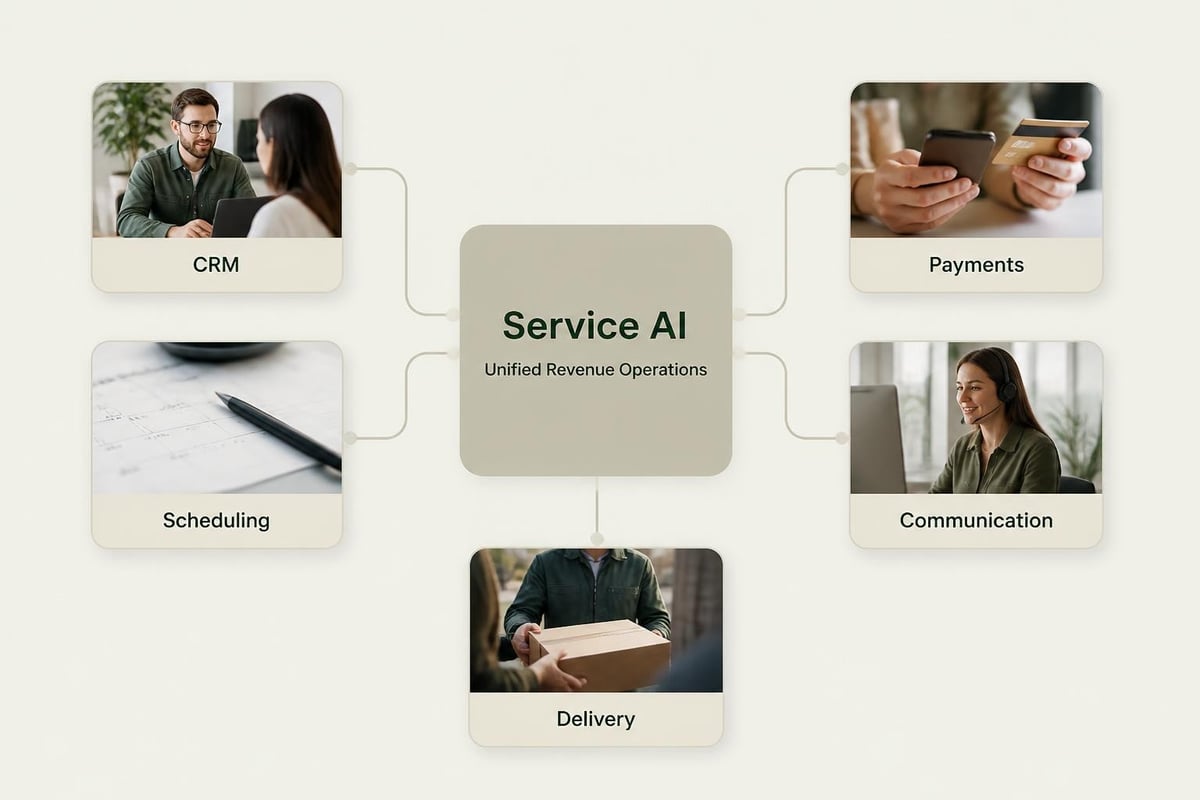
The architecture of service AI relies on three core components: data integration, pattern recognition, and autonomous execution. These systems pull information from CRM platforms, payment processors, scheduling tools, and communication channels to create a unified revenue view. Unlike traditional business intelligence that simply reports problems, service AI actively intervenes to prevent revenue loss.
Key Capabilities That Define Service AI
Modern service AI platforms deliver specific functionality designed for revenue optimization:
- Lead response automation that engages prospects within seconds of inquiry
- Follow-up persistence that maintains contact through multiple channels and timeframes
- Payment recovery sequences that reduce outstanding receivables automatically
- Retention triggers that identify at-risk customers before they churn
- Reactivation campaigns that bring dormant customers back into the revenue stream
Each capability operates independently while contributing to a cohesive revenue strategy. The system learns from historical patterns, adjusts timing based on customer behavior, and optimizes messaging for maximum conversion.

Research on task decomposition and retrieval-augmented generation demonstrates how service AI systems break complex revenue processes into manageable workflows while maintaining contextual awareness. This architectural approach ensures reliability and allows business owners to understand exactly how decisions are made.
Revenue Leakage and the Service AI Solution
Revenue leakage occurs at predictable points in every service business. Prospects inquire but never receive follow-up. Estimates are sent but not converted. Services are delivered but invoices remain unpaid. Customers complete transactions but never return.
Traditional approaches address these problems through hiring additional staff, implementing reminder systems, or accepting loss as a cost of doing business. Service AI takes a different approach by treating revenue leakage as a systems problem requiring automated intervention.
Quantifying Revenue Leaks
The first step in addressing revenue leakage involves measurement. Service AI platforms analyze historical data to identify patterns:
| Leak Type | Typical Impact | Detection Method |
|---|---|---|
| Unconverted leads | 30-45% revenue loss | Response time, follow-up gaps |
| Unpaid invoices | 15-25% cash flow impact | Payment timing, customer history |
| Non-returning customers | 40-60% lifetime value loss | Purchase frequency, engagement drops |
| Abandoned estimates | 20-35% pipeline waste | Quote-to-close gaps, competitor timing |
Once quantified, these leaks become addressable through targeted automation. A local HVAC company might discover that 38% of service estimate requests receive no response within 24 hours. Business automation systems can immediately deploy AI-driven engagement to capture these opportunities before they move to competitors.
The AI Scaling Strategy Audit provides a rigorous assessment of exactly where revenue leakage occurs in your operation. This diagnostic process examines acquisition, conversion, follow-up, retention, and reactivation to quantify commercial impact and identify which infrastructure investments will deliver the highest returns.

Automated Revenue Recovery
Service AI doesn't simply identify problems; it executes solutions. When an invoice reaches 15 days past due, the system initiates a multi-touch sequence combining email, SMS, and automated calling. When a customer hasn't booked in 90 days, reactivation campaigns deploy personalized offers based on service history.
This operational model shifts revenue management from reactive to proactive. Teams no longer chase payments or remember to follow up because the system handles these functions autonomously. As outlined in Forrester's strategic guidance for AI in customer service, prioritizing high-value use cases where AI reliably outperforms manual processes creates immediate operational leverage.
Implementation Architecture for Local Service Businesses
Deploying service AI requires careful consideration of data infrastructure, integration points, and operational workflows. Local service businesses benefit from systems designed specifically for their operational reality rather than enterprise-grade platforms requiring extensive customization.
Data Integration Requirements
Service AI performs only as well as the data it accesses. Effective implementations connect:
- Customer relationship management systems containing lead and customer records
- Scheduling platforms tracking appointments, cancellations, and service completion
- Payment processors providing transaction history and outstanding balances
- Communication tools including email, SMS, and phone systems
- Service delivery platforms documenting work performed and customer satisfaction
These integrations enable service AI to see the complete customer journey. When a scheduled appointment is cancelled, the system recognizes the event and automatically initiates rebooking outreach. When payment is received, follow-up sequences adjust accordingly.
The AI for business operations approach emphasizes creating unified data visibility across previously siloed systems, enabling AI engines to make informed decisions based on complete context rather than fragmented information.
Compliance and Safety Considerations
Deploying service AI requires attention to regulatory frameworks and ethical guidelines. The European Union's AI Act, which entered force in August 2024, establishes transparency and risk management obligations for AI systems interacting with customers. Even businesses operating outside the EU should consider these principles as emerging best practices.
Key compliance considerations include:
- Transparency: Customers should understand when they're interacting with AI systems
- Data privacy: Service AI must handle customer information according to applicable regulations
- Bias mitigation: Automated decisions should not discriminate based on protected characteristics
- Human oversight: Critical revenue decisions should include review mechanisms
- Audit trails: Systems should maintain records of automated actions for accountability
The DTSP best practices report on AI automation provides detailed guidance on implementing safety guardrails, monitoring for unintended consequences, and maintaining human oversight of automated customer-facing systems.
Measuring Service AI Performance
Effective service AI implementation requires establishing clear metrics and monitoring systems. Unlike traditional software where adoption is the primary success measure, service AI performance ties directly to revenue outcomes.
Core Performance Indicators
Service businesses should track specific metrics to evaluate service AI effectiveness:
| Metric | Calculation | Target Improvement |
|---|---|---|
| Lead response time | Time from inquiry to first contact | Under 5 minutes |
| Lead-to-customer conversion | Percentage of inquiries becoming customers | +15-30% increase |
| Payment collection rate | Percentage of invoices paid within terms | +20-40% improvement |
| Customer retention rate | Percentage of customers returning annually | +25-50% increase |
| Revenue per customer | Total lifetime value per acquired customer | +30-60% growth |
These metrics connect directly to financial outcomes. A 20% improvement in payment collection rate reduces working capital requirements and improves cash flow predictability. A 30% increase in customer retention compounds annually, dramatically increasing business valuation.
Attribution and ROI Analysis
Service AI often works invisibly, making attribution challenging. A customer who receives three automated follow-up messages before booking may not realize these touchpoints were AI-generated. Robust measurement requires tracking all system interventions and correlating them with revenue events.
Modern service AI platforms provide detailed analytics showing which automated sequences generate conversions, which timing strategies optimize response rates, and which customer segments respond best to specific messaging. This data enables continuous optimization.
The revenue automation strategy framework provides a structured approach to measuring automation impact across the entire revenue lifecycle, ensuring that AI investments deliver documented returns rather than assumed benefits.
Scaling Operations Through Service AI
The ultimate value of service AI emerges in its scaling characteristics. Traditional service businesses face linear growth constraints: doubling revenue typically requires doubling team size, facilities, or operational complexity. Service AI breaks this pattern by automating the revenue layer independently of service delivery.
Operational Leverage Points
Service AI creates leverage through several mechanisms:
- Eliminating response bottlenecks that limit lead conversion during high-demand periods
- Maintaining consistent follow-up regardless of team workload or seasonal fluctuations
- Recovering revenue that would otherwise be lost due to human oversight
- Personalizing customer engagement at a scale impossible for manual operations
- Reducing administrative overhead by automating routine revenue management tasks
A local plumbing company serving 500 customers might struggle to personally follow up with every past customer quarterly. Service AI executes this task effortlessly, sending personalized maintenance reminders, special offers, and reactivation campaigns to thousands of contacts simultaneously.
Building Sustainable Competitive Advantages
As service AI becomes more sophisticated, businesses that deploy it early develop compounding advantages. Their systems accumulate more data, refine their models more effectively, and operate more efficiently with each customer interaction.
This creates a defensive moat that becomes difficult for competitors to overcome. A business that has been operating service AI for two years has refined its messaging, optimized its timing, and eliminated most revenue leaks. A competitor starting from scratch must invest similar time and resources to achieve comparable results.
The managed AI approach recognizes that many service businesses lack internal expertise to deploy and optimize these systems independently. Managed service AI provides the technology, ongoing optimization, and strategic guidance needed to maintain competitive advantages over time.
Service AI and the Future of Revenue Operations
The trajectory of service AI points toward increasingly autonomous revenue operations. Current systems require initial configuration and periodic oversight. Future iterations will self-optimize, identify new revenue opportunities, and recommend strategic adjustments based on market conditions.
Agentic AI and Autonomous Service Management
Recent research on agentic AI in IT service management demonstrates how AI systems are evolving from reactive automation to proactive decision-making. These systems don't simply execute predefined workflows; they analyze situations, consider multiple approaches, and select optimal interventions autonomously.
For revenue operations, agentic service AI will:
- Identify emerging revenue leaks before they significantly impact performance
- Adapt messaging strategies based on real-time customer response patterns
- Optimize resource allocation by predicting demand fluctuations
- Test and implement improvements without requiring manual experimentation
- Generate strategic recommendations based on competitive intelligence and market trends
This evolution transforms service AI from a useful tool into a strategic asset that actively drives business growth.
Privacy, Security, and Trust
As service AI becomes more capable, questions about data privacy and system security become more critical. Microsoft's security and privacy guidance for AI agents in customer service contexts provides practical frameworks for governance, monitoring, and compliance.
Service businesses must ensure their service AI implementations:
- Encrypt customer data both in transit and at rest
- Limit data access to only what's necessary for specific functions
- Maintain audit logs of all automated customer interactions
- Implement failsafe mechanisms that escalate unusual situations to human review
- Regular security assessments to identify and address vulnerabilities
Trust is the foundation of service businesses. Service AI should enhance rather than compromise that trust through transparent, secure, and reliable operation.
Practical Next Steps for Service Businesses
Implementing service AI doesn't require massive upfront investment or complete operational transformation. The most successful deployments start with targeted use cases that address specific revenue leaks, demonstrate clear ROI, and build organizational confidence.
Starting Points for Service AI Deployment
Consider beginning with one of these high-impact applications:
- Lead response automation: Ensure every inquiry receives immediate acknowledgment and personalized follow-up
- Payment collection sequences: Automate the process of converting invoices to collected revenue
- Appointment reminder systems: Reduce no-shows through multi-channel confirmation and reminder campaigns
- Customer reactivation campaigns: Systematically bring dormant customers back into active status
- Review and referral requests: Automate the collection of testimonials and referral generation
Each of these use cases operates independently, delivers measurable results, and requires minimal disruption to existing operations. Success in one area builds momentum for expanding service AI into additional revenue functions.
The AI leak detection system identifies exactly where revenue is escaping your current operations, providing a data-driven starting point for prioritizing AI deployment based on maximum financial impact.
Building Internal Capability
While managed service AI solutions handle technical complexity, successful implementations require internal stakeholders who understand the technology, monitor performance, and ensure alignment with business objectives.
Develop this capability through:
- Education: Team members should understand how service AI works and what it can accomplish
- Data hygiene: Maintain clean, accurate customer data that enables effective AI operation
- Performance review: Regular analysis of service AI metrics and outcomes
- Feedback loops: Processes for identifying issues and recommending improvements
- Strategic planning: Ongoing assessment of new service AI opportunities as the business grows
This internal capability ensures that service AI becomes a sustainable competitive advantage rather than a temporary technology experiment.
Service AI represents the most significant opportunity for local service businesses to scale revenue without proportionally scaling operational complexity. By automating the revenue layer-from initial inquiry through long-term retention-these systems recover lost opportunities, improve cash flow, and create sustainable growth. Leverage Scaling has built an AI Revenue Operations System specifically designed for local service businesses, identifying revenue leaks, quantifying their impact, and deploying AI Profit Engines that automatically capture, recover, and retain more revenue while you focus on delivering excellent service.