
The modern business landscape demands more than traditional software solutions. An AI engine represents the next evolution in operational intelligence, capable of processing vast amounts of data, identifying patterns invisible to human analysis, and executing strategic actions autonomously. For local service businesses facing revenue leakage, operational inefficiencies, and scaling challenges, understanding how an AI engine operates and delivers value has become essential. These systems move beyond simple automation to create intelligent, adaptive frameworks that continuously optimize revenue performance while reducing the cognitive burden on business owners.
Understanding the AI Engine Architecture
An AI engine is fundamentally different from conventional business software. Rather than executing predetermined workflows, it combines machine learning models, inference systems, and orchestration layers to create adaptive intelligence that improves with use.
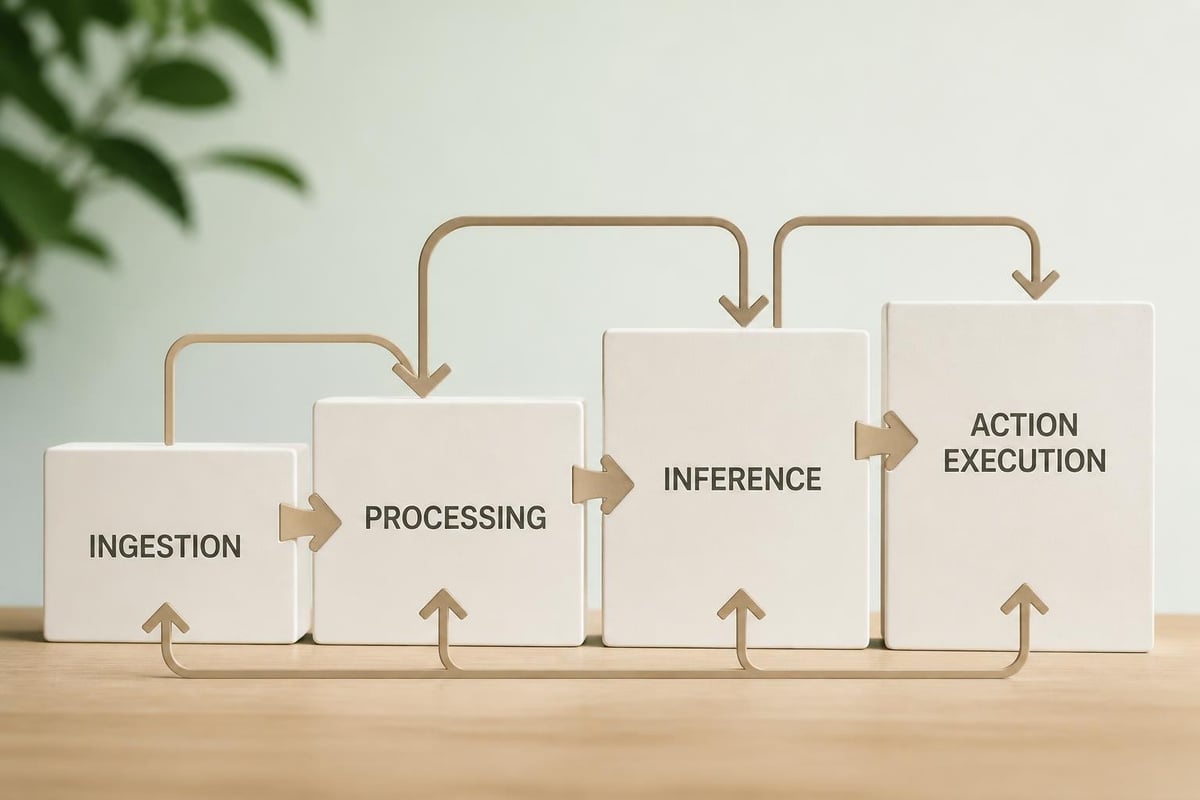
The core architecture consists of several integrated components working in concert. Data ingestion layers collect information from multiple sources, including CRM systems, communication platforms, payment processors, and customer interaction logs. This raw data flows into processing pipelines where normalization, cleaning, and feature extraction prepare it for analysis.
At the heart of the system sits the inference engine, which applies trained models to incoming data streams. Modern inference architectures enable real-time prediction and decision-making at scale, processing thousands of transactions per second while maintaining low latency. These engines must balance computational efficiency with accuracy, particularly when operating under resource constraints.
Model Training and Optimization
Building an effective AI engine requires careful consideration of model selection, training methodologies, and continuous optimization. The system must learn from historical patterns while adapting to changing business conditions.
Training begins with curated datasets that represent the full spectrum of business scenarios. For revenue operations, this includes successful conversions, missed opportunities, customer churn patterns, and recovery interventions. Comprehensive benchmarking frameworks ensure that models meet performance thresholds before deployment.
The optimization process involves several iterative steps:
- Feature engineering to identify the most predictive variables
- Hyperparameter tuning to maximize model accuracy
- Cross-validation to prevent overfitting
- A/B testing in production environments
- Continuous retraining as new data accumulates
Modern AI engines leverage automated machine learning (AutoML) techniques to accelerate this cycle, reducing the time from hypothesis to production deployment from months to days.
Revenue Operations and AI Engine Integration
For local service businesses, the practical value of an AI engine emerges through its integration with revenue operations. The system must connect with existing business processes while introducing intelligence that identifies and captures revenue that would otherwise slip through the cracks.
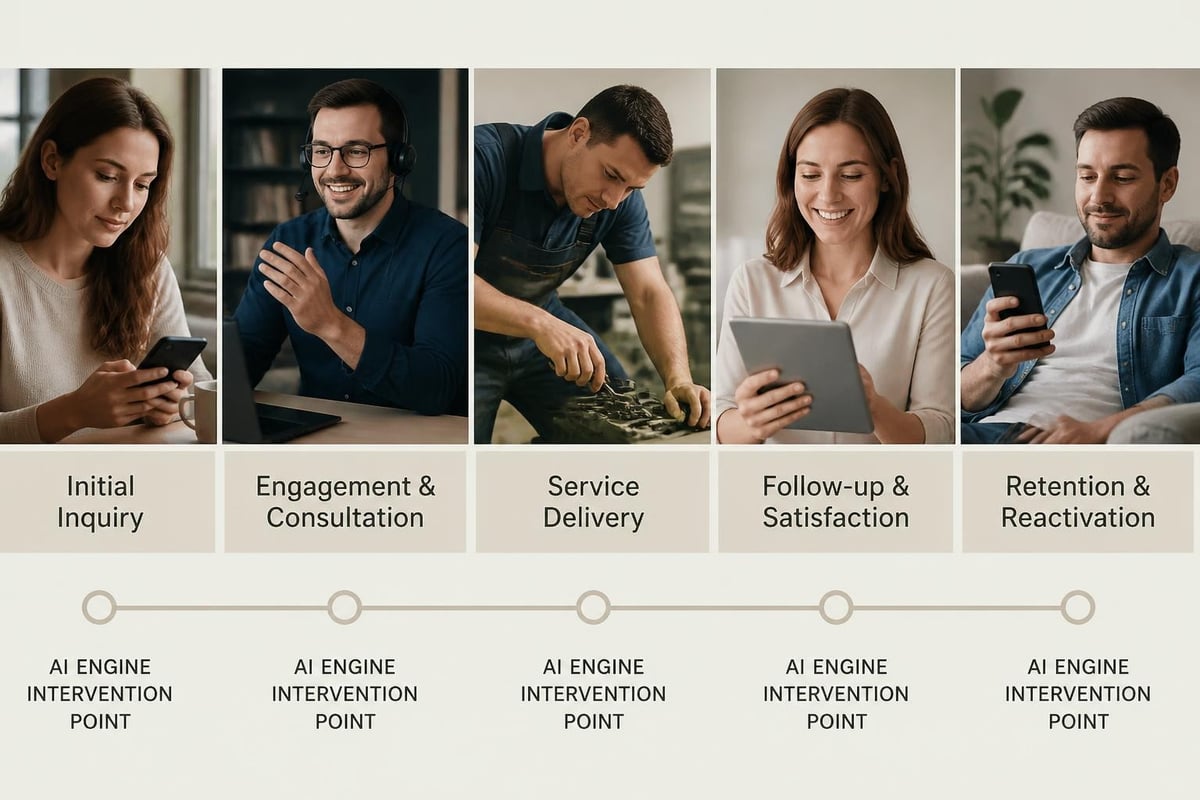
Revenue leakage occurs at multiple points in the customer journey. Leads go uncontacted during high-volume periods. Follow-up sequences fail to execute consistently. Pricing errors reduce margins. Customer dissatisfaction leads to quiet churn without intervention. Each leak represents quantifiable lost revenue that compounds over time.
An AI engine addresses these challenges through continuous monitoring and automated intervention. When a high-value lead enters the system, the engine predicts conversion probability based on dozens of factors including inquiry source, timing, service type, and historical patterns. It then triggers optimized engagement sequences, adjusts follow-up intensity, and alerts human operators only when strategic decisions require judgment.
| Revenue Leak Type | Traditional Detection | AI Engine Detection | Recovery Rate Improvement |
|---|---|---|---|
| Uncontacted Leads | Manual CRM review | Real-time monitoring | 340% |
| Failed Follow-ups | Weekly reports | Instant alerts | 280% |
| Pricing Errors | Monthly audits | Transaction-level analysis | 190% |
| At-risk Customers | Quarterly surveys | Behavioral pattern detection | 420% |
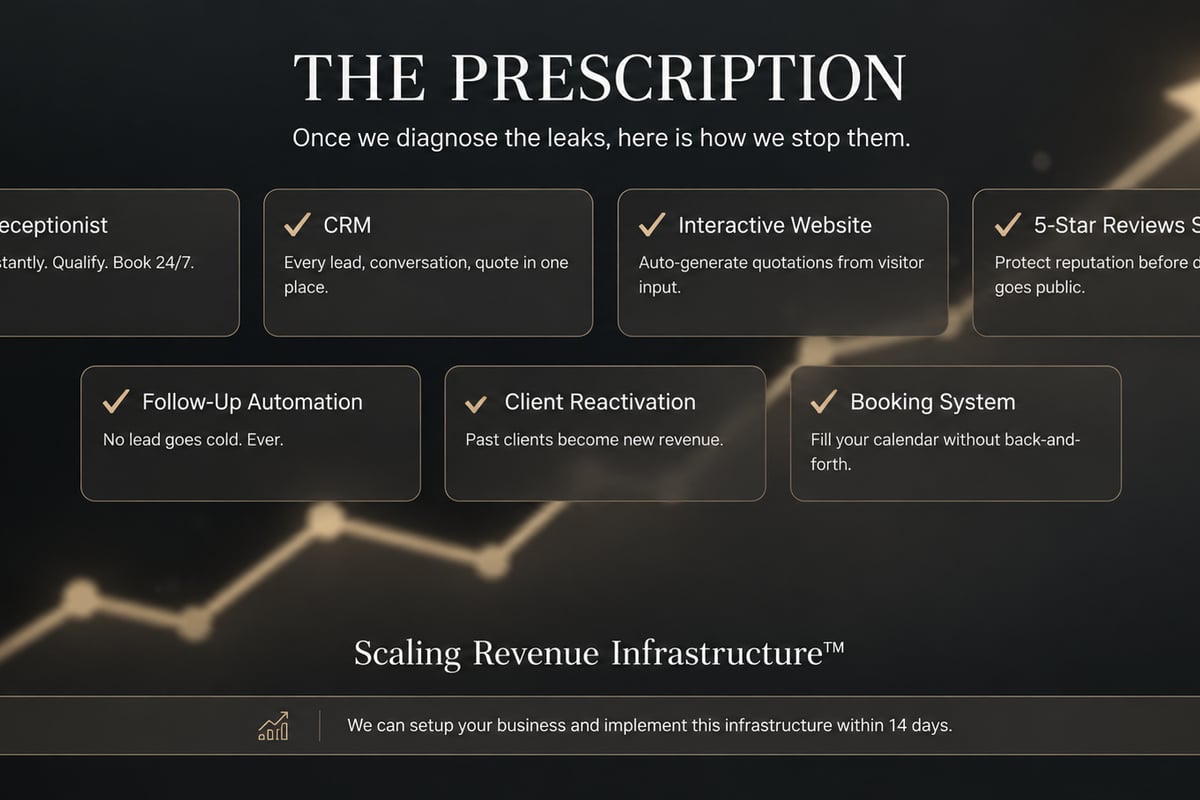
The Leverage Scaling approach demonstrates this integration in practice. AI-powered business automation systems connect with existing service business infrastructure to create a comprehensive revenue protection layer. The engine analyzes every customer interaction, quantifies revenue impact, and executes recovery actions without requiring manual oversight.
Operational Workflow Enhancement
Beyond leak detection, an AI engine enhances day-to-day operational workflows by reducing friction and eliminating repetitive decision-making. Service businesses operate in dynamic environments where priorities shift constantly and resource allocation directly impacts profitability.
The engine observes operational patterns across scheduling, technician deployment, customer communication, and service delivery. It identifies bottlenecks before they cascade into service failures. When appointment volumes spike, the system automatically adjusts scheduling algorithms, reallocates resources, and manages customer expectations through proactive communication.
This operational intelligence extends to financial processes as well. The AI engine monitors payment patterns, predicts cash flow fluctuations, and triggers collection sequences calibrated to customer relationships. It balances aggressive revenue recovery with long-term customer value, optimizing for lifetime profitability rather than short-term gains.
Technical Infrastructure and Deployment Considerations
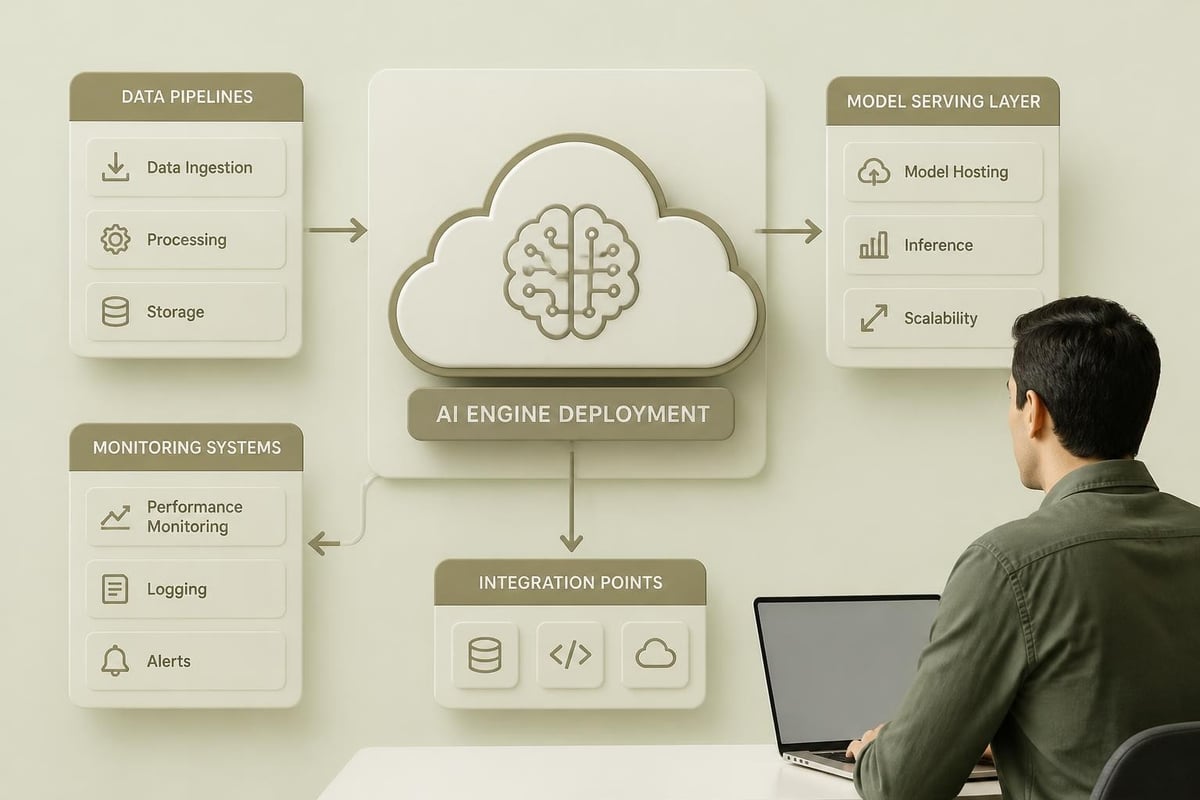
Implementing an AI engine requires careful attention to infrastructure, scalability, and operational reliability. The system must perform consistently under varying load conditions while maintaining data security and regulatory compliance.
Inference Optimization and Performance
The inference layer represents a critical performance bottleneck in production AI engines. Every millisecond of latency compounds across thousands of daily transactions, creating perceptible delays that degrade user experience and reduce conversion rates.
Cross-platform inference runtimes enable deployment across diverse hardware environments, from cloud servers to edge devices. This flexibility allows businesses to optimize for cost, latency, and data privacy requirements. Cloud deployments offer unlimited scalability, while edge inference reduces network dependency and enables offline operation.
Hardware acceleration through GPUs, TPUs, or specialized AI chips dramatically improves throughput. However, the cost-benefit analysis depends on request volume, model complexity, and latency requirements. Many production systems employ hybrid architectures that route simple predictions to CPU-based inference while reserving accelerators for complex models or high-volume periods.
Model compression techniques reduce computational requirements without sacrificing accuracy. Quantization converts high-precision floating-point weights to lower-precision integers. Pruning removes redundant neural network connections. Knowledge distillation trains smaller models to replicate larger model behavior. These optimizations reduce memory footprint, accelerate inference, and enable deployment on resource-constrained hardware.
Production Deployment and MLOps
Moving an AI engine from development to production requires robust operational practices. Model registry and deployment workflows provide the governance structure necessary for enterprise reliability.
The deployment pipeline includes:
- Version control for models, code, and configuration
- Automated testing including unit tests, integration tests, and performance benchmarks
- Staged rollouts with canary deployments and traffic shadowing
- Monitoring for model performance, data drift, and system health
- Rollback procedures when issues emerge in production
Cloud-native serving platforms simplify deployment orchestration, particularly in Kubernetes environments. These systems handle autoscaling, load balancing, and fault tolerance, allowing engineering teams to focus on model development rather than infrastructure management.
Continuous monitoring prevents model degradation over time. Production data distributions shift as markets evolve, customer preferences change, and external factors influence behavior. The AI engine must detect these drifts and trigger retraining workflows before prediction accuracy deteriorates noticeably.
Building Revenue-Focused AI Engines
The most effective AI engines align technical capabilities with specific business outcomes. For revenue operations, this means designing systems that directly impact profitability through measurable interventions.
Revenue-focused architecture prioritizes several key capabilities:
Real-time decision-making enables the engine to intervene at critical moments in the customer journey. When a high-value prospect submits an inquiry, delays of even a few hours dramatically reduce conversion probability. The AI engine must process the signal, assess priority, and trigger engagement within minutes.
Multi-channel orchestration coordinates customer interactions across phone, email, SMS, web chat, and in-person touchpoints. The engine maintains context across channels, preventing redundant communication while ensuring no inquiry goes unanswered. It adapts message timing, tone, and content based on customer preferences and engagement history.
Predictive resource allocation optimizes operational capacity against demand forecasts. The system analyzes booking patterns, seasonal trends, and external factors to predict service demand weeks in advance. This foresight enables proactive hiring, inventory management, and capacity planning that prevents revenue loss from inability to serve customer requests.
Automated recovery workflows execute multi-step sequences designed to recapture lost revenue. When a customer shows churn signals, the engine initiates retention interventions calibrated to relationship value and churn risk. It may offer incentives, request feedback, or escalate to human outreach, selecting tactics based on predicted effectiveness.
Businesses seeking to leverage these capabilities often benefit from structured assessment of their current systems. An AI Scaling Strategy Audit provides rigorous analysis of existing processes, quantifies revenue leakage, and creates prioritized roadmaps for AI engine implementation. This diagnostic approach ensures technical investments align with the highest-impact operational improvements.
Data Quality and Preparation
An AI engine's effectiveness depends entirely on the quality of data it processes. Local service businesses often accumulate years of operational data across disconnected systems, each with different formats, conventions, and quality standards.
Data preparation involves several critical steps that directly impact model performance:
- Deduplication to eliminate redundant records and conflicting information
- Normalization to standardize formats, units, and categorical values
- Enrichment to supplement sparse records with external data sources
- Validation to identify and correct errors, outliers, and inconsistencies
- Privacy compliance to ensure handling meets regulatory requirements
The investment in data quality pays exponential returns. Clean, comprehensive datasets enable more accurate predictions, reduce false positives, and accelerate model training. Many businesses discover that 60-70% of their AI engine implementation effort focuses on data pipeline development rather than model architecture.
Industry Applications and Use Cases
AI engines transform operations across diverse service industry segments. Each vertical presents unique challenges that benefit from intelligent automation and predictive analysis.
Home Services and Field Operations
HVAC companies, plumbing services, electrical contractors, and similar businesses face complex scheduling challenges, variable demand patterns, and high customer acquisition costs. An AI engine optimizes technician routing to minimize drive time, predicts equipment failure before emergency calls, and identifies upsell opportunities during service visits.
The system analyzes historical service records to detect patterns that indicate imminent equipment failure. When a customer's furnace shows early warning signs, the engine triggers proactive outreach offering inspection or maintenance before a costly emergency repair becomes necessary. This approach increases revenue through preventive service while improving customer satisfaction.
Professional Services
Legal practices, accounting firms, consulting businesses, and similar organizations manage complex client relationships, project-based revenue, and knowledge-intensive workflows. The AI engine tracks engagement metrics, identifies scope creep that erodes margins, and predicts which clients will require additional services.
For recurring revenue models, the system monitors client health scores compiled from communication frequency, payment promptness, service utilization, and satisfaction indicators. When scores decline, automated interventions re-engage at-risk clients before they churn to competitors.
Healthcare and Wellness
Medical practices, dental offices, physical therapy clinics, and wellness centers depend on appointment consistency, treatment plan adherence, and patient retention. The AI engine reduces no-shows through optimized reminder sequences, identifies patients who've lapsed in care, and personalizes communication to improve compliance.
Businesses leveraging AI operations report dramatic improvements in appointment fill rates, treatment completion, and patient lifetime value. The engine learns which communication approaches work for different patient segments, continuously optimizing engagement strategies.
Future Developments and Emerging Capabilities
The AI engine landscape continues to evolve rapidly as new techniques emerge from research and early production deployments prove their value. Several trends will shape the next generation of revenue operations systems.
Multimodal learning expands beyond text and structured data to incorporate voice, image, and video analysis. Customer service calls become rich data sources where the engine detects sentiment, urgency, and intent from vocal patterns. Technician photos of service sites provide visual context that improves diagnostic accuracy and parts prediction.
Federated learning enables model training across distributed data sources without centralizing sensitive information. Multiple businesses can collectively improve model accuracy while maintaining data privacy and competitive separation. This approach accelerates learning for smaller operators who lack the transaction volume to train sophisticated models independently.
Explainable AI addresses the black-box criticism of complex neural networks by providing interpretable reasoning for predictions and recommendations. When the engine suggests a pricing adjustment or customer intervention, it articulates the factors driving that decision. This transparency builds trust and enables human operators to understand and refine system behavior.
Edge computing pushes inference closer to data sources, reducing latency and enabling offline operation. Field technicians access AI engine capabilities through mobile devices that function reliably even without network connectivity. The system synchronizes when connection resumes, maintaining consistent intelligence regardless of infrastructure limitations.
Hardware-optimized deployment approaches maximize performance across diverse device types, from high-end servers to resource-constrained mobile hardware. This flexibility allows businesses to balance cost, performance, and deployment complexity based on specific operational requirements.
Integration Strategies and Implementation Roadmap
Successful AI engine adoption follows a structured path that balances ambition with practical execution. Organizations that attempt comprehensive transformation in a single deployment typically encounter resistance, technical challenges, and disappointing results.
The recommended approach stages implementation across several phases:
Phase 1: Data Infrastructure
Before building intelligent systems, establish reliable data collection, storage, and access patterns. Connect existing business systems through APIs, implement event logging, and create unified customer records that consolidate interaction history across all touchpoints.
Phase 2: Baseline Analytics
Deploy descriptive analytics that quantify current performance, identify bottlenecks, and measure key revenue metrics. This foundation establishes benchmarks against which AI engine impact can be measured objectively.
Phase 3: Narrow AI Deployment
Implement focused AI capabilities that address specific, high-value use cases. Lead routing optimization, follow-up sequence management, or appointment no-show prediction represent contained projects with measurable outcomes. Success builds organizational confidence and demonstrates ROI.
Phase 4: System Expansion
Gradually broaden AI engine scope to encompass additional operational domains. Each expansion leverages existing infrastructure, data pipelines, and operational learnings, accelerating deployment and reducing risk.
Phase 5: Autonomous Operations
The mature implementation achieves extensive autonomous operation where the AI engine manages routine decisions, flags exceptions for human judgment, and continuously optimizes performance without intervention.
Organizations exploring this journey can examine comprehensive AI operating systems purpose-built for service business environments. These platforms accelerate implementation by providing pre-configured workflows, industry-specific models, and integration patterns proven across hundreds of deployments.
Measuring AI Engine Performance and ROI
Investment in an AI engine requires clear metrics that demonstrate business impact beyond theoretical benefits. Revenue operations provide concrete, measurable outcomes that directly tie technology investment to profitability.
Key performance indicators span several categories:
| Metric Category | Specific Measures | Target Improvement |
|---|---|---|
| Lead Conversion | Contact rate, response time, conversion percentage | 25-40% increase |
| Revenue Capture | Recovered opportunities, upsell completion, pricing optimization | $15-50K monthly |
| Customer Retention | Churn reduction, reactivation success, lifetime value | 30-60% improvement |
| Operational Efficiency | Manual task reduction, decision automation, process time | 40-70% decrease |
Beyond aggregate metrics, cohort analysis reveals how AI engine capabilities improve over time. Comparing customer groups acquired before and after implementation demonstrates learning effects and system maturation. The engine becomes increasingly effective as it accumulates operational data and refines predictive models.
Attribution analysis separates AI engine impact from other variables affecting business performance. Controlled experiments, holdout groups, and statistical analysis isolate the causal effect of specific interventions. This rigor prevents false attribution where correlation masquerades as causation.
Financial modeling translates operational improvements into revenue and margin impact. A 5% reduction in customer churn compounds over years of customer lifetime, creating value far exceeding the initial annual savings. Managed AI systems that operate autonomously generate returns that scale with business growth rather than requiring proportional staff increases.
Risk Management and Ethical Considerations
Deploying an AI engine introduces risks that require proactive management. Technical failures, model bias, privacy violations, and over-automation can damage customer relationships and create legal exposure.
Model monitoring detects when predictions deviate from expected accuracy. Sudden drops in conversion rate, increases in customer complaints, or anomalous behavior patterns trigger alerts that pause automated actions until human review confirms system integrity.
Bias auditing examines whether the AI engine treats different customer segments equitably. Historical data often encodes past discrimination or suboptimal practices. The engine must not perpetuate these patterns, particularly in pricing, service prioritization, or resource allocation decisions.
Privacy protection ensures customer data handling meets regulatory requirements and ethical standards. The engine should operate on minimally necessary information, implement access controls, and maintain audit trails documenting how data influences decisions.
Human oversight remains essential even in highly automated systems. Critical decisions affecting customer relationships, significant financial commitments, or reputational risk should route to human judgment. The AI engine provides recommendation and context, but accountability rests with people.
Frameworks for AI engine compilation and deployment include governance features that enforce policy controls, audit model behavior, and maintain compliance with evolving regulatory requirements.
AI engines represent a fundamental shift in how service businesses manage revenue operations, moving from reactive problem-solving to proactive opportunity capture. The combination of real-time analysis, predictive intelligence, and autonomous action creates operational leverage that scales without proportional resource increases. Leverage Scaling provides an AI Revenue Operations System purpose-built for local service businesses, identifying revenue leaks, quantifying their impact, and deploying AI Profit Engines that capture, recover, and retain revenue automatically while you focus on core operations.