
The artificial intelligence landscape has shifted dramatically from experimental deployments to mission-critical business infrastructure. Organizations across industries now recognize that successful AI implementation requires more than initial setup; it demands ongoing expertise, continuous optimization, and strategic oversight. This realization has fueled the rapid growth of managed AI services, where specialized teams handle the complex operational demands of production AI systems while businesses focus on core objectives and revenue generation.
Understanding the Managed AI Service Model
Managed AI represents a comprehensive approach to deploying and operating artificial intelligence systems where external experts assume responsibility for the technical, operational, and strategic layers of AI infrastructure. Unlike traditional software-as-a-service offerings, managed AI encompasses model development, deployment, monitoring, retraining, compliance, and continuous optimization.
The service model addresses a fundamental challenge: most businesses lack the specialized talent and resources needed to maintain production AI systems effectively. Data scientists, machine learning engineers, MLOps specialists, and AI governance professionals remain scarce and expensive. Managed AI providers aggregate this expertise across multiple clients, delivering enterprise-grade capabilities at a fraction of the cost of building internal teams.
Core Components of Managed AI Operations
Successful managed AI implementations rest on several interconnected operational pillars:
- Model lifecycle management including development, testing, deployment, and versioning
- Continuous monitoring of model performance, data drift, and prediction accuracy
- Infrastructure orchestration across cloud platforms, edge devices, and hybrid environments
- Compliance and governance frameworks aligned with industry regulations and ethical standards
- Cost optimization through resource management and architectural efficiency
- Integration management connecting AI systems to existing business processes and data sources
These components work together to create a reliable, scalable AI operation that evolves with business needs and technological advances.

The Business Case for Managed AI Services
Organizations pursuing AI-driven growth face a critical decision: build internal capabilities or partner with managed AI providers. The business case for managed services becomes compelling when examining total cost of ownership, time to value, and risk mitigation.
Internal AI teams require significant investment in recruiting, training, and retention. Senior machine learning engineers command salaries exceeding $150,000 annually, and building a functional team typically requires multiple specialists. Beyond personnel costs, organizations must invest in development tools, infrastructure, and ongoing education as the field evolves rapidly.
| Cost Factor | Internal Team | Managed AI Service |
|---|---|---|
| Initial Setup | $200,000 - $500,000 | $10,000 - $50,000 |
| Annual Personnel | $400,000 - $1,000,000 | Included in service fee |
| Infrastructure | $50,000 - $200,000 | Optimized and shared |
| Training & Development | $25,000 - $75,000 | Provider responsibility |
| Time to Production | 6-18 months | 4-12 weeks |
Managed AI providers deliver immediate access to proven expertise and established methodologies. They bring experience from multiple deployments across different industries, avoiding common pitfalls and accelerating time to value. For local service businesses specifically, this expertise translates to faster revenue capture without diverting management attention from core operations.
Operational Excellence in Managed AI Deployments
The operational maturity of managed AI services distinguishes them from basic automation tools. Leading providers implement sophisticated monitoring frameworks that track dozens of metrics across model performance, system health, and business impact. These frameworks align with MLOps practices and ML Health Operations standards that define operational excellence in production machine learning.
Performance Monitoring and Optimization
Managed AI teams establish baseline performance metrics during initial deployment, then continuously monitor for degradation. Model accuracy rarely remains static in production environments. Data distributions shift, user behaviors evolve, and external market conditions change. Without active monitoring, AI systems silently lose effectiveness until business impact becomes obvious.
Effective monitoring encompasses multiple dimensions:
- Prediction accuracy measured against ground truth data and business outcomes
- Latency and throughput ensuring response times meet user expectations
- Resource utilization tracking compute, memory, and storage consumption
- Data quality identifying anomalies, missing values, and distribution shifts
- Business metrics connecting AI performance to revenue, conversion, and retention
When managed AI providers detect performance degradation, they initiate remediation workflows. These might include retraining models with fresh data, adjusting hyperparameters, or redesigning features. The entire optimization cycle happens transparently, maintaining system effectiveness without business disruption.

Revenue-focused platforms like Leverage Scaling's revenue automation strategy demonstrate this principle in action. Their AI Profit Engines continuously monitor customer engagement patterns, identify revenue leakage points, and automatically adjust recovery strategies based on performance data. This closed-loop optimization exemplifies how managed AI delivers sustained business value.
Risk Management and Governance in Managed AI
The governance layer separates mature managed AI services from basic automation offerings. As AI systems make increasingly consequential decisions, organizations face regulatory scrutiny, ethical considerations, and reputational risks. The NIST AI Risk Management Framework provides foundational guidance for assessing and governing AI risk across the complete lifecycle.
Managed AI providers implement governance frameworks that address multiple risk domains:
- Algorithmic fairness preventing discriminatory outcomes across demographic groups
- Transparency and explainability documenting how models reach specific decisions
- Privacy protection ensuring compliance with GDPR, CCPA, and industry regulations
- Security controls defending against adversarial attacks and data breaches
- Audit trails maintaining detailed records of model versions, training data, and decisions
These controls require specialized expertise and ongoing attention. The NTIA's AI Accountability Policy Report emphasizes that accountability mechanisms must be built into procurement and operational contracts, making clear assignment of responsibility essential in managed AI relationships.
Compliance Across Industries
Different industries impose varying compliance requirements on AI systems. Healthcare organizations must satisfy HIPAA regulations while maintaining model accuracy for diagnostic applications. Financial services firms navigate SEC regulations and fair lending laws. Local service businesses, while facing fewer formal regulations, still bear responsibility for customer data protection and fair treatment.
Managed AI providers maintain current expertise across regulatory landscapes, updating systems as requirements evolve. This includes technical controls like differential privacy, organizational processes like impact assessments, and documentation practices that demonstrate compliance during audits.
Economics and Cost Optimization for Managed AI
AI workloads present unique economic challenges that distinguish them from traditional IT operations. Training large models can cost thousands of dollars in compute resources. Inference at scale generates unpredictable expenses as usage fluctuates. Storage requirements grow as organizations accumulate training data and maintain model versions.
The FinOps Foundation's guidance on managing AI value addresses these challenges through cost attribution, showback mechanisms, and governance for unpredictable AI spending. Managed AI providers implement these practices systematically, optimizing resource usage while maintaining performance guarantees.
Cost Optimization Strategies
Experienced managed AI teams employ multiple strategies to control expenses:
Infrastructure efficiency: Selecting appropriate compute resources for different workload phases. Training might leverage high-powered GPU instances, while inference runs on cost-effective CPU configurations or specialized inference processors.
Model optimization: Techniques like quantization, pruning, and distillation reduce model size and computational requirements without significantly impacting accuracy. A well-optimized model might deliver 90% of original performance at 20% of the computational cost.
Caching and batching: Intelligent caching of common predictions and batching of inference requests reduce overall compute consumption. These optimizations require careful implementation to maintain response time requirements.
Auto-scaling policies: Dynamic resource allocation matches infrastructure to actual demand, preventing overprovisioning while ensuring availability during peak periods.
For businesses implementing revenue growth automation, cost optimization directly impacts profitability. Efficient AI operations maximize the margin between revenue captured and operational expenses, accelerating return on investment.
Selecting and Evaluating Managed AI Providers
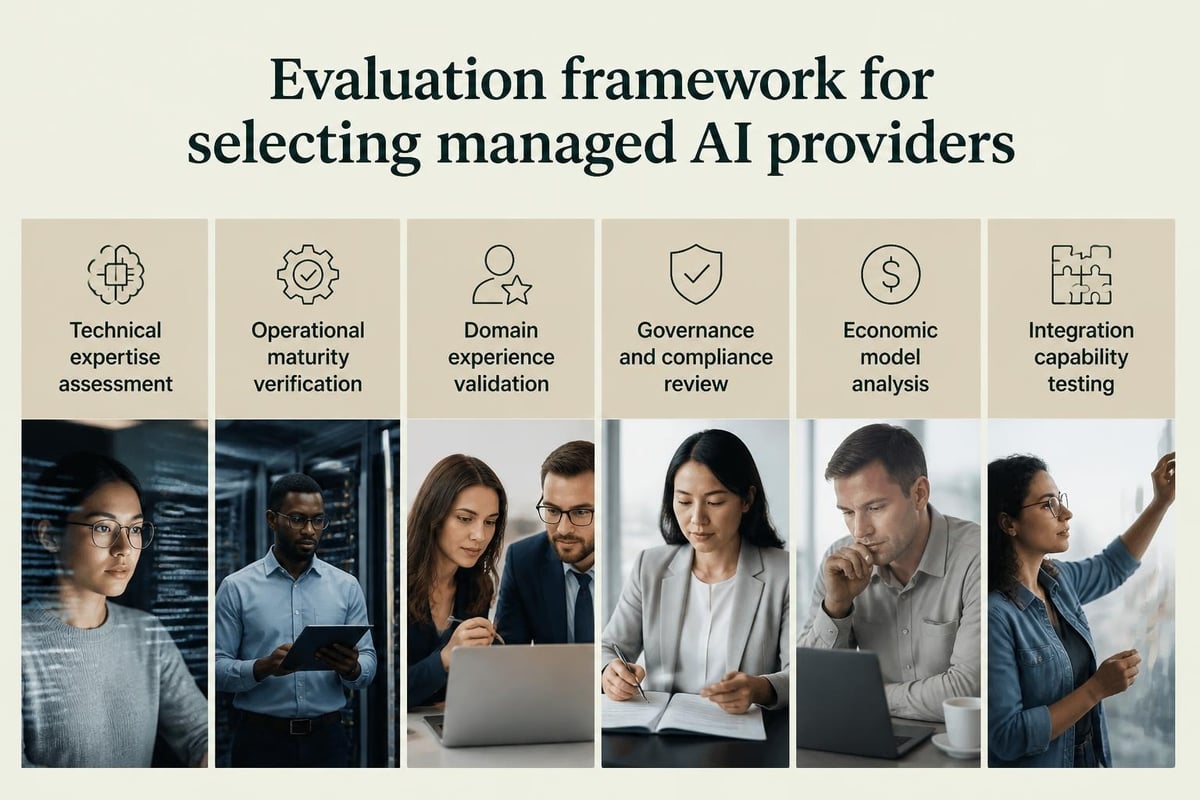
The managed AI market has expanded rapidly, creating both opportunities and complexity for organizations evaluating providers. Effective selection requires assessing technical capabilities, operational maturity, domain expertise, and strategic alignment.
| Evaluation Criteria | Key Questions | Red Flags |
|---|---|---|
| Technical Expertise | What model architectures do they specialize in? | Generic claims without specific examples |
| Operational Maturity | How do they handle model degradation? | No monitoring or alerting processes |
| Industry Experience | Have they solved similar business problems? | Lack of relevant case studies |
| Governance Framework | What compliance certifications do they hold? | Vague privacy and security policies |
| Economic Model | How are costs structured and optimized? | Opaque pricing or unlimited commitments |
| Integration Capabilities | What systems and platforms do they connect to? | Proprietary lock-in requirements |
Organizations should request detailed proposals that outline specific methodologies, success metrics, and escalation procedures. The best managed AI providers welcome technical due diligence and provide transparent documentation of their processes.
Domain Specialization Matters
Generic AI capabilities rarely translate to optimal business outcomes without domain expertise. A managed AI provider with deep experience in local service businesses understands the revenue cycle, customer journey complexities, and operational constraints that shape effective solutions.
Platforms like Leverage OS demonstrate this specialization advantage. Rather than offering generic AI tools, they focus specifically on revenue operations for local service businesses, addressing challenges like appointment no-shows, follow-up timing, and customer reactivation that directly impact profitability.
An AI Scaling Strategy Audit provides organizations with rigorous assessment of their current systems and identifies where managed AI can deliver maximum impact. By quantifying revenue leakage and mapping underutilized growth opportunities, businesses gain clarity on which AI investments will generate measurable returns. This diagnostic approach ensures that managed AI implementations target high-value interventions rather than pursuing technology for its own sake.

Implementation Patterns for Managed AI Success
Successful managed AI deployments follow recognizable patterns that maximize value while minimizing disruption. These patterns reflect lessons learned across hundreds of implementations and align with established best practices for production machine learning systems.
Phased Deployment Approach
- Discovery and assessment: Map current processes, identify AI opportunities, and establish success metrics
- Proof of concept: Validate technical feasibility and business value with limited-scope deployment
- Pilot deployment: Expand to representative user group while maintaining manual fallback options
- Production rollout: Scale to full user base with comprehensive monitoring and support
- Continuous optimization: Iterate on model performance, feature engineering, and business integration
This phased approach reduces risk by validating assumptions before major commitments. Each phase produces concrete deliverables and decision points where organizations can adjust strategy based on results.
The recent MLOps practices review emphasizes that successful production ML requires addressing organizational challenges alongside technical considerations. Managed AI providers navigate these challenges through established change management processes, stakeholder communication, and training programs.
Advanced Capabilities in Modern Managed AI
The capabilities available through managed AI services have expanded significantly as the field matures. Beyond basic model deployment, advanced providers now offer sophisticated functionality that was previously available only to technology giants with extensive internal teams.
Generative AI integration: Large language models and generative capabilities now power customer communications, content creation, and process automation. Managed AI providers implement these technologies following AWS best practices for generative AI, ensuring appropriate safeguards and cost controls.
Multi-modal learning: Modern systems process text, images, audio, and structured data simultaneously, enabling richer understanding and more sophisticated automation. Local service businesses can leverage multi-modal AI to analyze customer communications across channels, identifying intent and sentiment regardless of format.
Reinforcement learning: Advanced optimization approaches where AI systems learn optimal strategies through experimentation and feedback. This proves particularly valuable for dynamic pricing, resource allocation, and sequential decision-making.
Federated learning: Privacy-preserving approaches that train models across distributed data sources without centralizing sensitive information. This enables collaboration while maintaining data sovereignty and compliance.
These advanced capabilities require significant expertise to implement effectively. Managed AI providers absorb the complexity, delivering sophisticated functionality through simplified interfaces that business users can understand and control.
Operational Integration and Business Process Alignment
Technology deployment succeeds only when it integrates seamlessly with existing business processes. Managed AI providers must bridge the gap between advanced machine learning capabilities and practical operational workflows that employees execute daily.
Effective integration requires understanding process dependencies, data flows, approval hierarchies, and exception handling. AI systems cannot operate in isolation; they must interact with CRM platforms, scheduling systems, payment processors, and communication tools that businesses already use.
Leading managed AI implementations establish clear integration patterns:
- Event-driven triggers that activate AI processing based on business events (new lead, appointment scheduled, payment received)
- Bidirectional data synchronization ensuring AI systems access current data and update source systems with results
- Human-in-the-loop workflows where AI makes recommendations but humans retain final decision authority for critical actions
- Escalation procedures that route edge cases and low-confidence predictions to appropriate personnel
For businesses exploring business automation systems, integration architecture determines whether AI delivers incremental convenience or transformational impact. Deep integration enables AI to automate entire workflows rather than merely assisting with individual tasks.
Quality Assurance and Testing in Managed AI
Production AI systems require rigorous testing methodologies that extend beyond traditional software QA practices. Model behavior depends on training data, and subtle distribution shifts can produce unexpected results. The NIST AI Resource Center provides tools and methodologies for testing, evaluation, verification, and validation of AI systems.
Managed AI providers implement comprehensive testing frameworks:
Unit testing: Verifying individual model components, data preprocessing pipelines, and feature engineering logic function correctly in isolation.
Integration testing: Ensuring AI systems interact properly with surrounding infrastructure, handle edge cases gracefully, and maintain data consistency.
Performance testing: Validating systems meet latency, throughput, and accuracy requirements under realistic load conditions.
Adversarial testing: Attempting to fool or break models through carefully crafted inputs, identifying vulnerabilities before production deployment.
A/B testing: Comparing new model versions against current production systems with real user traffic, measuring business impact before full rollout.
These testing practices establish confidence that AI systems will perform reliably when deployed. They also provide regression protection, ensuring updates don't inadvertently degrade existing functionality.
Ethical Considerations and Responsible AI Practices
As AI systems influence increasingly important business decisions, ethical considerations move from philosophical concerns to operational requirements. Google Cloud's Responsible AI guidance and Microsoft's Responsible AI framework provide practical approaches for building and operating AI systems that align with organizational values and societal expectations.
Managed AI providers implement responsible AI practices across multiple dimensions:
- Fairness assessments that measure and mitigate disparate impact across demographic groups
- Transparency documentation explaining model behavior, limitations, and appropriate use cases
- Privacy engineering implementing technical controls like differential privacy and federated learning
- Environmental responsibility optimizing resource usage to minimize carbon footprint
- Human oversight maintaining meaningful human control over consequential decisions
These practices require dedicated focus and specialized expertise. Organizations rarely have bandwidth to develop responsible AI capabilities internally while simultaneously building domain-specific applications. Managed AI services centralize this expertise, applying it consistently across client deployments.
Scaling Managed AI Across Business Functions
Initial AI deployments typically target specific high-value use cases where return on investment can be demonstrated quickly. However, the real transformation occurs when organizations scale AI capabilities across multiple business functions, creating integrated intelligence that spans the entire operation.
Managed AI providers facilitate this expansion through several mechanisms:
Platform approaches: Rather than deploying isolated point solutions, mature providers build unified platforms that share infrastructure, data pipelines, and model components across use cases. This reduces marginal cost of additional applications while maintaining consistency.
Template libraries: Proven solution patterns for common business problems that can be customized for specific requirements. These templates accelerate deployment while leveraging accumulated best practices.
Cross-functional data integration: Breaking down silos to enable AI systems that consider customer interactions, operational data, and financial metrics holistically rather than optimizing narrow functional objectives.
Revenue-focused organizations benefit particularly from this integrated approach. When AI systems coordinate across lead generation, conversion optimization, delivery excellence, and customer retention, they identify opportunities that single-function tools miss. This comprehensive view drives the revenue layer efficiency that platforms like Leverage Scaling deliver for local service businesses.
Managed AI transforms artificial intelligence from an experimental capability into reliable business infrastructure that drives measurable revenue growth. By partnering with specialized providers, organizations access enterprise-grade AI expertise, operational excellence, and continuous optimization without building expensive internal teams. The key lies in selecting providers with proven domain expertise, robust governance frameworks, and commitment to sustainable business outcomes. Leverage Scaling delivers this comprehensive managed AI approach specifically for local service businesses, identifying revenue leaks and deploying AI Profit Engines that capture, recover, and retain more revenue automatically, allowing you to focus on core operations while our system optimizes your revenue layer.