
The impact of AI on modern business operations has shifted from theoretical potential to measurable reality. Revenue operations, particularly for local service businesses, have undergone fundamental transformation as artificial intelligence moves beyond simple automation into intelligent decision-making systems. Organizations now face both unprecedented opportunities and complex challenges as they navigate this technological evolution while maintaining competitive advantage and operational efficiency.
Revenue Leakage Detection Through Artificial Intelligence
The impact of AI on identifying hidden revenue losses represents one of the most significant advances in operational intelligence. Traditional manual auditing methods miss an estimated 15-30% of revenue leakage points across customer acquisition, conversion, and retention cycles. Modern AI systems analyze thousands of data points simultaneously, detecting patterns human operators cannot perceive.
Quantifying Lost Opportunities
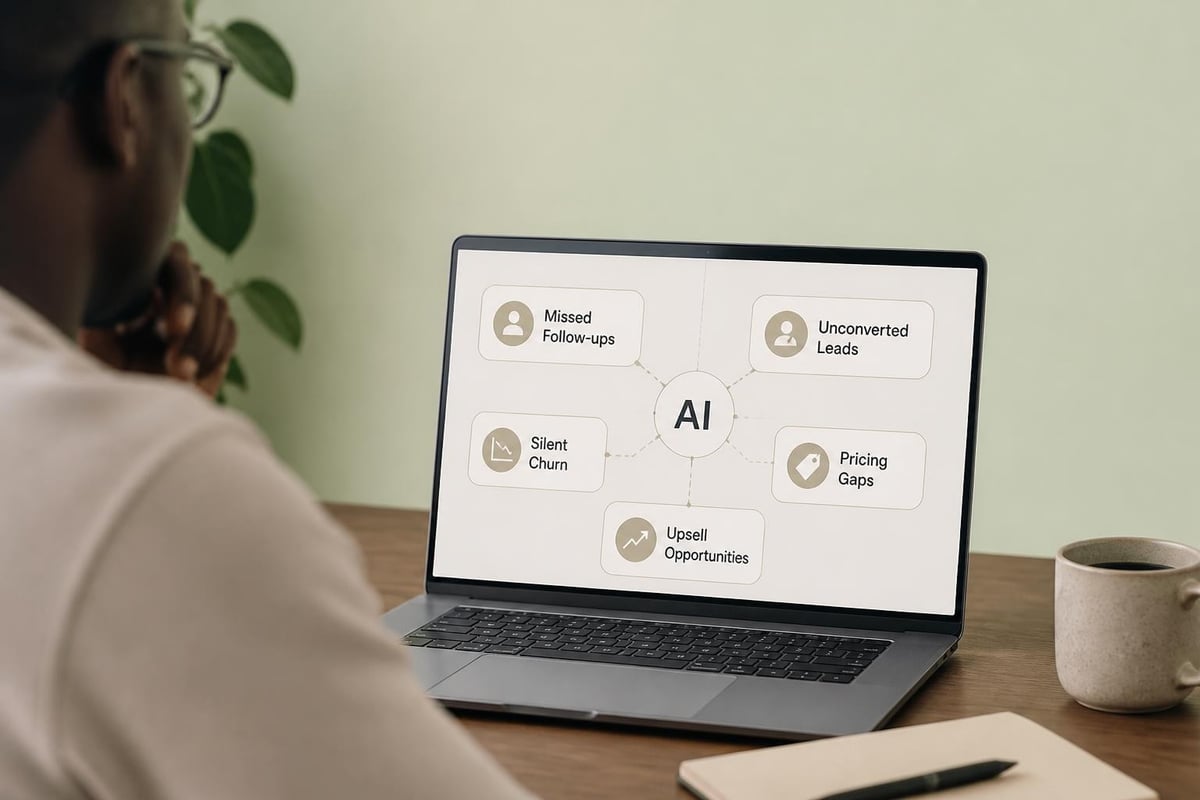
Revenue leakage occurs across multiple touchpoints in the customer journey. Missed follow-ups, unconverted leads, and silent customer churn collectively drain millions from service businesses annually. AI Revenue Operations Systems now identify these specific failure points and calculate their exact financial impact.
- Abandoned quote requests that never receive timely responses
- Seasonal customers who stop booking without intervention
- Referral opportunities buried in customer communications
- Pricing inconsistencies that erode profit margins
- Service upsells missed during existing customer interactions
The quantification process transforms vague suspicions into actionable intelligence. Business automation systems provide the infrastructure to capture this data continuously, creating a foundation for systematic revenue recovery.
| Revenue Leak Type | Traditional Detection Rate | AI Detection Rate | Average Recovery Value |
|---|---|---|---|
| Missed Follow-ups | 12% | 94% | $3,200/month |
| Lead Abandonment | 18% | 97% | $5,800/month |
| Silent Churn | 8% | 89% | $4,100/month |
| Pricing Errors | 22% | 91% | $2,900/month |
| Upsell Gaps | 6% | 86% | $3,700/month |
Understanding where revenue escapes creates the foundation for implementing intelligent capture mechanisms. The impact of AI extends beyond detection into automated recovery systems that operate continuously without human intervention.
Transformation of Customer Acquisition Processes
Modern AI systems have fundamentally altered how service businesses attract and convert potential customers. The traditional linear funnel model has evolved into a dynamic, responsive ecosystem that adapts to individual customer behavior in real-time. Harvard Business Review's analysis of generative AI adoption demonstrates how organizations are reshaping entire business functions around these capabilities.
Intelligent Lead Qualification
The impact of AI on lead qualification eliminates the traditional tension between speed and accuracy. Machine learning models now evaluate leads across dozens of dimensions simultaneously, routing high-value prospects to immediate engagement while nurturing longer-cycle opportunities appropriately.
Speed matters tremendously in service industries. Research consistently shows that response time within the first five minutes increases conversion rates by 400% compared to responses after one hour. AI systems achieve this consistently, regardless of when inquiries arrive.
Qualification criteria extend beyond demographic data:
- Behavioral signals from website interaction patterns
- Communication tone indicating purchase readiness
- Service complexity matching available capacity
- Geographic proximity to service territories
- Historical conversion patterns from similar profiles
The AI operating system approach integrates these qualification mechanisms directly into the revenue layer, creating seamless handoffs between automated and human touchpoints. This integration ensures no qualified lead falls through systematic gaps.
Automated Follow-Up and Customer Retention
Retention represents the most profitable revenue stream for established service businesses, yet most organizations systematically neglect existing customer relationships. The impact of AI on retention mechanics addresses this gap through persistent, personalized engagement that scales infinitely.
Systematic Reactivation Campaigns
Former customers represent the highest-probability conversion opportunity most businesses ignore completely. AI-powered reactivation systems identify customers who have stopped engaging and deploy personalized outreach based on service history, seasonal patterns, and trigger events.
These systems operate with precision impossible for manual processes. They track hundreds of customers simultaneously, remembering birthdays, service anniversaries, seasonal needs, and life events that create natural reengagement opportunities. The AI for business operations framework demonstrates how this systematic approach compounds revenue over time.

Consider the compounding mathematics of retention improvement. A service business with 500 active customers losing 30% annually must replace 150 customers just to maintain revenue. Reducing churn to 20% through systematic AI engagement decreases replacement requirements by 50 customers, freeing acquisition resources for growth rather than replacement.
Retention improvement creates exponential advantages:
- Lower customer acquisition costs as organic growth replaces paid acquisition
- Higher lifetime value from extended relationship duration
- Increased referral generation from satisfied long-term customers
- Better operational predictability from stable customer base
- Enhanced profit margins from reduced sales and marketing overhead
The impact of AI on these retention mechanics transforms them from occasional campaigns into continuous operational systems. Businesses using AI for systematic retention report 40-60% improvements in customer lifetime value within the first year of implementation.
Operational Efficiency and Resource Allocation
Service businesses face constant tension between delivering quality service and maintaining administrative efficiency. The impact of AI on operational workflows resolves this tension by handling repetitive decision-making and coordination tasks that traditionally consumed valuable human attention.
Capacity Optimization
Dynamic scheduling, route optimization, and resource allocation become computational problems rather than daily administrative burdens. AI systems balance multiple constraints simultaneously: technician skills, geographic efficiency, customer preferences, equipment availability, and revenue optimization.
This optimization extends beyond simple calendar management. Advanced systems predict service duration based on historical patterns, anticipate potential complications, and automatically buffer schedules to maintain service quality while maximizing revenue per day.
| Operational Metric | Manual Management | AI-Optimized Management | Improvement |
|---|---|---|---|
| Daily Jobs per Technician | 4.2 | 6.1 | +45% |
| Travel Time Percentage | 28% | 16% | -43% |
| Schedule Accuracy | 67% | 92% | +37% |
| Overtime Hours | 12/week | 3/week | -75% |
| Customer Satisfaction | 3.8/5 | 4.6/5 | +21% |
The revenue automation strategy centers on identifying these operational inefficiencies and deploying targeted AI interventions that create measurable improvement without disrupting existing workflows. Small efficiency gains compound across hundreds of daily decisions into substantial revenue increases.
Regulatory Considerations and Risk Management
The rapid advancement of AI capabilities has prompted regulatory frameworks worldwide. The impact of AI on compliance requirements demands attention from business leaders implementing these systems. The European AI Act, which entered force in August 2024, establishes risk-based governance requirements that may influence global standards.
Navigating Ethical Implementation
Service businesses must balance automation benefits against customer privacy, data security, and transparent operations. The NIST AI Risk Management Framework provides structured guidance for identifying and mitigating risks associated with AI deployment.
Key compliance considerations include:
- Data governance ensuring customer information protection
- Algorithmic transparency in decision-making processes
- Human oversight of critical customer interactions
- Bias mitigation preventing discriminatory outcomes
- Audit trails documenting automated decisions
Organizations implementing AI revenue systems should document decision logic, maintain human review of edge cases, and ensure customers understand when they interact with automated systems versus human representatives. The Brookings Institution's research on AI effects highlights the importance of thoughtful implementation that considers both business outcomes and broader societal impacts.

Integration Challenges and Technical Infrastructure
The impact of AI on existing technology stacks presents both opportunity and complexity. Most service businesses operate with fragmented systems: separate platforms for scheduling, customer communication, payment processing, and customer relationship management. AI revenue operations require integration across these silos.
Building Connected Revenue Systems
Successful AI implementation depends on data accessibility and system interoperability. APIs, data warehouses, and integration platforms create the technical foundation allowing AI systems to access information and execute actions across multiple platforms simultaneously.
The technical requirements should not intimidate business leaders. Modern AI services increasingly offer pre-built integrations with common business platforms, reducing implementation complexity. The key is approaching integration systematically rather than attempting wholesale replacement of functional existing systems.
Strategic integration follows a priority sequence:
- Customer data consolidation creating unified customer profiles
- Communication platform integration enabling automated outreach
- Scheduling system connection for appointment management
- Payment processing linkage for transaction automation
- Analytics infrastructure for performance measurement
The Scaling Strategy Audit process helps businesses understand their current technical landscape and identify the highest-value integration points before committing to extensive infrastructure changes. This diagnostic approach prevents costly missteps and focuses investment on integrations that deliver measurable revenue impact.

Competitive Dynamics and Market Positioning
The impact of AI on competitive dynamics within local service markets has accelerated dramatically. Early adopters are establishing significant operational advantages that compound over time. The gap between AI-enabled operations and traditional manual processes widens quarterly as systems learn from accumulated data.
First-Mover Advantages
Service businesses implementing comprehensive AI revenue operations gain several compounding advantages. Customer responsiveness, operational efficiency, and systematic follow-up create superior customer experiences that generate organic growth through referrals and reputation.
Consider the competitive scenario: Two similar HVAC companies serve the same market. Company A responds to inquiries within minutes using AI qualification, follows up systematically with unconverted leads, and reactivates former customers automatically. Company B relies on manual processes with average response times of four hours and inconsistent follow-up.
Within twelve months, Company A captures 60% more inbound opportunities, converts at 40% higher rates, and retains customers 50% longer. These advantages compound exponentially as satisfied customers generate referrals and online reviews, creating a virtuous cycle of growth. The AI competition landscape increasingly favors businesses that implement these systems quickly and comprehensively.
Market positioning shifts from competing on price or availability to competing on customer experience and relationship quality. AI enables smaller service businesses to deliver enterprise-level customer experiences previously available only to large organizations with dedicated support staff.
Environmental and Sustainability Considerations
As AI systems become more sophisticated and widespread, energy consumption and environmental impact warrant consideration. Research published in Nature examining generative AI's environmental costs highlights the energy intensity of large-scale AI models and data centers.
Service businesses implementing AI revenue operations should consider the environmental efficiency of their chosen platforms. Cloud-based systems, optimized algorithms, and efficient data processing minimize environmental footprint while delivering business results.
Practical sustainability measures include:
- Selecting providers committed to renewable energy data centers
- Implementing efficient algorithms that minimize computational requirements
- Consolidating data processing to reduce redundant operations
- Monitoring system resource consumption and optimizing regularly
- Balancing AI deployment with genuine business value rather than automation for its own sake
The impact of AI on sustainability extends beyond energy consumption. Optimized routing reduces fuel consumption for mobile service businesses. Better scheduling minimizes unnecessary trips. Improved retention reduces the environmental cost of customer acquisition marketing.
Workforce Transformation and Human Capital
The impact of AI on workforce composition and skill requirements represents both opportunity and challenge. Contrary to dystopian predictions, successful AI implementation in service businesses typically augments rather than replaces human workers, shifting responsibilities from administrative tasks toward higher-value customer relationships and complex problem-solving.
Redefining Role Structures
Customer service representatives evolve into relationship managers focusing on complex situations and high-value accounts. Schedulers and dispatchers become capacity strategists optimizing resource deployment. Technicians gain time for skill development and customer education as administrative burden decreases.
This transition requires deliberate change management. Organizations must invest in training, communicate transparently about technology adoption, and involve frontline workers in implementation planning. The UNESCO policy guidance on AI ethics emphasizes the importance of equitable transitions that protect worker interests while enabling technological progress.
Successful workforce transformation includes:
- Skills assessment identifying gaps between current and future requirements
- Training programs building AI literacy and new technical capabilities
- Role redesign creating positions that leverage uniquely human capabilities
- Performance metrics aligned with new operational models
- Compensation structures rewarding desired behaviors and outcomes
The AI and work relationship becomes collaborative rather than competitive when implemented thoughtfully. Workers freed from repetitive administrative tasks report higher job satisfaction and engage more meaningfully with customers and complex challenges.
Measurement Frameworks and Performance Analytics
The impact of AI on business performance remains theoretical without rigorous measurement. Successful implementations establish clear baseline metrics, track progress systematically, and adjust strategies based on quantitative evidence rather than assumptions.
Revenue Attribution Models
Advanced analytics separate correlation from causation, isolating AI system contributions from general market trends or seasonal variations. This attribution clarity justifies continued investment and identifies opportunities for optimization.
| Performance Indicator | Measurement Frequency | Target Improvement | Tracking Method |
|---|---|---|---|
| Lead Response Time | Real-time | <5 minutes | Automated timestamping |
| Conversion Rate | Weekly | +25% | CRM attribution |
| Customer Retention | Monthly | +15% | Cohort analysis |
| Revenue per Customer | Quarterly | +30% | Financial integration |
| Operational Efficiency | Daily | +40% | System logs |
The managed AI approach includes ongoing performance monitoring and optimization as core components, ensuring systems continuously improve rather than stagnating after initial deployment. This continuous improvement mindset separates successful AI implementations from abandoned experiments.
Analytics should drive decision-making at multiple organizational levels. Executive dashboards track overall revenue impact and strategic KPIs. Operational reports identify tactical optimization opportunities. Technician-level feedback creates accountability and engagement with new systems.
Future Trajectory and Strategic Planning
The impact of AI on service business operations will accelerate throughout the remainder of this decade. Current systems represent early implementations of capabilities that will become dramatically more sophisticated. Strategic planning must account for both immediate opportunities and longer-term technological evolution.
Preparing for Advancing Capabilities
Organizations establishing AI revenue operations today create foundations for increasingly sophisticated capabilities. Natural language processing will enable more nuanced customer communication. Predictive analytics will anticipate customer needs before they arise. Autonomous systems will handle increasingly complex decision-making with minimal human oversight.
The strategic imperative is building flexible, scalable infrastructure that accommodates technological advancement without requiring complete system replacement every eighteen months. This requires selecting platforms committed to continuous improvement and maintaining data ownership that enables platform migration if necessary.
Forward-looking service businesses should:
- Establish data collection practices capturing information that will enable future AI capabilities
- Build organizational AI literacy preparing teams for evolving technology
- Monitor emerging capabilities in AI vendor ecosystem
- Maintain strategic flexibility avoiding lock-in to limited platforms
- Invest in integration infrastructure enabling rapid adoption of new tools
The scaling AI challenge involves balancing current operational needs with long-term strategic positioning. Organizations that master this balance will dominate their markets as AI capabilities continue advancing exponentially.
The impact of AI on revenue operations has transitioned from emerging possibility to competitive necessity for service businesses serious about sustainable growth. Organizations that implement systematic, AI-powered revenue operations capture more opportunities, retain customers longer, and operate with superior efficiency compared to competitors relying on manual processes. Leverage Scaling provides the AI Revenue Operations System designed specifically for local service businesses, identifying revenue leaks, quantifying their impact, and deploying AI Profit Engines that automatically capture, recover, and retain revenue while you focus on delivering exceptional service to your customers.