
The concept of engine AI has evolved dramatically over the past few years, transforming from a theoretical framework into a practical operational necessity for businesses seeking sustainable growth. Unlike traditional AI applications that focus on singular tasks or isolated processes, engine AI represents a comprehensive system designed to power continuous, intelligent decision-making across entire business operations. For revenue operations teams managing complex customer journeys, engine AI serves as the foundational infrastructure that identifies patterns, predicts outcomes, and executes strategic interventions without constant human oversight.
Understanding Engine AI Architecture
Engine AI functions as a systematic approach to artificial intelligence deployment, where multiple AI components work together within a unified framework to drive specific business outcomes. The architecture differs fundamentally from standalone AI tools by creating interconnected processes that learn, adapt, and improve continuously.
Core Components of Engine AI Systems
Modern engine AI implementations typically incorporate several critical layers that work in concert. Data ingestion and processing form the foundation, capturing information from multiple touchpoints across the customer lifecycle. Pattern recognition algorithms analyze this data to identify trends, anomalies, and opportunities that human teams might overlook. Decision engines then determine optimal actions based on predefined business rules and learned behaviors.
The integration layer connects these components to existing business systems, ensuring seamless data flow and action execution. For local service businesses, this might include CRM platforms, scheduling systems, payment processors, and communication tools. The business automation systems that support these integrations must be robust enough to handle real-time data processing while maintaining accuracy.

Evaluation Frameworks for Engine AI Performance
Implementing engine AI without proper evaluation mechanisms creates significant risk. Organizations need structured approaches to measure effectiveness, reliability, and business impact. The Stanford HAI research on AI systems evaluation provides valuable frameworks for assessing engine AI performance in high-stakes business environments.
| Evaluation Metric | Purpose | Measurement Frequency |
|---|---|---|
| Revenue Impact | Quantify captured opportunities | Weekly |
| Prediction Accuracy | Validate decision quality | Daily |
| System Latency | Ensure real-time response | Continuous |
| False Positive Rate | Minimize wasted interventions | Monthly |
The evaluation process must account for both technical performance and business outcomes. An engine AI system might demonstrate excellent technical metrics while failing to deliver meaningful revenue improvements. Conversely, strong business results achieved through poor technical fundamentals create unsustainable growth patterns.
Engine AI in Revenue Operations
Revenue operations represents one of the most compelling use cases for engine AI technology. The complexity of modern customer journeys, combined with the need for rapid response to opportunities and threats, makes manual management increasingly impractical.
Identifying Revenue Leakage Points
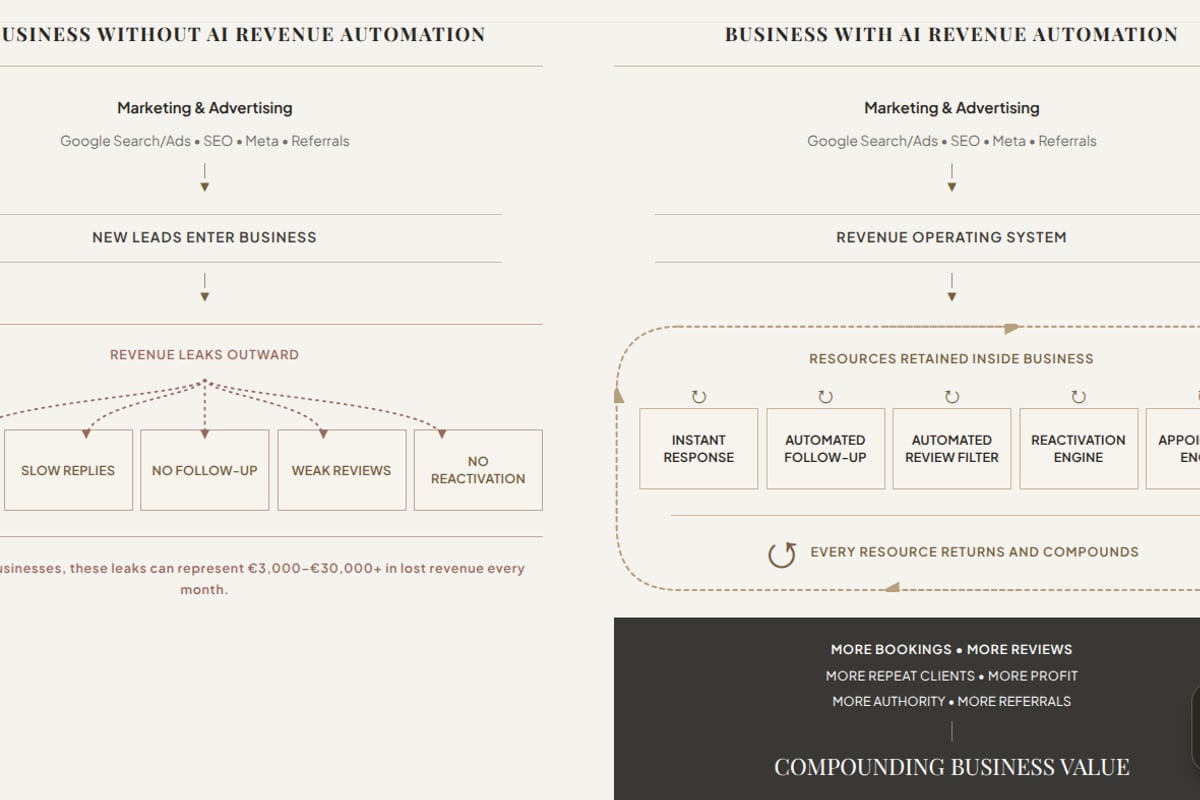
Engine AI excels at detecting patterns that indicate revenue leakage across the customer lifecycle. These systems analyze thousands of customer interactions to identify where prospects drop off, where existing customers reduce engagement, and where reactivation opportunities exist.
For local service businesses, common leakage points include:
- Inquiry response delays that allow prospects to engage competitors
- Follow-up gaps after initial consultations or quotes
- Appointment no-shows without automated confirmation sequences
- Service completion without requesting reviews or referrals
- Inactive customer periods exceeding optimal reactivation windows
The AI Revenue Operations System approach demonstrates how engine AI can systematically address each leakage point through automated detection and intervention. Rather than requiring manual monitoring, the system continuously scans for indicators and executes predefined recovery sequences.
Quantifying Impact Through AI-Driven Analysis
Traditional revenue analysis relies on historical reporting and manual interpretation. Engine AI transforms this process by providing real-time impact quantification and predictive modeling. The system doesn't just identify that revenue is being lost but calculates exactly how much, where, and why.
This quantification capability enables data-driven prioritization. Instead of guessing which operational improvements will deliver the greatest return, businesses receive clear impact projections for each potential intervention. An AI Scaling Strategy Audit provides this type of rigorous assessment, identifying structural revenue leakage and quantifying its commercial impact across acquisition, conversion, follow-up, retention, and reactivation stages.
Automated Revenue Recovery Mechanisms
Detection and quantification provide limited value without execution. Engine AI closes this loop by automating revenue recovery actions based on identified opportunities. These mechanisms operate continuously, responding to triggers and executing sequences without manual intervention.
Common automated recovery actions include:
- Instant inquiry responses with personalized follow-up sequences
- Appointment confirmations with multiple touchpoints and rescheduling options
- Service completion workflows triggering review requests and upsell opportunities
- Reactivation campaigns targeting dormant customers with relevant offers
- Retention interventions for customers showing disengagement signals
The managed AI approach illustrates how these mechanisms function as a comprehensive system rather than disconnected tools. Each component feeds data back into the engine AI framework, enabling continuous learning and optimization.
Technical Implementation Considerations
Deploying engine AI requires careful attention to infrastructure, integration, and operational readiness. Organizations must balance technical sophistication with practical business requirements.
Deployment Architecture Options
Engine AI systems can be deployed through various architectural patterns, each with distinct advantages. Cloud-based implementations offer scalability and reduced infrastructure management but may introduce latency for real-time applications. The Microsoft Azure guide on AI/ML deployment provides comprehensive coverage of deployment options and trade-offs.
Edge deployment brings inference capabilities closer to data sources, reducing latency and enabling offline operation. For service businesses with field operations, this architecture supports real-time decision-making even without constant connectivity. Hybrid approaches combine cloud-based model training with edge inference for optimal balance.
| Deployment Pattern | Latency | Scalability | Complexity |
|---|---|---|---|
| Cloud-Only | Moderate | High | Low |
| Edge-Only | Low | Limited | High |
| Hybrid | Low | High | Moderate |
Model Serving and Inference Optimization
Production engine AI systems require robust model serving infrastructure to deliver consistent performance. The TensorFlow Serving architecture demonstrates best practices for production inference engines, including versioning, A/B testing, and performance monitoring.
Inference optimization becomes critical when engine AI must process thousands of customer interactions daily. Techniques include model quantization, batch processing, and caching strategies that reduce computational overhead without sacrificing accuracy. For revenue operations, sub-second response times often determine whether an opportunity is captured or lost.

Ensuring Transparency and Explainability
As engine AI systems make increasingly consequential business decisions, transparency becomes essential. Stakeholders need to understand why specific actions were recommended or executed. The Nature Machine Intelligence research on explainable AI addresses critical considerations for building trustworthy decision engines.
Explainability mechanisms should provide multiple levels of detail:
- Executive summaries highlighting key decisions and their expected impact
- Operational dashboards showing decision rationale for front-line teams
- Technical logs enabling detailed analysis for optimization purposes
The AI for business operations framework emphasizes that transparency builds trust and enables continuous improvement through team feedback.
Industry-Specific Engine AI Applications
Different industries leverage engine AI in ways that address their unique operational challenges and revenue models. Understanding these applications provides valuable insights for implementation strategy.
Manufacturing and Industrial Applications
Industrial settings pioneered many engine AI techniques, particularly around predictive maintenance and optimization. The IEEE review of AI in industrial engines documents extensive case studies from manufacturing and aviation sectors.
These systems analyze sensor data from equipment to predict failures, optimize maintenance schedules, and reduce downtime. The same pattern recognition and predictive capabilities translate effectively to revenue operations, where customer behavior replaces sensor data as the primary input.
Service Business Revenue Engines
Local service businesses face distinct challenges that make engine AI particularly valuable. Customer acquisition costs continue rising, making retention and reactivation increasingly important. Manual follow-up processes create inconsistent experiences and missed opportunities.
Engine AI addresses these challenges through systematic automation:
- Capture every inquiry with instant, personalized responses
- Convert prospects through multi-touch follow-up sequences
- Retain customers by identifying disengagement signals early
- Reactivate dormant customers with targeted, timely outreach
The scaling AI capabilities demonstrate how service businesses implement these revenue engines without requiring technical teams or complex infrastructure management.
Cross-Industry Pattern Recognition
Despite industry differences, engine AI implementations share common patterns. Successful deployments focus on specific, measurable outcomes rather than general AI adoption. They integrate deeply with existing workflows rather than requiring process redesign. They prioritize explainability and human oversight, especially during initial deployment.
Measuring ROI and Business Impact
Engine AI investments require justification through clear ROI demonstration. Organizations need frameworks that connect technical capabilities to financial outcomes.
Direct Revenue Impact Metrics
The most compelling ROI metrics tie engine AI directly to revenue improvements:
- Captured revenue from previously lost opportunities
- Increased conversion rates through optimized follow-up
- Extended customer lifetime value via improved retention
- Reactivated revenue from dormant customer bases
These metrics should be tracked against baseline performance established before engine AI deployment. The comparison reveals true incremental value rather than conflating correlation with causation.
Operational Efficiency Gains
Beyond direct revenue impact, engine AI delivers operational benefits that reduce costs and improve team productivity:
- Reduced manual tasks freeing teams for high-value activities
- Faster response times improving customer experience
- Consistent execution eliminating human variability
- 24/7 operation capturing opportunities outside business hours
- Scalable growth without proportional headcount increases
The AI operating system approach quantifies these efficiency gains by tracking time savings, error reduction, and capacity improvements across the organization.
Long-Term Strategic Value
Engine AI creates compounding value over time through continuous learning and optimization. Early implementations focus on obvious opportunities, while mature systems identify increasingly subtle patterns and interventions.
This learning curve means ROI calculations should account for both immediate wins and long-term strategic positioning. Organizations that deploy engine AI early gain competitive advantages that compound as their systems become more sophisticated.
Implementation Roadmap for Revenue Operations
Deploying engine AI effectively requires systematic planning and phased execution. Organizations that rush implementation often struggle with adoption, while those that move too slowly miss competitive opportunities.
Assessment and Planning Phase
Begin by mapping current revenue operations to identify leakage points, quantify their impact, and prioritize opportunities. This assessment should involve both quantitative analysis and qualitative input from teams managing customer interactions.
Document existing systems, data sources, and integration requirements. Identify gaps in data quality or availability that might limit engine AI effectiveness. Establish baseline metrics against which future performance will be measured.
Pilot Implementation Strategy
Start with a focused pilot addressing a specific, high-impact use case. Common starting points include inquiry response automation, appointment confirmation sequences, or reactivation campaigns targeting dormant customers.
The pilot should run long enough to generate statistically significant results while remaining short enough to maintain momentum. Typically, 30-90 days provides sufficient data for evaluation while allowing rapid iteration.
Scaling and Optimization
Following successful pilot validation, expand engine AI coverage to additional use cases and customer segments. Prioritize based on expected ROI and implementation complexity. Build on proven patterns rather than introducing entirely new approaches simultaneously.
Continuous optimization becomes critical as the system scales. Monitor performance metrics, gather team feedback, and refine decision logic based on real-world results. The AI leak detection capabilities illustrate how ongoing monitoring identifies new optimization opportunities.
Future Evolution of Engine AI
The engine AI landscape continues evolving rapidly, with emerging capabilities that will reshape revenue operations over the coming years. Organizations planning implementations should consider these developments in their strategic roadmaps.
Advanced Pattern Recognition
Next-generation engine AI systems will identify increasingly complex patterns spanning longer timeframes and more data sources. Current systems primarily analyze structured interaction data, while future implementations will incorporate unstructured sources including conversation sentiment, market signals, and competitive intelligence.
These enhanced capabilities will enable predictive interventions earlier in customer journeys, addressing potential issues before they manifest as revenue leakage. The shift from reactive to proactive revenue management represents a fundamental transformation in operational strategy.
Autonomous Decision-Making
While current engine AI implementations typically recommend actions for human approval, autonomous systems will execute increasingly consequential decisions independently. This evolution requires robust governance frameworks, comprehensive testing, and clear accountability structures.
The transition to autonomy will happen gradually, with systems earning trust through consistent performance in lower-stakes scenarios before receiving authority over critical revenue decisions. Organizations must balance the efficiency gains of autonomy against the risks of errors or unintended consequences.
Integration with Broader Business Intelligence
Engine AI will increasingly integrate with enterprise-wide intelligence systems, connecting revenue operations with financial planning, workforce management, and strategic decision-making. This integration enables holistic optimization across the entire business rather than point solutions for isolated functions.
For local service businesses, this means revenue engines will inform capacity planning, hiring decisions, marketing budget allocation, and expansion strategies. The AI manage capabilities demonstrate early examples of these cross-functional integrations.
Engine AI represents a fundamental shift in how businesses approach revenue operations, moving from reactive manual processes to proactive automated systems that continuously identify and capture opportunities. The technology has matured beyond experimental stages into proven frameworks delivering measurable ROI across industries. For local service businesses facing increasing competition and rising customer acquisition costs, engine AI provides the infrastructure necessary to scale efficiently while maintaining service quality. Leverage Scaling specializes in deploying these AI Revenue Operations Systems, identifying where your business is losing revenue, quantifying the impact, and implementing automated profit engines that capture, recover, and retain more revenue while you focus on core operations.