
The integration of business ai into operational frameworks has moved from experimental to essential in 2026. For local service businesses, artificial intelligence no longer represents a distant technological ambition but an immediate operational necessity that directly impacts revenue capture, customer retention, and competitive positioning. The transformation is particularly pronounced in revenue operations, where AI systems identify structural inefficiencies, quantify commercial impact, and execute corrective actions without requiring constant human oversight. This shift enables businesses to focus on core service delivery while intelligent systems manage the critical revenue layer that determines long-term viability.
Understanding Business AI Beyond the Hype
Business ai encompasses more than chatbots and automated email responses. The technology represents a fundamental rearchitecting of how companies identify opportunities, execute processes, and measure outcomes. According to research on how AI is changing organizational work, the most significant transformations occur at the operational level where AI systems assume responsibilities previously requiring human judgment and intervention.
The Revenue Operations Challenge
Local service businesses face a specific set of operational complexities that make revenue operations particularly vulnerable to leakage:
- Lead response delays that cause qualified prospects to choose competitors
- Inconsistent follow-up sequences that fail to nurture potential customers through decision cycles
- Manual data entry errors that corrupt customer records and prevent accurate analysis
- Fragmented communication channels that create gaps in customer experience
- Reactive customer service that addresses problems after revenue has already been lost
Each inefficiency represents quantifiable revenue loss. A single missed follow-up on a qualified lead doesn't simply mean one lost customer; it compounds over time as referrals never materialize and lifetime value evaporates.

The AI Advantage in Service Operations
The application of business ai to service operations creates measurable advantages across the revenue cycle. Unlike traditional automation that follows rigid if-then logic, modern AI systems adapt to patterns, learn from outcomes, and optimize processes without requiring constant reprogramming.
Pattern Recognition at Scale
AI systems analyze thousands of customer interactions simultaneously, identifying behavioral patterns that predict conversion probability, churn risk, and upsell opportunities. This capability transforms reactive service models into predictive revenue engines that intervene before opportunities are lost.
Execution Without Delay
The competitive advantage in service businesses often comes down to response speed. Business ai eliminates the lag between opportunity identification and action execution. When a high-value lead enters the system, AI triggers immediate, personalized engagement sequences that match the urgency of the opportunity.
Consistent Process Adherence
Human teams, regardless of training quality, introduce variability in process execution. AI systems maintain perfect adherence to optimized workflows, ensuring every customer receives the same high-quality experience that drives conversion and retention.
Implementing Business AI in Revenue Operations
The transition to AI-augmented revenue operations requires more than technology procurement. Successful implementation demands a systematic approach that addresses infrastructure, process redesign, and change management simultaneously.
Infrastructure Assessment and Preparation
Before deploying business ai systems, organizations must evaluate their current technological foundation. Future-ready AI infrastructure requires consideration of data architecture, system integration capabilities, and computational resources.
| Infrastructure Component | Current State Assessment | AI Readiness Requirement |
|---|---|---|
| Customer Data Platform | Siloed across multiple tools | Unified, accessible data layer |
| Communication Channels | Disconnected systems | Integrated API architecture |
| Process Documentation | Tribal knowledge | Documented, measurable workflows |
| Analytics Capability | Lagging indicators only | Real-time performance metrics |
Many local service businesses discover that their existing systems create more barriers than enablers for AI deployment. The fragmentation common in operational technology stacks prevents AI systems from accessing the comprehensive data required for intelligent decision-making.
Process Mapping and Opportunity Identification
Effective business ai implementation begins with rigorous process analysis. Organizations must map current state workflows, identify decision points, measure performance against benchmarks, and quantify the commercial impact of inefficiencies.
The Revenue Leak Audit
A structured revenue operations audit reveals where current processes fail to capture available revenue:
- Acquisition analysis measuring lead capture rates, response times, and qualification effectiveness
- Conversion evaluation tracking touchpoint sequences, objection handling, and close rates
- Fulfillment review assessing delivery consistency, communication quality, and expectation management
- Retention assessment measuring satisfaction trends, renewal rates, and churn triggers
- Reactivation potential identifying dormant customer opportunities and win-back scenarios
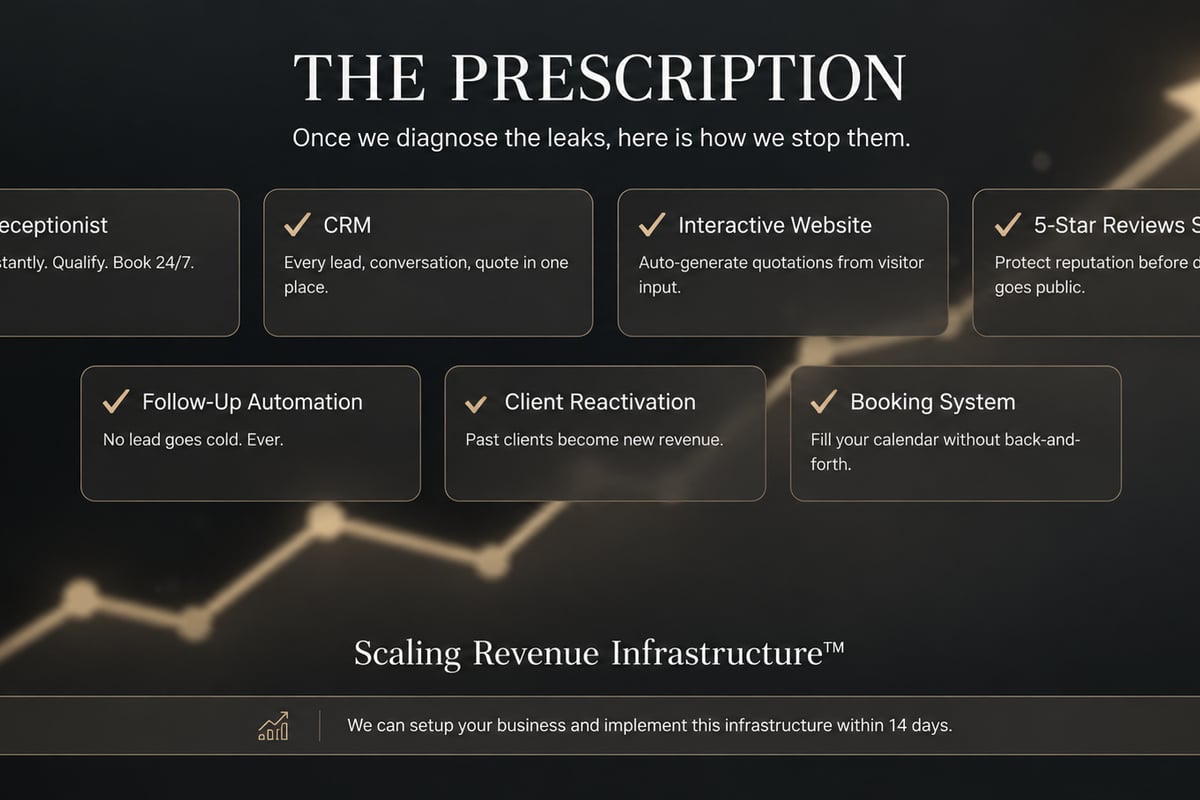
The AI business automation approach at Leverage Scaling focuses specifically on these revenue-critical processes, ensuring AI deployment addresses the highest-impact opportunities first rather than automating low-value tasks that don't materially affect financial performance.
For businesses seeking to understand where their revenue operations create the most significant leakage, a comprehensive evaluation provides the foundation for strategic AI deployment. The AI Scaling Strategy Audit delivers rigorous assessment of systems, processes, and customer journeys, quantifying commercial impact and identifying underutilized growth opportunities across the entire revenue cycle.

System Integration and Data Flow
Business ai systems require comprehensive data access to function effectively. Integration architecture determines whether AI operates with complete visibility or makes decisions based on incomplete information.
Critical Data Connections
- Customer relationship management platforms containing interaction history and relationship context
- Communication systems capturing email, SMS, call, and chat conversations
- Scheduling tools tracking appointments, cancellations, and availability patterns
- Payment processors providing transaction history and billing status
- Service delivery platforms recording fulfillment activities and customer feedback
The integration challenge extends beyond technical connectivity. Data must flow bidirectionally, allowing AI systems to both consume information and write back actions, updates, and insights. Systems operating as AI for business operations require this two-way integration to close the loop between insight generation and action execution.
Operational AI Deployment Models
The architecture of business ai systems varies significantly based on operational requirements, technical capabilities, and strategic objectives. Understanding deployment models helps organizations select approaches aligned with their specific circumstances.
Managed AI Operations
For many local service businesses, building and maintaining AI infrastructure internally represents an impractical allocation of resources. Managed AI operations provide an alternative model where specialized systems handle the technical complexity while businesses focus on core service delivery.
The managed AI approach treats AI as an operational service rather than a technology project. This model addresses several common barriers to AI adoption:
- Technical expertise gaps that prevent effective system design and optimization
- Resource constraints that make dedicated AI teams financially unfeasible
- Maintenance overhead that diverts attention from revenue-generating activities
- Scalability challenges that limit growth potential
Managed operations shift AI from capital investment to operational expense, reducing risk and accelerating time to value.
Embedded AI Engines
Rather than deploying AI as a separate layer requiring constant attention, embedded approaches integrate intelligence directly into existing operational workflows. This creates what might be termed AI Profit Engines that operate continuously within the revenue cycle.
Key Characteristics of Embedded AI
- Operates autonomously within defined parameters and escalation rules
- Learns from outcomes to improve performance over time
- Requires minimal ongoing configuration or manual intervention
- Integrates seamlessly with existing team workflows
- Provides transparency into decision logic and action rationale
The embedded model proves particularly effective for revenue operations because it removes the friction of moving between systems or translating AI recommendations into manual actions.
Measuring Business AI Impact
Deployment without measurement creates uncertainty about return on investment and improvement opportunities. Effective business ai implementation requires clear metrics, baseline establishment, and continuous performance monitoring.
Revenue-Centric Metrics
The most meaningful measures of AI effectiveness connect directly to revenue outcomes rather than activity indicators:
| Metric Category | Traditional Measure | AI-Enhanced Measure |
|---|---|---|
| Lead Management | Total leads captured | Qualified leads converted within 24 hours |
| Customer Acquisition | Marketing cost per lead | True cost per acquired customer including follow-up |
| Conversion | Overall close rate | Close rate by lead source and engagement pattern |
| Retention | Annual churn percentage | Predicted churn prevented through intervention |
| Recovery | Win-back campaign response | Automated reactivation revenue |
These metrics shift focus from operational activity to commercial outcomes. The question transitions from "how many emails did we send" to "how much revenue did AI-driven engagement capture that would otherwise have been lost."
Leading and Lagging Indicators
Comprehensive measurement requires both predictive and confirmatory metrics. Leading indicators signal future performance trends, while lagging indicators confirm actual results.
Leading Indicators
- Response time to qualified leads
- Engagement sequence completion rates
- Customer satisfaction trend direction
- Intervention acceptance rates
- Process adherence percentages
Lagging Indicators
- Revenue captured versus baseline
- Customer lifetime value trends
- Acquisition cost evolution
- Retention rate improvements
- Reactivation revenue generation
The combination provides both early warning of performance degradation and confirmation of improvement sustainability.
Governance and Risk Management
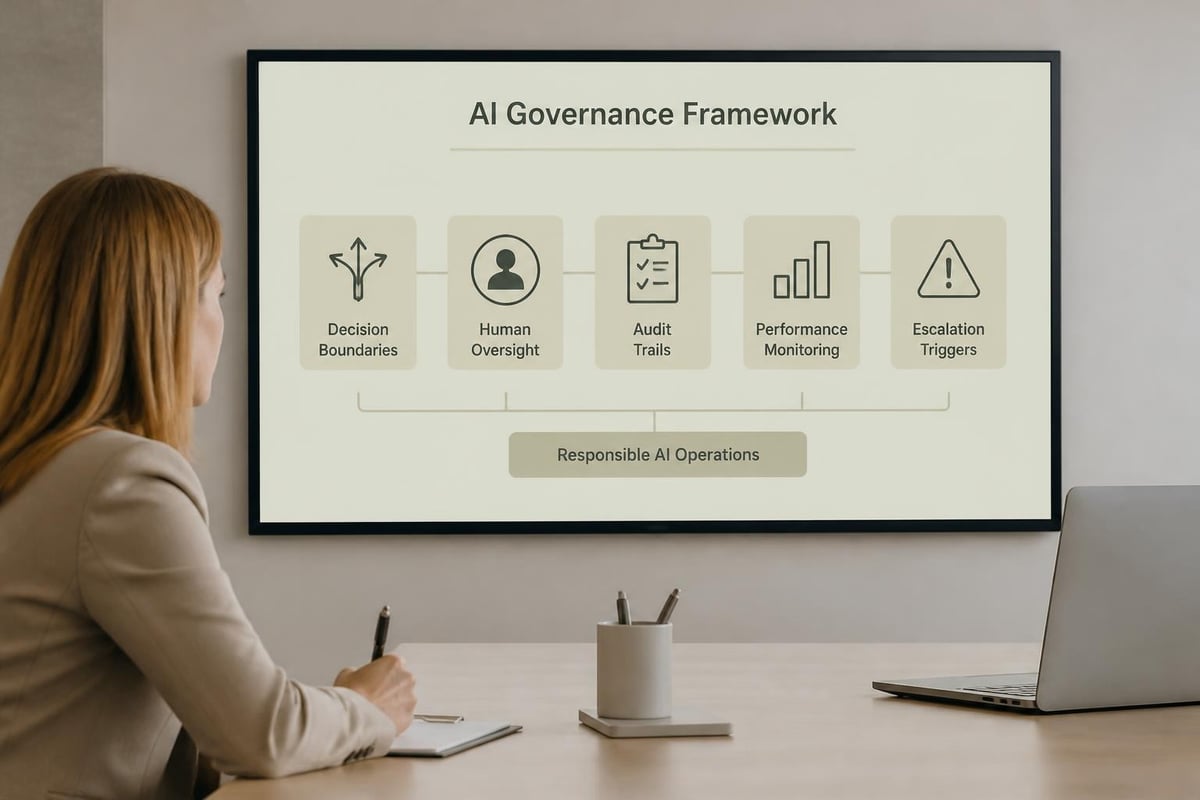
As business ai assumes more operational responsibility, governance frameworks become essential for ensuring systems operate within acceptable parameters and align with organizational values. The NIST AI Risk Management Framework provides structured guidance for organizations implementing AI governance.
Operational Controls
AI systems operating in revenue-critical functions require controls that prevent unintended consequences while preserving operational efficiency:
- Decision boundaries defining which actions AI can execute autonomously versus requiring human approval
- Escalation triggers that flag unusual situations for human review
- Audit trails documenting AI decisions and the data supporting each action
- Performance monitoring detecting degradation or drift from expected behavior
- Override capabilities allowing human operators to intervene when necessary
These controls balance automation efficiency with risk mitigation, ensuring AI augments rather than undermines operational reliability.
Ethical Considerations
Beyond technical controls, organizations must address ethical dimensions of AI deployment. Responsible AI principles emphasize transparency, fairness, reliability, and accountability.
Practical Application
- Ensuring AI-driven customer communications maintain authenticity and transparency
- Preventing discriminatory patterns in lead qualification or service delivery
- Protecting customer data privacy throughout AI processing
- Maintaining human accountability for automated decisions
- Providing recourse mechanisms for customers affected by AI actions
For service businesses, reputation depends on customer trust. AI systems must enhance rather than compromise that trust through careful attention to ethical implementation.
The Competitive Imperative
The adoption curve for business ai in local service markets has reached an inflection point in 2026. Early adopters have demonstrated measurable competitive advantages that make AI deployment increasingly non-optional for businesses seeking to maintain market position.
Market Dynamics and AI Adoption
Research exploring GPT use in business and management reveals that knowledge gaps persist regarding optimal AI implementation, but practical deployment continues accelerating despite theoretical uncertainties. Businesses waiting for perfect information risk competitive displacement by organizations learning through implementation.
Observable Competitive Shifts
- AI-enabled competitors responding to leads within minutes versus hours
- Automated engagement sequences maintaining consistent customer communication
- Predictive systems preventing churn before customers actively seek alternatives
- Data-driven pricing and service optimization improving margin performance
- Scalable operations growing without proportional staff increases
The performance gap between AI-augmented and traditional operations compounds over time. Each lost customer, missed opportunity, and operational inefficiency creates cumulative disadvantage.
Strategic Positioning for 2026 and Beyond
Organizations viewing business ai as tactical automation miss the strategic implications. AI represents a fundamental shift in how service businesses compete, enabling capabilities previously available only to enterprises with massive operational teams.
The AI operating system concept reflects this strategic shift. Rather than implementing point solutions for specific tasks, leading organizations deploy comprehensive AI platforms that manage entire operational layers.
Strategic Capabilities
- Continuous revenue optimization without constant manual adjustment
- Predictive resource allocation matching capacity to demand
- Personalized customer experiences scaled across thousands of relationships
- Real-time competitive response based on market signal detection
- Operational resilience through automated process execution
These capabilities transform service delivery economics, enabling growth without proportional cost increases and quality consistency regardless of scale.
Implementation Roadmap
Moving from business ai concepts to operational reality requires structured implementation that manages technical complexity, organizational change, and performance validation simultaneously.
Phase 1: Foundation (Weeks 1-4)
- Audit current revenue operations to establish baseline performance and identify leakage points
- Map critical workflows documenting processes that directly impact revenue capture and retention
- Assess technical infrastructure evaluating data accessibility and integration capabilities
- Define success metrics establishing clear measures for AI performance evaluation
- Select deployment model choosing between managed services, embedded engines, or hybrid approaches
Businesses exploring the business automation systems that enable AI deployment benefit from understanding both the technical requirements and the operational transformation necessary for success.
Phase 2: Deployment (Weeks 5-12)
- Configure AI systems with organizational data, process rules, and decision parameters
- Integrate communication channels connecting AI to customer touchpoints
- Establish monitoring dashboards providing visibility into AI performance and outcomes
- Train team members on AI interaction, override procedures, and escalation protocols
- Launch pilot programs testing AI in controlled scenarios before full deployment
Phase 3: Optimization (Ongoing)
- Analyze performance data identifying improvement opportunities and edge cases
- Refine decision rules based on outcome patterns and business feedback
- Expand AI scope extending automation to additional processes as confidence builds
- Benchmark against goals measuring actual results against projected improvements
- Iterate continuously treating AI as evolving capability rather than fixed deployment
The optimization phase never truly ends. Business ai systems improve through exposure to real operational scenarios, making continuous refinement an ongoing operational discipline.
Business AI has transitioned from future speculation to present operational necessity for service businesses competing in 2026 markets. The technology delivers measurable revenue impact through improved lead response, consistent process execution, and proactive customer retention that human teams cannot match at scale. Leverage Scaling helps local service businesses capture these advantages through AI Revenue Operations Systems that identify revenue leaks, quantify their commercial impact, and deploy intelligent automation to recover and retain more revenue automatically while you focus on delivering exceptional service.