
The evolution of artificial intelligence from experimental projects to production-grade business systems has created an entirely new operational discipline. As organizations deploy intelligent systems to drive revenue, customer engagement, and operational efficiency, they face complex challenges around monitoring, governance, reliability, and continuous improvement. AI operations represents the systematic approach to deploying, managing, and scaling these systems in ways that deliver measurable business outcomes while maintaining quality, compliance, and cost efficiency.
Operationalizing AI for Revenue Impact
For service businesses, ai operations translates directly into revenue outcomes. Systems that identify customer opportunities, optimize pricing, predict churn, or automate follow-up require operational excellence to deliver consistent value.
Revenue-focused AI operations prioritizes business metrics alongside technical metrics. While data scientists track model accuracy and precision, operations teams must connect these technical measures to customer acquisition cost, conversion rates, lifetime value, and revenue per customer. This alignment ensures that operational investments support strategic business goals rather than purely technical optimization.
Building Reliable Data Pipelines
Revenue intelligence depends on accurate, timely data flowing through operational systems. Effective ai operations establishes robust pipelines that:
Validate data quality at ingestion, flagging anomalies before they corrupt models
Transform and enrich raw inputs into features that drive intelligent decisions
Version datasets so model behavior can be traced to specific training data
Monitor drift in both input distributions and relationships between variables
Ensure compliance with privacy regulations and data retention policies.
The Feast feature store documentation outlines operational patterns for managing feature engineering at scale. Feature stores centralize reusable transformations, enable consistent feature definitions across models, and provide point-in-time correct data for training and serving.
Pipeline Stage | Operational Requirement | Revenue Impact |
|---|---|---|
Data Ingestion | Real-time validation, error handling | Prevents decisions on incomplete information |
Feature Engineering | Versioning, reproducibility | Ensures consistent customer scoring |
Model Serving | Low latency, high availability | Captures time-sensitive opportunities |
Feedback Loops | Automated labeling, monitoring | Improves accuracy over time |
Monitoring and Performance Management
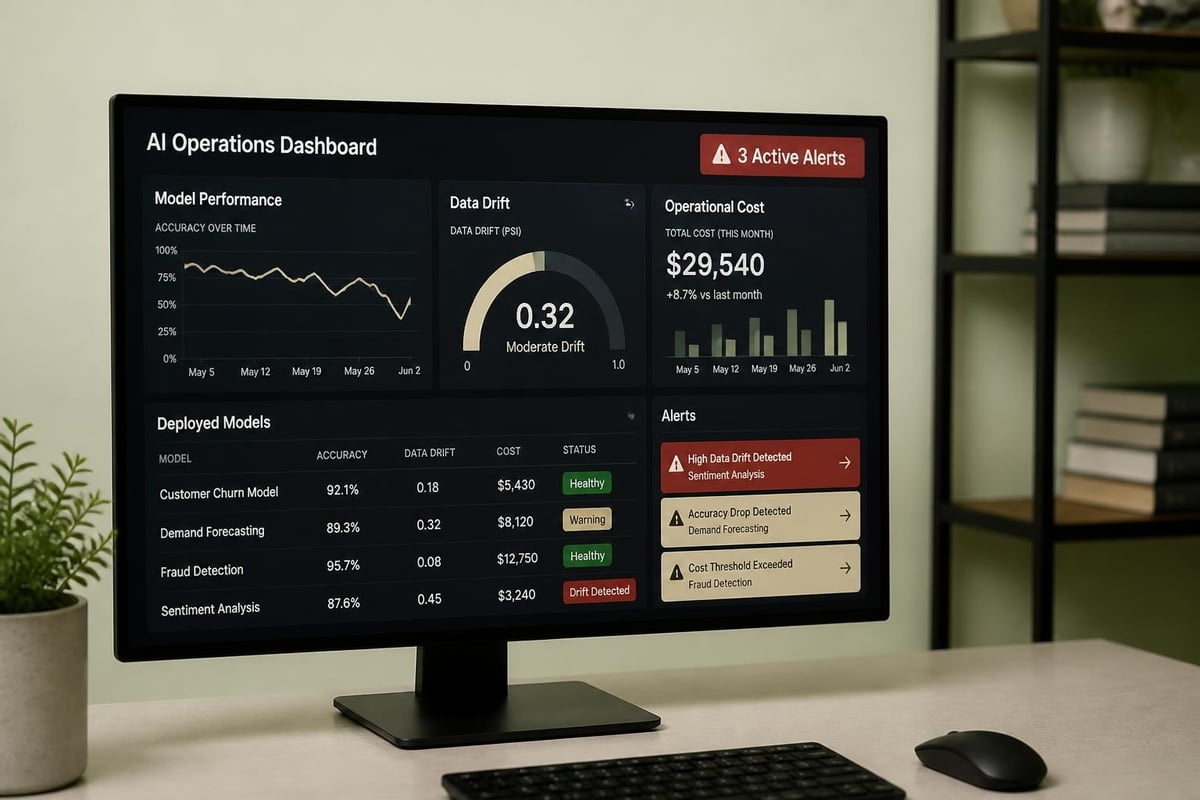
Production AI systems require specialized monitoring beyond traditional application observability. Models can fail silently, delivering plausible but incorrect outputs that gradually degrade business performance.
Comprehensive ai operations monitoring tracks multiple signal types. Prediction quality metrics measure whether models maintain their accuracy in production. Data distribution monitoring detects when incoming requests differ from training data, signaling potential performance issues. Business outcome tracking connects model decisions to actual revenue results, closing the loop between AI outputs and commercial impact.
Research on monitoring and retraining language models demonstrates that proactive drift detection prevents significant performance degradation. Organizations implementing continuous monitoring reduce the time between performance decline and corrective action by 60-80%.
Implementing Automated Response Systems
Manual intervention in AI operations doesn't scale. Modern practices emphasize automated responses to common operational events:
Automatic model retraining when performance drops below defined thresholds
Traffic routing to fallback models during degradation events
Alert escalation that notifies teams only when human intervention is required
Resource scaling that adjusts compute capacity based on demand patterns
Cost controls that prevent runaway infrastructure spending
The Google Cloud GenOps framework extends traditional MLOps practices to generative AI, addressing unique operational challenges like prompt management, output validation, and API cost optimization.
Infrastructure and Cost Optimization
AI workloads consume significant computational resources. Training sophisticated models requires GPU clusters, while serving predictions at scale demands low-latency infrastructure. Effective ai operations balances performance requirements against infrastructure costs.
Cloud-native architectures provide flexibility to scale resources dynamically. Organizations can provision intensive training compute on-demand, then scale down to cost-efficient serving infrastructure. Containerization and orchestration platforms like Kubernetes enable consistent deployment across environments while optimizing resource utilization.
The AWS cost optimization pillar offers practical strategies for controlling machine learning infrastructure spending. Techniques include spot instance usage for training workloads, committed capacity for predictable serving needs, and automated shutdown of idle resources.
Right-Sizing Operational Infrastructure
Many organizations overprovision AI infrastructure, maintaining expensive capacity for peak loads that occur infrequently. Strategic ai operations implements:
Autoscaling policies that expand capacity during high-demand periods and contract during quiet times
Model optimization through quantization, pruning, and distillation to reduce serving costs
Batch processing windows that consolidate non-urgent workloads into cost-efficient time slots
Multi-tier serving that routes requests to appropriately-sized models based on complexity
Reserved capacity planning that commits to baseline infrastructure at discounted rates
Building Audit Trails and Explainability
Production AI operations maintains comprehensive records of system behaviour. Audit trails capture which model version made each prediction, what input data informed decisions, and how outputs influenced business processes. This traceability supports compliance requirements while enabling root cause analysis when issues arise.
For revenue-critical applications, explainability helps operations teams understand why systems recommend specific actions. When an AI system identifies a high-value lead or flags a churn risk, operations staff should understand the key factors driving that assessment. This transparency builds trust and enables human operators to validate recommendations before execution.
Organizations implementing expert-driven monitoring approaches combine automated detection with domain expertise. Subject matter experts define business-relevant metrics and thresholds that complement purely statistical monitoring, creating more effective operational oversight.
Scaling AI Operations for Business Growth
As organizations expand their AI deployments, operational complexity increases exponentially. Managing dozens or hundreds of models across multiple business functions requires systematic approaches to ai operations at scale.
Platform thinking treats AI operations as a shared service. Rather than each team building custom operational tooling, organizations establish centralized platforms that provide common capabilities: model registries, deployment pipelines, monitoring dashboards, and governance workflows. The Leverage Scaling documentation outlines patterns for building cloud-native ML platforms that support multiple teams and use cases.
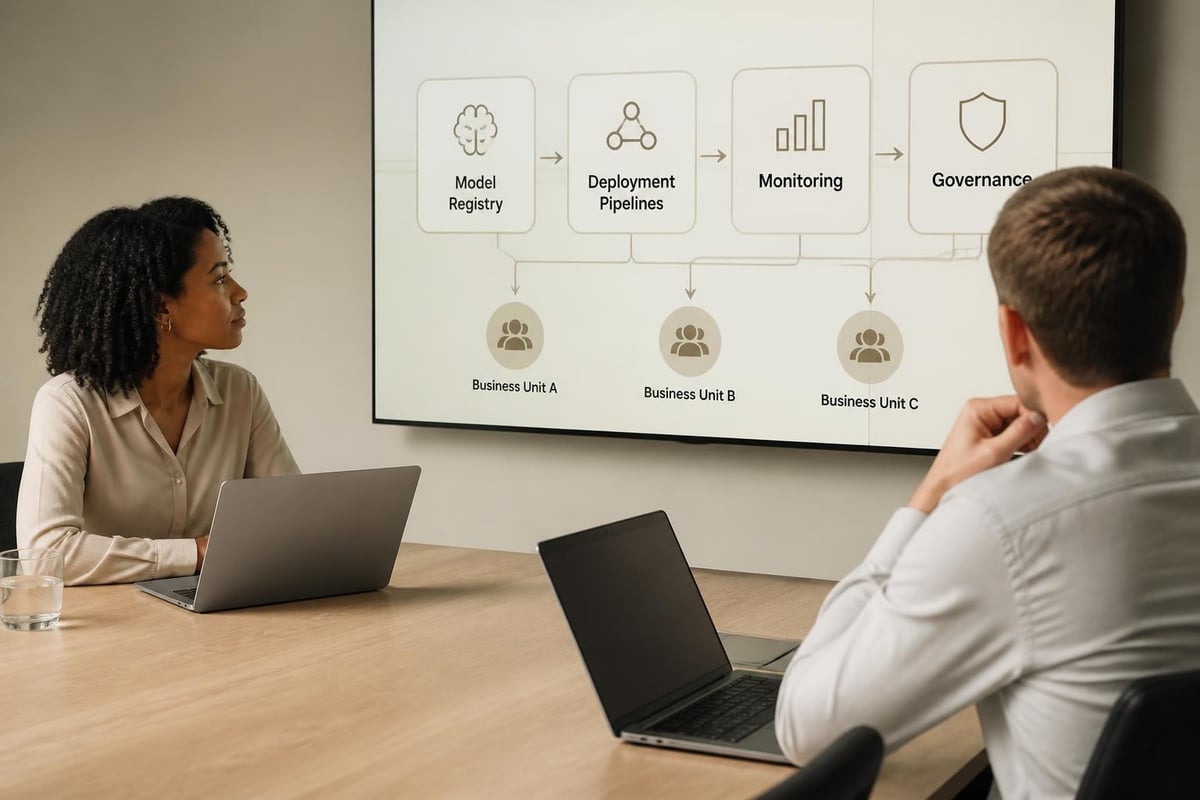
Standardization accelerates operational maturity. When teams follow consistent practices for model packaging, deployment, and monitoring, knowledge transfers efficiently across the organization. New team members onboard faster, troubleshooting follows established playbooks, and best practices propagate naturally.
Operational Excellence for Local Service Businesses
Service businesses face unique ai operations challenges. Unlike software companies with deep technical teams, service providers need operational approaches that deliver revenue impact without requiring extensive data science expertise.
Automated operations become essential when internal technical resources are limited. Systems should detect issues, initiate corrective actions, and escalate only when automated responses prove insufficient. This operational autonomy allows service businesses to benefit from AI without building large technical organizations.
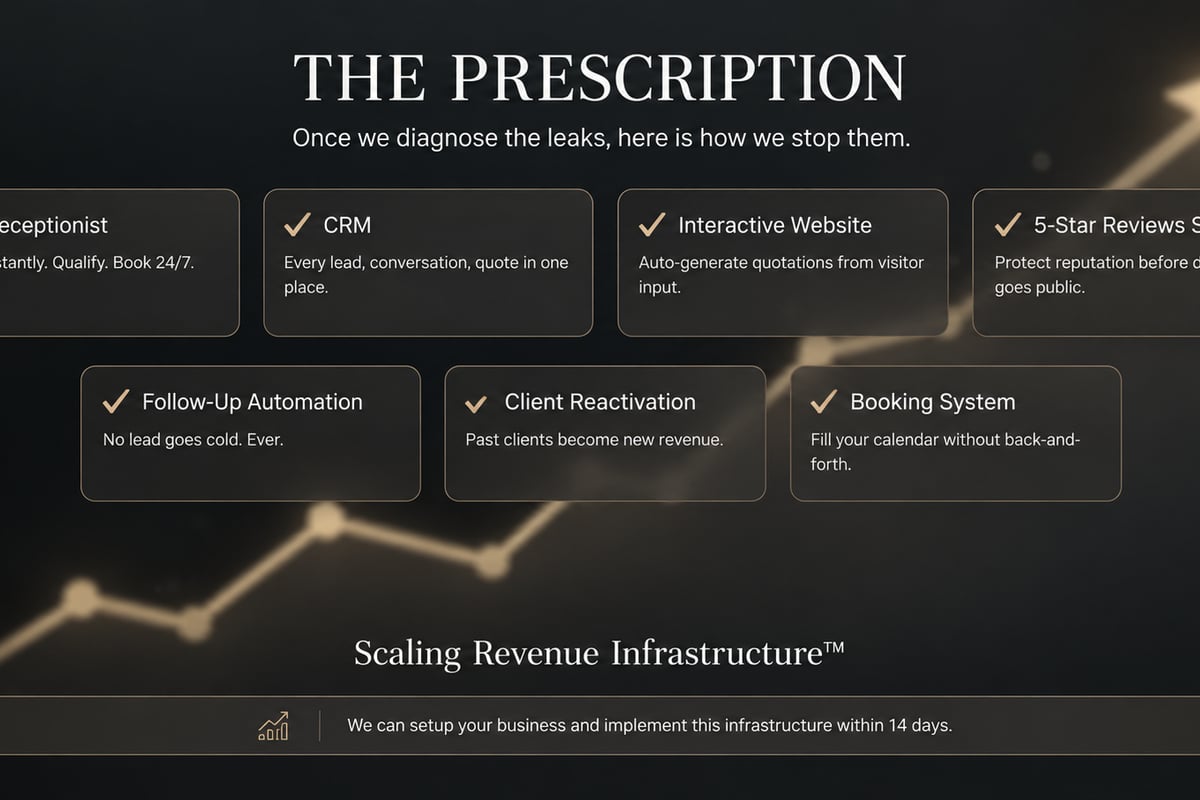
For companies focused on revenue optimization, ai operations must translate directly into commercial outcomes. The AI Scaling Strategy Audit examines how operational systems identify revenue leakage, quantify commercial impact, and deploy automated interventions across customer acquisition, conversion, and retention.
Revenue operations AI requires different operational patterns than general-purpose machine learning. Models must integrate tightly with CRM systems, communication platforms, and scheduling tools. Monitoring focuses on business metrics like response times, conversion rates, and customer lifetime value rather than purely technical measures. Deployment cycles prioritize stability and consistency over rapid experimentation.
Operational Maturity and Continuous Improvement
AI operations evolves through distinct maturity stages. Organizations typically begin with manual, ad-hoc approaches before progressing toward systematic, automated operations.
Initial stage operations rely on manual deployment, reactive monitoring, and custom scripts. Teams respond to issues as they arise, lacking systematic processes or tooling. This approach works for experimental projects but doesn't scale to production revenue systems.
Developing stage organizations establish baseline automation: CI/CD pipelines for model deployment, basic monitoring dashboards, and documented runbooks. Teams can deploy updates reliably and detect major issues, though response remains largely manual.
Mature stage ai operations implements comprehensive automation, proactive monitoring, and continuous optimization. Systems detect subtle degradation, initiate automated responses, and provide rich operational intelligence to guide improvement efforts. The Google Cloud best practices provide actionable guidance for organizations advancing toward operational maturity.
Measuring Operational Performance
Effective ai operations requires clear performance metrics that align technical excellence with business outcomes:
Model performance stability tracking accuracy, precision, and recall over time
System reliability measuring uptime, latency, and error rates for production systems
Operational efficiency monitoring costs per prediction, infrastructure utilization, and team productivity
Business impact connecting AI operations to revenue growth, customer satisfaction, and competitive advantage
Deployment velocity measuring time from model development to production deployment
Organizations making the transition to business automation systems discover that operational maturity directly influences revenue outcomes. Reliable AI operations creates consistent customer experiences, captures time-sensitive opportunities, and scales revenue without proportional increases in operational costs.
Building Cross-Functional AI Operations Teams
Successful ai operations requires collaboration across traditional organizational boundaries. Data scientists develop models, engineers build infrastructure, operations teams manage production systems, and business stakeholders define success metrics.
Cross-functional teams break down silos that impede operational excellence. When data scientists understand operational constraints, they design more deployable models. When operations engineers grasp business objectives, they prioritize reliability improvements that matter most. When business stakeholders appreciate technical tradeoffs, they set realistic expectations and timelines.
Communication protocols become critical. Regular operational reviews create forums for discussing system performance, upcoming changes, and improvement opportunities. Shared dashboards provide common visibility into system health and business impact. Post-incident reviews extract lessons from operational events without assigning blame.
Developing Operational Competencies
Organizations building ai operations capabilities invest in skills development across multiple dimensions:
Technical skills in machine learning, cloud infrastructure, and DevOps practices
Business acumen connecting technical capabilities to revenue opportunities
Operational discipline following systematic processes even under pressure
Communication abilities translating between technical and business stakeholders
Strategic thinking anticipating future operational requirements
Training programs that combine technical instruction with business context prove most effective. Teams learn not just how to deploy models, but why operational excellence matters for revenue growth and customer satisfaction.
AI operations represents a fundamental capability for organizations deploying intelligent systems to drive revenue growth. The discipline encompasses technical excellence in deployment and monitoring while maintaining tight alignment with business objectives and operational constraints.
For service businesses seeking to scale revenue through intelligent automation, operational maturity determines success. Leverage Scaling delivers AI Revenue Operations systems purpose-built for local service providers, automatically identifying revenue leaks, quantifying their commercial impact, and deploying AI Profit Engines that capture, recover, and retain revenue without requiring extensive technical teams or operational overhead.