
The artificial intelligence revolution has moved far beyond experimental projects and proof-of-concept demonstrations. Modern AI services now represent critical infrastructure for businesses seeking to scale revenue operations efficiently. For local service businesses, these intelligent systems identify opportunities, automate complex workflows, and capture revenue that traditional manual processes consistently miss. Understanding how to strategically implement AI services transforms operational capacity without proportionally expanding overhead costs.
Understanding Modern AI Services Architecture
AI services encompass far more than chatbots or basic automation tools. Today's enterprise-grade offerings integrate across multiple operational layers, from customer acquisition through retention and reactivation campaigns.
The architecture typically includes several distinct components working in concert. Natural language processing handles customer communications across channels. Predictive analytics forecast customer behavior and revenue patterns. Computer vision processes documents and visual data. Machine learning models continuously improve decision-making accuracy based on operational feedback.
Microsoft's Azure AI Services demonstrate this integrated approach, offering vision, speech, language, and decision capabilities through unified APIs. Similarly, AWS provides comprehensive AI tools and services spanning infrastructure, frameworks, and application-level solutions.
Cloud-Native Versus Custom Deployment Models
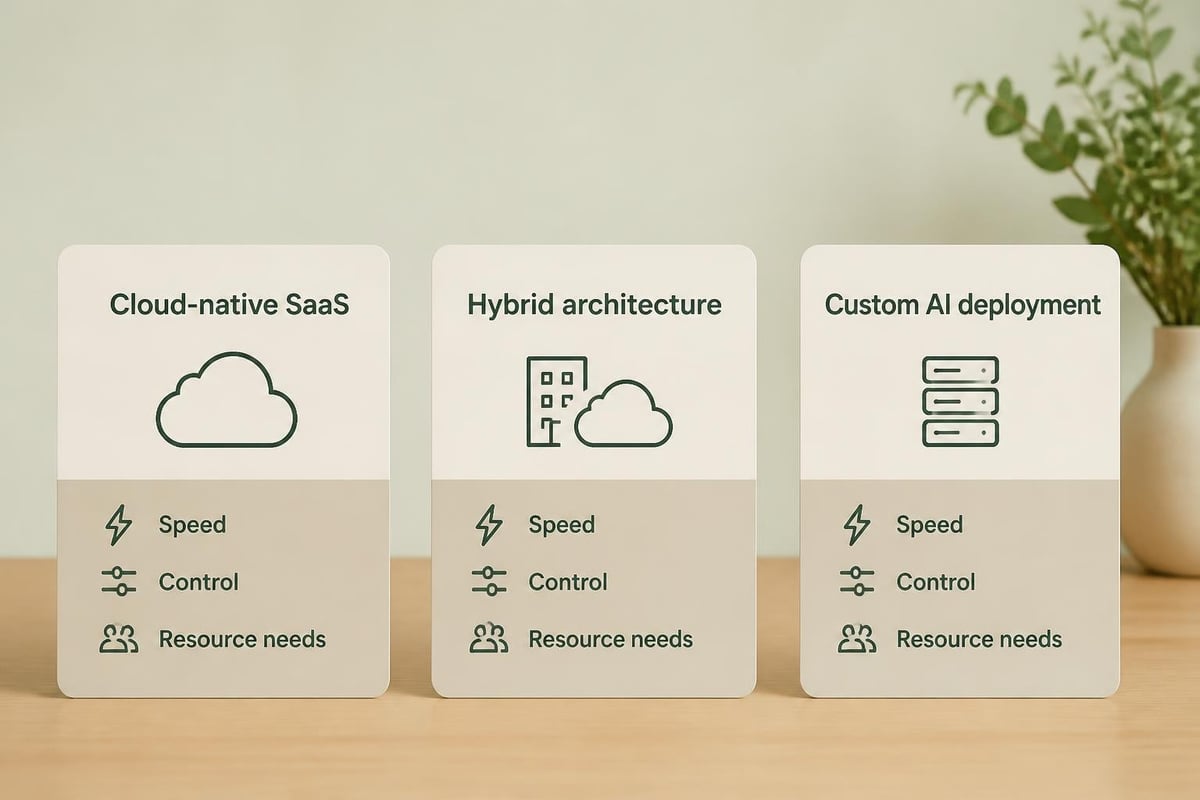
Organizations face fundamental choices about deployment architecture. Cloud-native AI services offer rapid implementation, managed infrastructure, and continuous updates without internal DevOps overhead.
Custom deployments provide greater control over data residency, model tuning, and integration specifics. Many revenue operations systems require hybrid approaches that leverage both cloud capabilities and proprietary logic. The business automation systems implemented across modern RevOps platforms exemplify this balanced architecture.
Deployment Model | Time to Value | Customization Depth | Operational Overhead | Data Control |
|---|---|---|---|---|
Cloud-Native SaaS | 1-4 weeks | Limited to APIs | Minimal | Shared infrastructure |
Hybrid Architecture | 2-3 months | Moderate flexibility | Moderate | Selective on-premise |
Fully Custom | 6-12 months | Complete control | Significant | Full ownership |
Revenue Operations Applications
AI services deliver measurable impact when applied to specific revenue cycle stages. The most significant returns emerge from systematically addressing revenue leakage across customer journey touchpoints.
Lead Capture and Qualification Intelligence
Traditional lead management suffers from timing gaps and inconsistent follow-up. AI services monitor inbound inquiries 24/7, instantly qualifying prospects against ideal customer profiles and routing high-value opportunities appropriately.
Advanced natural language like the one developed by Leverage Scaling is understanding, extracts intent, budget signals, and urgency indicators from initial contact. This intelligence enables prioritization logic that directs sales resources toward conversions with highest probability and lifetime value.
Instant response systems acknowledge inquiries within seconds, dramatically improving conversion rates
Behavioral scoring applies machine learning to historical patterns, predicting which leads warrant immediate attention
Multi-channel orchestration maintains context across email, SMS, phone, and chat interactions
Automated nurture sequences keep prospects engaged during consideration phases without manual intervention
Conversion Optimization Through Behavioral Analysis
Between initial interest and final purchase decision, numerous micro-conversions determine ultimate revenue capture. AI services track engagement patterns, identifying friction points and optimization opportunities invisible to manual analysis.
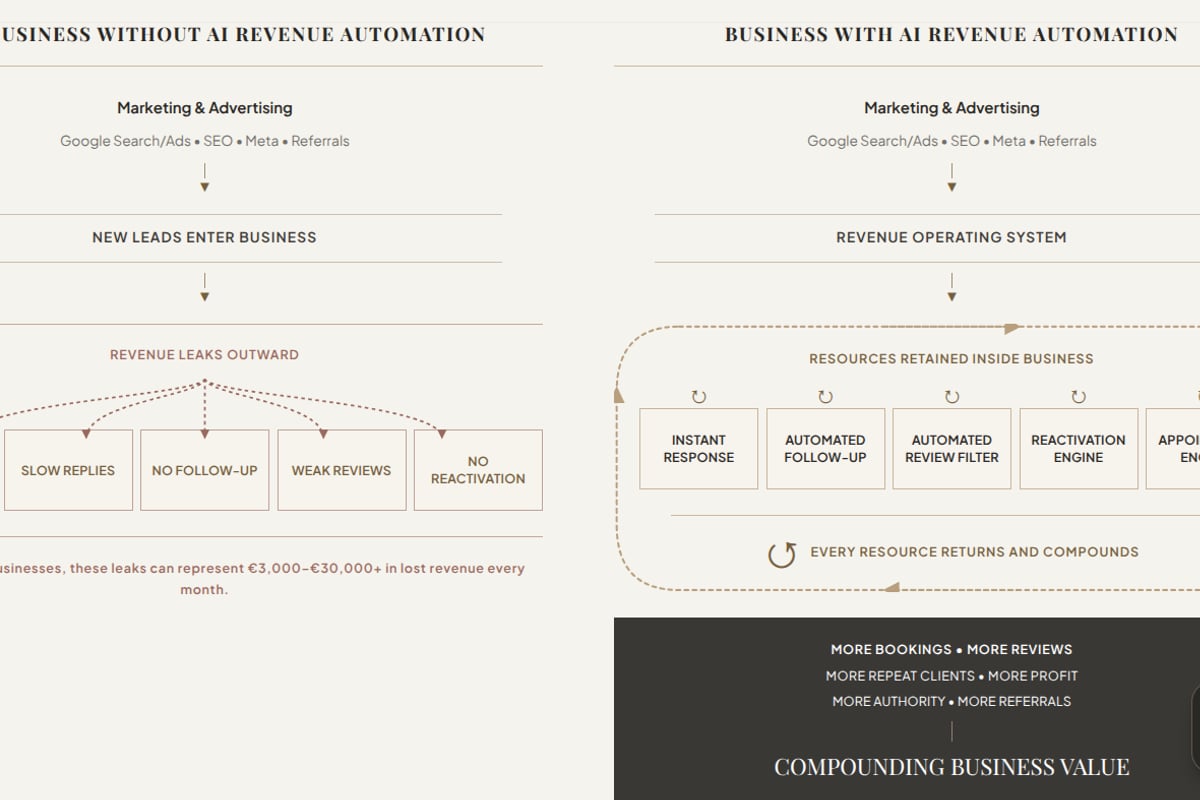
Systems like Leverage OS apply this intelligence specifically to local service businesses, where quote follow-up, appointment scheduling, and payment collection represent critical conversion gates. The platform identifies exactly where revenue leaks occur and deploys targeted automation to recover those opportunities.
When evaluating AI services for conversion optimization, businesses should examine their capability to handle complex, multi-step customer journeys rather than simple linear funnels. Service businesses rarely convert through single-touch interactions, requiring persistent, context-aware engagement over days or weeks.
Implementation Frameworks and Best Practices
Successful AI services deployment follows structured methodologies rather than ad-hoc experimentation. Organizations that achieve rapid ROI typically begin with focused use cases demonstrating clear value before expanding scope.
Identifying High-Impact Starting Points
Not all revenue operations processes benefit equally from AI augmentation. Strategic selection criteria include:
Volume and repetition - Tasks performed hundreds or thousands of times monthly
Clear success metrics - Outcomes measured through conversion rates, response times, or revenue captured
Existing data availability - Historical patterns AI models can learn from
Operational pain points - Bottlenecks causing visible revenue leakage or customer friction
Quantifiable cost of failure - Lost deals, missed follow-ups, or abandoned opportunities with calculable dollar impact
The AI revenue operations approach demonstrates this focused methodology by specifically targeting revenue leakage rather than attempting to automate everything simultaneously. This prioritization ensures measurable returns justify continued investment and expansion.
Data Quality and Model Training Considerations
AI services perform only as well as the data they process. Implementation success depends on establishing clean, representative datasets and validation protocols that catch errors before they impact customer experience.
Google Cloud's machine learning best practices outline essential patterns for production AI systems, including continuous monitoring, versioning, and rollback capabilities. These operational disciplines become critical when AI services directly interact with revenue-generating customer touchpoints.
Training data must represent actual operational conditions rather than idealized scenarios. For service businesses, this means incorporating seasonal variations, regional differences, service category nuances, and the full spectrum of customer communication styles.
Evaluating AI Service Safety and Reliability
Language model-based AI services introduce specific risks around hallucinations, inconsistent responses, and unintended bias. The comprehensive survey of large language model safety documents these challenges and established mitigation strategies.
Critical safety measures include:
Human oversight for high-stakes decisions (pricing, contract terms, refunds)
Confidence thresholds that escalate uncertain situations to human review
Regular audits comparing AI recommendations against actual outcomes
Transparent logging enabling post-incident analysis and continuous improvement
Regulatory Compliance Across Jurisdictions
Organizations operating in multiple markets must navigate varying AI regulations. The EU Artificial Intelligence Act establishes risk-based requirements affecting AI services deployed within European markets, regardless of where the technology originates.
For revenue operations specifically, compliance focuses on:
Data protection alignment with GDPR, CCPA, and sector-specific privacy requirements
Transparency obligations around automated decision-making affecting customer outcomes
Algorithmic fairness ensuring AI services don't discriminate across protected categories
Auditability requirements maintaining sufficient documentation to demonstrate compliance

Performance Measurement and Optimization
Deploying AI services represents just the beginning of value realization. Continuous measurement and refinement determine whether these systems deliver sustained ROI or become expensive overhead.
Establishing Meaningful Metrics
Traditional IT metrics like uptime and response time matter but fail to capture business impact. Revenue operations AI services require metrics tied directly to financial outcomes.
Metric Category | Example Measures | Business Impact |
|---|---|---|
Lead Response | Time to first contact, qualification accuracy | Conversion rate improvement |
Follow-up Consistency | Touch frequency, sequence completion rate | Pipeline velocity increase |
Revenue Recovery | Abandoned quote reactivation, payment collection | Direct revenue capture |
Retention Intelligence | Churn prediction accuracy, intervention success | Lifetime value protection |
Operational Efficiency | Manual task reduction, capacity per representative | Margin expansion |
The holistic evaluation framework for language models provides academic rigor for benchmarking AI service performance across multiple dimensions beyond simple accuracy scores.
Continuous Improvement Cycles
Static AI services degrade over time as customer behavior, market conditions, and competitive dynamics evolve. World-class implementations establish feedback loops that systematically improve model performance.
This requires capturing outcome data, analyzing prediction accuracy against actual results, and retraining models on expanded datasets. For revenue operations, specific patterns to monitor include:
Seasonal fluctuations in customer inquiry patterns and conversion timelines
Service category differences in objection handling and decision factors
Regional variations in communication preferences and buying cycles
Competitive pressure shifts affecting pricing sensitivity and urgency
Organizations leveraging managed AI for business operations gain the advantage of systems that evolve automatically, incorporating learnings across similar businesses rather than relying solely on single-company data.
Integration Architecture for Revenue Systems
AI services deliver maximum value when seamlessly integrated across existing revenue technology stacks rather than operating as isolated tools. Modern integration patterns enable intelligent systems to access data, trigger actions, and coordinate workflows across CRM, scheduling, payment processing, and communication platforms.
API-First Design Principles
Robust AI services expose well-documented APIs enabling bidirectional data flow. This architecture allows revenue systems to:
Query AI models for predictions, recommendations, and classifications on demand
Submit new data as customer interactions occur, keeping intelligence current
Receive automated triggers when AI systems identify opportunities or risks requiring action
Synchronize state ensuring all systems reflect current customer journey status
The technical foundation established through AI operating systems demonstrates how properly architected integrations eliminate data silos while maintaining security boundaries.
Event-Driven Automation Workflows
Traditional batch processing introduces delays between customer action and system response. Event-driven architectures such as the one of LeverageOS enable real-time reaction to revenue signals.
When a prospect submits a quote request, event-driven AI services immediately trigger qualification analysis, estimate generation, personalized follow-up sequences, and team notifications without human orchestration. This responsiveness directly impacts conversion rates in time-sensitive service industries.
Vendor Selection and Evaluation Criteria
The AI services market spans from massive cloud platforms to specialized vertical solutions. Selecting appropriate providers requires matching technical capabilities, business model alignment, and long-term strategic fit.
Build Versus Buy Decision Framework
Organizations face constant pressure to develop proprietary AI capabilities internally versus licensing external services. This decision hinges on several factors:
Build internally when:
Core competitive differentiation depends on proprietary AI logic
Unique data assets create defensible advantages
Existing technical teams possess deep machine learning expertise
Budget supports multi-year R&D investment before ROI
License external AI services when:
Speed to value outweighs customization depth
Solutions address well-understood, common use cases
Internal teams lack specialized AI/ML competencies
Total cost of ownership favors operational expense over capital investment
For most local service businesses, the economic reality favors leveraging purpose-built AI services rather than assembling data science teams. The AI for business operations approach recognizes this by delivering pre-trained, industry-specific intelligence immediately applicable to revenue operations.
Evaluating Provider Capabilities and Track Record
Marketing claims about AI capabilities often exceed actual product maturity. Rigorous evaluation examines:
Demonstrated results through case studies with verifiable metrics in similar businesses
Technical transparency about model architectures, training data sources, and update frequencies
Integration flexibility supporting existing technology stacks without forced platform migration
Support and expertise including implementation assistance and ongoing optimization guidance
Pricing predictability with clear correlation between usage, value delivered, and costs
Request pilot programs or proof-of-concept engagements before committing to enterprise contracts. AI services that perform well in controlled demonstrations may struggle with real-world operational complexity, data quality issues, and edge cases.
Scaling AI Services Across Revenue Operations
Initial AI service deployments typically address isolated use cases. Sustainable competitive advantage emerges from coordinated intelligence spanning the complete revenue cycle.
Creating Unified Customer Intelligence
Fragmented AI implementations generate siloed insights that fail to leverage complete customer context. Unified approaches aggregate signals across acquisition, conversion, delivery, retention, and reactivation stages.
This comprehensive view enables sophisticated analysis like:
Lifetime value prediction incorporating service history, engagement patterns, and referral behavior
Churn risk modeling that identifies at-risk customers before visible disengagement
Upsell opportunity detection based on service utilization patterns and expressed needs
Referral likelihood scoring to focus advocacy programs on customers most likely to recommend
The revenue leak detection capabilities exemplify this holistic intelligence, identifying exactly where revenue escapes across multiple touchpoints rather than optimizing individual stages in isolation.
Organizational Change Management
Technology alone rarely transforms outcomes. AI services require parallel evolution in processes, responsibilities, and performance expectations.
Successful scaling addresses:
Role redefinition as AI services handle routine tasks, enabling humans to focus on complex, high-value interactions
Skill development ensuring teams understand when to trust AI recommendations versus applying judgment
Incentive alignment rewarding outcomes AI services optimize rather than activity metrics automation renders obsolete
Cultural adaptation shifting from "gut feel" decision-making toward data-informed approaches
Organizations implementing business automation systems typically discover that human capital optimization delivers returns rivaling direct revenue capture.

Future-Proofing AI Service Investments
Artificial intelligence capabilities evolve rapidly, creating risk that today's cutting-edge solutions become tomorrow's technical debt. Strategic AI service adoption balances current value delivery with long-term flexibility.
Platform Versus Point Solution Trade-offs
Comprehensive AI platforms promise unified experiences but may lock organizations into single-vendor ecosystems. Specialized point solutions offer best-of-breed capabilities within narrow domains while requiring more complex integration work.
The optimal approach typically involves:
Core platform providing foundational capabilities (data infrastructure, workflow orchestration, basic intelligence)
Specialized services addressing unique requirements where platform capabilities fall short
Standard integration protocols enabling component substitution as better alternatives emerge
Preparing for Generative AI Evolution
Large language models and generative AI represent paradigm shifts in what automated systems can accomplish. Revenue operations particularly benefit from these advances through:
Hyper-personalized communications tailored to individual customer context, preferences, and history
Complex reasoning about multi-factor decisions previously requiring human judgment
Dynamic content creation for proposals, follow-ups, and customer education
Sophisticated conversation handling maintaining context across extended multi-turn interactions
Organizations building AI service strategies today must ensure architectures can incorporate generative capabilities as they mature and costs decline.
AI services have transitioned from experimental technology to essential revenue operations infrastructure for local service businesses. Strategic implementation focuses resources on high-impact use cases, establishes rigorous measurement, and scales intelligence across the complete customer lifecycle. When your business is ready to identify exactly where revenue leaks occur and deploy AI automation to capture those opportunities systematically, Leverage Scaling provides the revenue operations intelligence specifically designed for service businesses seeking predictable, scalable growth without proportional overhead expansion.