
The operational complexity facing local service businesses has reached an inflection point. Revenue leakage occurs across multiple touchpoints-from initial lead capture through customer retention-and traditional systems lack the sophistication to identify, quantify, and resolve these gaps systematically. An AI platform designed specifically for revenue operations transforms this challenge by creating an intelligent layer that continuously monitors, learns, and optimizes every revenue-generating interaction without requiring constant manual oversight.
Understanding Modern AI Platform Architecture
An AI platform represents far more than a collection of algorithms or automation scripts. The architecture encompasses integrated infrastructure that combines data ingestion, model training, deployment capabilities, and operational monitoring into a cohesive system. Vertex AI's comprehensive documentation demonstrates how enterprise-grade platforms provide unified environments where teams can develop, deploy, and manage machine learning models at scale.
For revenue operations specifically, this architecture must address unique requirements. The platform needs to process transactional data, customer interaction histories, communication patterns, and behavioral signals in real time. It must also generate actionable insights that directly impact revenue capture rather than merely producing analytics dashboards.
Core Components of Revenue-Focused AI Platforms
Data Pipeline Infrastructure forms the foundation. Every customer interaction, lead inquiry, appointment booking, service completion, and payment transaction feeds into the system. The platform ingests this data continuously, standardizing formats and establishing relationships between disparate data points.
Predictive Modeling Engines analyze historical patterns to forecast future behaviors. These models identify which leads are most likely to convert, which customers face elevated churn risk, and which revenue recovery opportunities offer the highest return potential. The sophistication lies not in prediction accuracy alone but in translating predictions into automated interventions.
Orchestration Layers coordinate actions across multiple systems. When the AI platform identifies a high-value lead showing engagement signals, it automatically triggers personalized follow-up sequences, assigns appropriate resources, and adjusts communication timing based on response patterns.
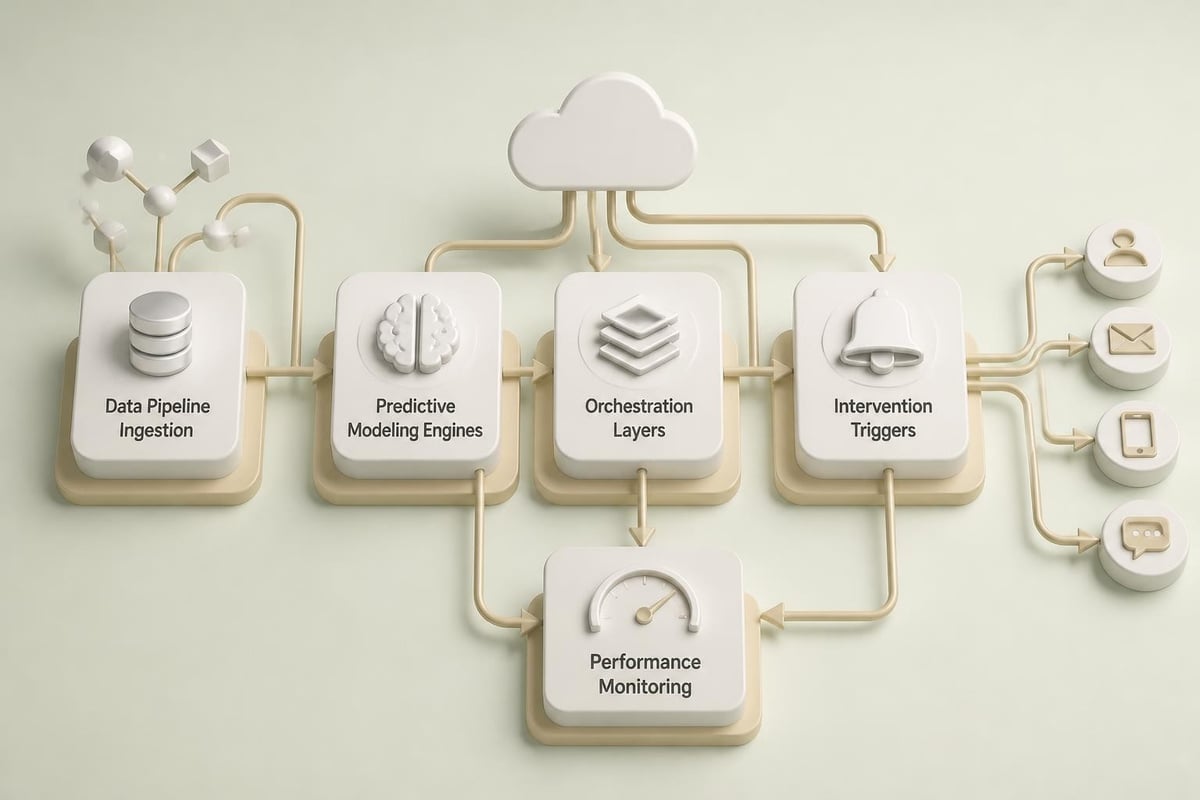
| Platform Component | Primary Function | Revenue Impact |
|---|---|---|
| Data Pipeline | Continuous ingestion and standardization | Eliminates blind spots in customer journey |
| Predictive Models | Pattern recognition and forecasting | Identifies revenue opportunities before they're lost |
| Orchestration | Cross-system coordination | Ensures timely, consistent interventions |
| Monitoring | Performance tracking and optimization | Quantifies ROI and guides resource allocation |
Enterprise AI Platform Capabilities for Service Businesses
Azure Machine Learning's enterprise framework illustrates how comprehensive AI platforms address governance, security, and lifecycle management alongside technical capabilities. Service businesses benefit from these enterprise features when they translate into operational reliability and compliance assurance.
The distinction between generic AI tools and a purpose-built ai platform becomes evident in production environments. Generic tools require extensive customization, ongoing maintenance, and specialized expertise to maintain effectiveness. Purpose-built platforms embed domain knowledge directly into their architecture, understanding the nuances of service business revenue cycles, seasonal patterns, and customer lifecycle dynamics.
Automated Revenue Leak Detection
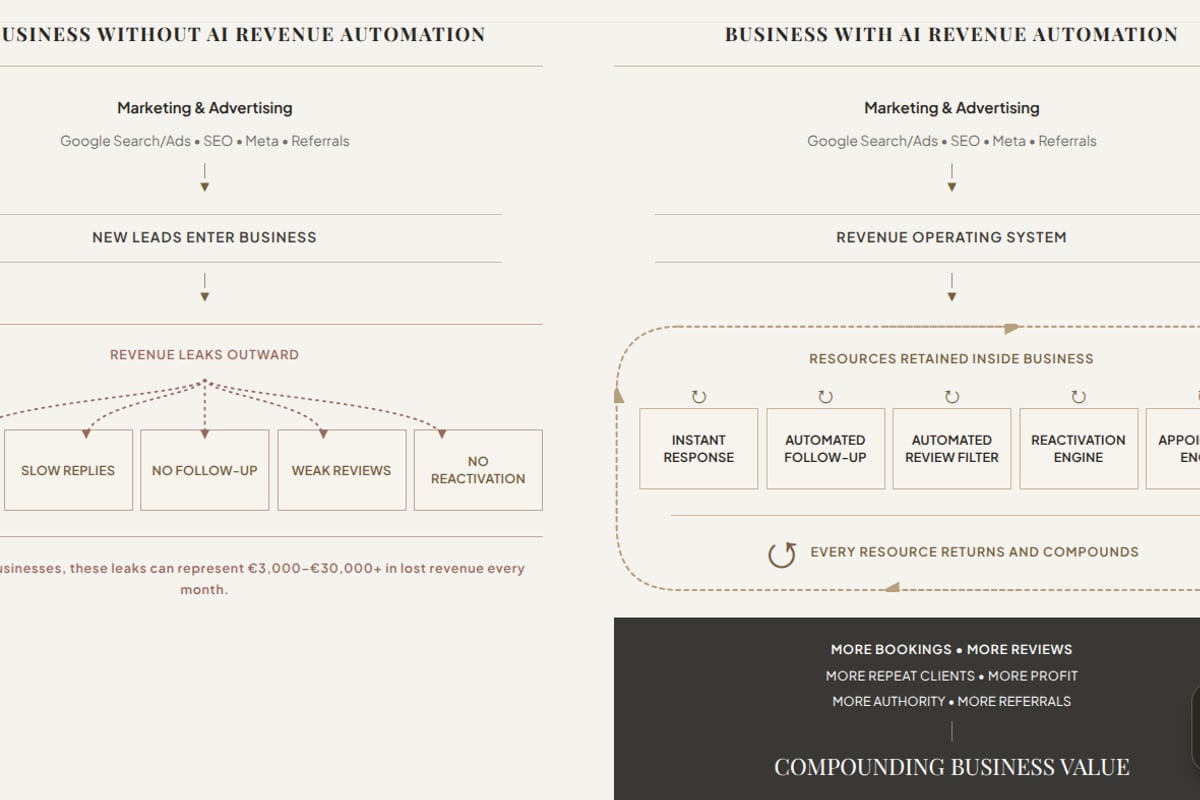
Revenue leakage manifests in predictable patterns that most businesses fail to detect systematically. Leads enter the pipeline but receive inconsistent follow-up. Customers signal dissatisfaction through behavioral changes before canceling. Payment issues arise but lack proactive resolution workflows.
An ai platform designed for revenue operations continuously scans for these patterns. It measures response time gaps, identifies communication breakdowns, detects engagement decline signals, and quantifies the financial impact of each leak category. This systematic identification provides the foundation for targeted intervention.
Follow-up consistency represents one of the most significant leak categories for local service businesses. The platform tracks every lead inquiry, measures response timing, monitors conversation progression, and flags stalled opportunities. When follow-up gaps emerge, automated sequences engage prospects with contextually relevant information while alerting team members to high-priority situations.
- Lead response time tracking with automated escalation
- Engagement scoring based on interaction patterns
- Conversational AI handling initial qualification
- Dynamic prioritization adjusting to capacity and opportunity value
- Recovery sequences for stalled pipeline opportunities
Retention and Reactivation Intelligence
Customer retention economics dwarf acquisition costs, yet most service businesses operate reactively rather than predictively. An ai platform shifts this paradigm by identifying retention risks before customers churn and quantifying the lifetime value at stake.
The platform analyzes service utilization patterns, communication frequency, payment behaviors, and satisfaction indicators. It detects deviations from healthy customer patterns and triggers retention interventions calibrated to risk level and customer value. For businesses implementing AI-driven business automation systems, retention automation delivers measurable impact quickly.
Reactivation workflows apply similar intelligence to dormant customer segments. The platform identifies customers whose service patterns have lapsed, determines optimal reactivation timing based on historical data, and deploys personalized re-engagement campaigns that address specific lapse reasons.

Building vs. Buying AI Platform Infrastructure
The build-versus-buy decision carries profound implications for service businesses. AWS's whitepaper on enterprise ML platforms outlines the architectural complexity, security considerations, and operational requirements involved in constructing robust AI infrastructure from scratch.
Build Considerations
Building a custom ai platform requires substantial technical investment. Organizations need data engineering expertise to construct pipelines, machine learning specialists to develop and maintain models, DevOps capabilities to manage infrastructure, and security professionals to ensure compliance and data protection.
The timeline from initial development to production deployment typically spans 12-18 months for basic functionality, with ongoing refinement and expansion continuing indefinitely. For local service businesses, this investment rarely aligns with core competencies or strategic priorities.
Operational overhead compounds initial development costs. Models require regular retraining as data distributions shift. Infrastructure needs monitoring, scaling, and maintenance. Security patches and compliance updates demand continuous attention.
Purpose-Built Platform Advantages
Purpose-built AI platforms deliver immediate value by encoding domain expertise directly into their architecture. These platforms understand service business revenue cycles, recognize industry-specific patterns, and provide pre-configured workflows addressing common revenue operations challenges.
Implementation timelines compress from months to weeks. The platform arrives with proven models trained on relevant data, established best practices for service business operations, and support infrastructure managing technical complexity behind the scenes.
Leverage Scaling's approach exemplifies this model, providing an AI Revenue Operations System specifically designed for local service businesses that identifies revenue leaks, quantifies impact, and deploys AI Profit Engines to capture, recover, and retain revenue automatically.
Many organizations benefit from conducting an AI Scaling Strategy Audit to assess current revenue operations, identify specific leakage patterns, and develop a prioritized roadmap for AI platform implementation. This diagnostic process quantifies the commercial impact of operational gaps and establishes clear metrics for measuring platform ROI.
Advanced AI Platform Features Driving Revenue Impact
The sophistication of modern AI platforms extends beyond basic automation into genuinely intelligent systems that learn, adapt, and optimize continuously. Research on emerging AI agent architectures demonstrates how advanced platforms incorporate reasoning capabilities, tool utilization, and autonomous decision-making within defined parameters.
Conversational AI Integration
Natural language processing capabilities transform how service businesses engage prospects and customers. The ai platform handles initial inquiries, qualifies leads through intelligent conversation, schedules appointments, answers common questions, and seamlessly escalates complex situations to human team members.
This integration operates continuously without fatigue or inconsistency. Response times compress to seconds rather than hours. Qualification happens systematically rather than haphazardly. Every interaction feeds data back into the platform, continuously refining conversation models and improving outcomes.
Personalization at scale becomes achievable when conversational AI accesses complete customer histories, service records, preference data, and interaction patterns. Each conversation reflects this context, creating experiences that feel individually tailored despite being entirely automated for routine interactions.
Predictive Revenue Forecasting
Traditional forecasting relies on historical trends and linear projections. AI platform forecasting incorporates dozens of variables simultaneously-seasonal patterns, marketing campaign performance, competitive dynamics, economic indicators, team capacity, and pipeline velocity metrics.
The platform generates probability-weighted scenarios rather than single-point estimates. It identifies leading indicators that signal forecast variance early, enabling proactive adjustments. For service businesses managing capacity planning, this capability transforms operational efficiency.
| Forecasting Approach | Data Sources | Update Frequency | Accuracy Range |
|---|---|---|---|
| Traditional Spreadsheet | Historical revenue, manual pipeline review | Monthly or quarterly | ±25-40% variance |
| Basic CRM Reporting | Pipeline data, closed deals | Weekly | ±15-25% variance |
| AI Platform Forecasting | Multi-source integration, behavioral signals, external factors | Real-time continuous | ±5-12% variance |
Dynamic Resource Allocation
Service businesses face constant tension between capacity utilization and service quality. An ai platform optimizes this balance by predicting demand patterns, matching customer requirements to team capabilities, and dynamically adjusting scheduling to maximize both revenue capture and customer satisfaction.
The system learns which team members excel at specific customer types, which service combinations drive highest satisfaction, and which scheduling patterns minimize cancellations. It applies this intelligence automatically, creating optimal assignments without manual coordination overhead.
Implementation Strategy for AI Platform Adoption
Successful AI platform implementation follows structured phases rather than attempting wholesale transformation simultaneously. Amazon SageMaker's end-to-end workflow documentation illustrates how enterprise platforms guide users through progressive capability adoption.
Phase One: Foundation and Visibility
Initial implementation establishes data connections, configures tracking mechanisms, and creates visibility into current revenue operations performance. The platform begins ingesting data from existing systems-CRM platforms, scheduling tools, communication channels, payment processors, and customer service platforms.
During this phase, the ai platform establishes baseline metrics. It quantifies current lead response times, measures follow-up consistency, calculates conversion rates by source and channel, and identifies existing revenue leakage patterns. This diagnostic phase typically spans 30-45 days, providing comprehensive assessment of operational health.
Quick wins emerge even during the foundation phase. Basic automation eliminates manual data entry, standardizes lead intake processes, and establishes consistent tracking that previously required extensive manual effort.
Phase Two: Automated Intervention Deployment
With foundation established, the platform deploys automated interventions targeting highest-impact revenue leaks identified during assessment. This typically begins with lead follow-up automation, ensuring every inquiry receives timely, consistent engagement regardless of when it arrives or current team capacity.
Retention monitoring activates next, with the platform identifying at-risk customers and triggering appropriate retention workflows. Revenue recovery automation addresses payment issues, service delivery gaps, and re-engagement opportunities systematically.
- Automated lead qualification and routing
- Intelligent follow-up sequences adapting to engagement signals
- Retention risk detection with triggered interventions
- Payment issue resolution workflows
- Reactivation campaigns for dormant customer segments
Phase Three: Optimization and Expansion
The ai platform continuously refines its models based on outcome data. It learns which message variations drive higher conversion, which intervention timings maximize retention, which customer segments respond to specific approaches, and which revenue recovery strategies deliver optimal ROI.
This learning compounds over time, creating increasingly sophisticated operations that improve results without increasing effort. The platform expands capabilities into adjacent areas-upsell identification, service bundling recommendations, capacity optimization, and strategic planning support.
Organizations leveraging AI for business operations find that maturity curves accelerate as data accumulates and models refine. The platform becomes increasingly valuable over time rather than requiring constant reinvestment to maintain effectiveness.

Measuring AI Platform ROI and Performance
Quantifying ai platform impact requires metrics directly tied to revenue outcomes rather than activity measures. Traditional marketing and operations metrics-email open rates, task completion counts, system uptime percentages-provide limited insight into actual business value delivered.
Revenue-Centric Metrics
Revenue capture rate measures the percentage of qualified leads that convert to paying customers. An effective AI platform systematically improves this metric by ensuring consistent follow-up, optimal engagement timing, and personalized communication that addresses specific prospect needs and concerns.
Revenue retention rate tracks the percentage of customer lifetime value actually realized versus theoretical potential. The platform impacts this metric through proactive retention interventions, service quality monitoring, and satisfaction management that prevents churn before it occurs.
Revenue recovery rate quantifies the value recaptured from at-risk situations-late payments resolved, service delivery issues corrected, dormant customers reactivated, and cancellation requests successfully retained. This metric often represents the most immediate measurable impact from AI platform implementation.
| Metric Category | What It Measures | Target Improvement | Typical Timeline |
|---|---|---|---|
| Lead Response Time | Average time from inquiry to first meaningful contact | 75-90% reduction | 30-60 days |
| Lead Conversion Rate | Percentage of qualified leads becoming customers | 25-45% increase | 60-90 days |
| Customer Retention | Percentage of customers retained year-over-year | 15-30% improvement | 90-180 days |
| Revenue per Customer | Average lifetime value realized | 20-40% increase | 120-240 days |
Operational Efficiency Gains
Beyond direct revenue impact, AI platforms deliver substantial efficiency improvements that free team capacity for high-value activities. Manual data entry, routine follow-up, scheduling coordination, and status tracking consume significant time that automation eliminates.
The impact of AI on operational efficiency manifests in measurable team capacity expansion. Organizations frequently report 20-35% increases in effective capacity without headcount additions, as team members redirect effort from administrative tasks to strategic revenue generation and complex customer situations.
Cost per acquisition improvements emerge as the platform optimizes marketing spend allocation, improves conversion efficiency, and reduces waste in lead generation processes. The system identifies which sources deliver highest-quality leads, which messaging drives best response, and which timing patterns maximize conversion probability.
Strategic Competitive Advantages From AI Platform Adoption
Service businesses implementing comprehensive AI platforms gain compounding competitive advantages that competitors using traditional operations struggle to match. These advantages extend beyond immediate revenue impact into strategic positioning and market differentiation.
Operational Consistency and Reliability
The ai platform delivers identical quality regardless of time, day, season, or current workload. Every lead receives appropriate follow-up. Every at-risk customer triggers retention protocols. Every revenue recovery opportunity receives systematic attention. This consistency creates predictable, reliable revenue performance that supports confident growth planning.
Competitors relying on manual processes inevitably experience variability. Follow-up depends on individual discipline and current workload. Retention efforts fluctuate with available attention. Revenue leaks persist undetected until they accumulate into significant impact.
Speed and Responsiveness
Modern customers expect immediate engagement. Inquiry response time directly correlates with conversion probability. An ai platform engaging prospects within seconds or minutes captures opportunities that competitors addressing inquiries hours or days later never receive.
This speed advantage compounds across the entire customer lifecycle. Issues receive faster resolution. Questions get immediate answers. Service delivery happens more smoothly. The cumulative effect creates superior customer experiences that drive both acquisition and retention advantages.
Data-Driven Decision Making
The platform generates comprehensive operational intelligence that informs strategic decisions. Leadership gains clear visibility into which services drive highest profitability, which customer segments offer greatest lifetime value, which marketing investments deliver optimal returns, and which operational improvements would generate maximum impact.
Businesses exploring AI operations capabilities discover that this strategic intelligence often proves as valuable as the direct revenue impact from automation. Data-driven optimization at the strategic level multiplies the effectiveness of tactical execution improvements.
AI platform architecture specifically designed for revenue operations transforms how service businesses capture, retain, and grow revenue. The systematic identification of leakage patterns, automated intervention deployment, and continuous optimization create measurable financial impact while reducing operational complexity. Leverage Scaling provides exactly this capability through Leverage OS, an AI Revenue Operations System that manages your revenue layer automatically while you focus on delivering exceptional service to your customers.