
The emergence of an ai operating system represents a fundamental shift in how businesses manage their revenue operations. Unlike traditional software that requires constant human intervention, an ai operating system functions as an autonomous layer that continuously monitors, analyzes, and optimizes business processes. For local service businesses in sectors like automotive repair, home services, contracting, real estate, aesthetics, and retail, this technology addresses the chronic revenue leakage that occurs when manual processes fail to capture, convert, or retain customers effectively.
Understanding the AI Operating System Architecture
An ai operating system differs fundamentally from conventional business software. Traditional tools require users to input data, make decisions, and execute actions manually. In contrast, an ai operating system operates continuously in the background, making autonomous decisions based on data patterns and business rules.
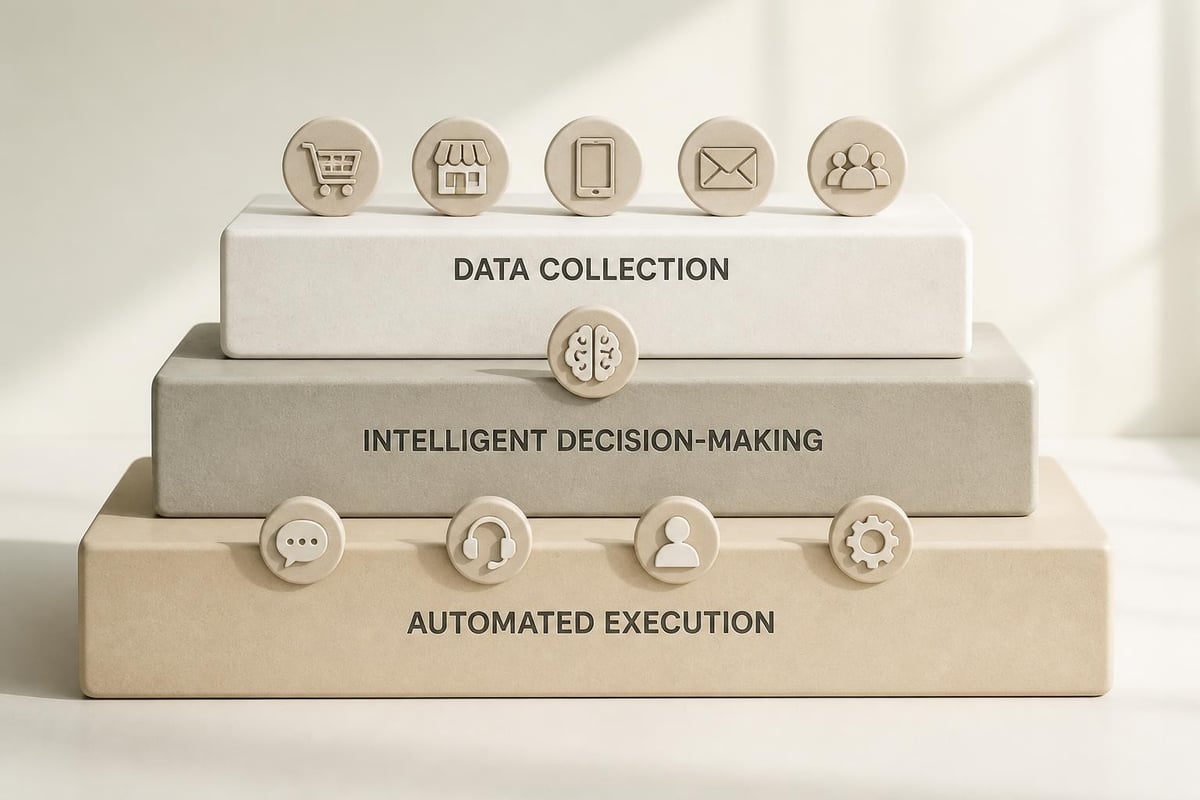
The architecture typically consists of three integrated layers: data collection and synthesis, intelligent decision-making, and automated execution. Organizations adopting AI-first operating models achieve significantly higher operational efficiency and revenue capture rates compared to those using traditional automation tools.
Core Components of an AI Operating System
The foundation relies on several critical components working in concert:
Context management and memory that maintains complete customer journey histories
Agent orchestration that coordinates multiple AI processes simultaneously
Tool integration connecting to existing business systems and data sources
Decision engines that evaluate scenarios and select optimal actions
Learning mechanisms that improve performance based on outcomes
According to Anthropic's Model Context Protocol, the standardization of how AI agents connect to data sources and tools has become essential for building reliable, interoperable ai operating system platforms. This protocol enables different AI components to share context seamlessly, creating a unified operational layer.
Revenue Leakage Patterns in Service Industries
Service businesses face unique operational challenges that create systematic revenue loss. These leakage points occur at every stage of the customer lifecycle, often invisible to owners focused on service delivery.
Lead Capture and Response Failures
In automotive repair shops, missed phone calls during peak service hours represent immediate revenue loss. When a potential customer calls about a check engine light or brake service and reaches voicemail, 72% will call a competitor within the next hour rather than leaving a message. The same pattern appears across home services, where emergency plumbing or HVAC calls require immediate response.
Leverage Scaling's analysis of service business operations reveals that the average shop loses $47,000 annually from after-hours and missed calls alone. An ai operating system eliminates this leakage by deploying intelligent voice agents that answer every call, qualify the need, check capacity, and book appointments directly into the scheduling system.
Industry | Average Missed Call Rate | Annual Revenue Impact | Recovery Potential with AI OS |
|---|---|---|---|
Auto Repair | 23% | $47,000 | 94% |
Home Services | 31% | $63,000 | 91% |
Contractors | 27% | $81,000 | 88% |
Real Estate | 19% | $124,000 | 96% |
Aesthetics | 15% | $38,000 | 97% |
Conversion and Follow-Up Gaps
Even when leads are captured, conversion rates suffer from inconsistent follow-up. A contractor who provides an estimate for a kitchen renovation might wait days to follow up, during which the homeowner receives three competing bids and signs with another company.
Leverage Scaling's research shows that follow-up speed directly correlates with conversion probability. Leads contacted within five minutes convert at 21%, while those contacted after 30 minutes drop to 4% conversion. The gap widens further for multi-touch follow-up sequences that never execute due to staff workload.
An ai operating system monitors every estimate, proposal, and quote. It automatically deploys personalized follow-up sequences through the customer's preferred channel, adjusts messaging based on engagement signals, and escalates hot opportunities to sales staff for human intervention.
Implementing an AI Operating System for Revenue Operations
The transition from manual operations to an ai operating system requires strategic planning and phased implementation. Service businesses cannot afford operational disruption, making careful rollout essential.
Phase One: Data Infrastructure and Integration
Before deploying autonomous agents, businesses must establish clean data flows. This means connecting point-of-sale systems, scheduling software, CRM platforms, and communication tools into a unified data layer.
For a multi-location auto repair chain, this might involve:
Integrating shop management software to capture service history, open estimates, and customer contact details
Connecting phone systems to enable call tracking, routing, and AI voice agent deployment
Linking payment processors to identify transaction patterns and payment failures
Establishing customer databases with proper segmentation and tagging
The Model Context Protocol standard announced by the Linux Foundation provides the technical framework for these integrations, ensuring that different AI agents can access relevant context regardless of where data originates.
Phase Two: Agent Deployment and Orchestration
With data infrastructure in place, businesses can deploy specialized AI agents for specific revenue operations tasks. Each agent operates autonomously while coordinating with others through the ai operating system's orchestration layer.
A home services company might deploy:
Lead qualification agents that assess inbound inquiries and route urgent vs. routine requests
Scheduling agents that match customer availability with technician capacity and location
Follow-up agents that nurture estimates through personalized, multi-touch sequences
Retention agents that monitor service intervals and proactively schedule maintenance
Reactivation agents that identify dormant customers and deploy win-back campaigns
As Leverage Scaling emphasizes in their operational framework, "the goal isn't to replace human expertise but to ensure that expertise focuses exclusively on high-value activities while the ai operating system manages the revenue layer automatically."

Real-World Applications Across Service Sectors
The practical impact of an ai operating system varies by industry based on specific operational bottlenecks and customer behaviour patterns.
Automotive and Repair Services
A regional auto repair chain with eight locations implemented an ai operating system to address their primary revenue leaks: missed calls, slow estimate follow-up, and poor retention.
The results within 90 days:
Missed call rate dropped from 23% to 1.4%
Estimate-to-approval conversion increased from 31% to 58%
Repeat customer rate improved from 34% to 61%
Net revenue increase of $143,000 monthly across all locations
The system deployed voice agents for after-hours and overflow calls, automated estimate follow-up with personalized text and email sequences based on service type, and scheduled proactive maintenance reminders based on mileage and service history.
Home Services and Contracting
For emergency services like plumbing and HVAC, response speed determines conversion. An ai operating system provides immediate qualification and dispatch coordination that human staff cannot match during crisis situations.
A plumbing company serving a metropolitan area captured an additional $89,000 in emergency service revenue during their first quarter with an ai operating system. The platform answered emergency calls 24/7, assessed urgency using natural language understanding, checked technician availability and location, provided immediate arrival estimates, and dispatched the optimal technician automatically.
According to Microsoft's internal case study on business operations automation, similar orchestration patterns scaled across their global operations, demonstrating that ai operating system principles apply regardless of business size.
Real Estate and Property Management
Real estate agents face constant communication demands that pull them away from showings, negotiations, and client relationship building. An ai operating system handles inquiry qualification, showing coordination, and follow-up nurturing automatically.
A boutique real estate agency with six agents implemented AI-powered lead management and experienced:
340% increase in qualified showing requests
89% reduction in agent time spent on coordination tasks
41% improvement in listing-to-showing conversion
$2.1M additional annual transaction volume
Aesthetic and Wellness Services
Medical spas, aesthetic clinics, and wellness centers struggle with appointment scheduling, treatment series completion, and membership retention. These businesses have unique compliance requirements and relationship sensitivity that make automation challenging.
An ai operating system specifically configured for aesthetic services manages:
Consultation booking with proper intake forms and consent collection
Treatment series tracking with automated reminders for multi-session packages
Membership management including usage monitoring and renewal outreach
Review generation with compliant, personalized requests post-appointment
One medical spa in Southern California recovered $127,000 in abandoned treatment packages during their first six months by implementing automated series completion reminders and personalized re-engagement campaigns.
Service Type | Primary Revenue Leak | AI OS Solution | Typical Recovery |
|---|---|---|---|
Oil Changes | Poor retention | Mileage-based reminders | $18K annually |
HVAC Seasonal | Missed maintenance windows | Calendar-triggered outreach | $34K annually |
Kitchen Remodels | Slow estimate follow-up | Multi-touch nurture sequences | $78K annually |
Property Showings | Unqualified leads | AI pre-qualification | $156K annually |
Botox Treatments | Incomplete series | Session tracking + reminders | $43K annually |

Technical Foundations and Standards Evolution
The rapid maturation of ai operating system technology stems from recent advances in agent architecture, context management, and industry standardization efforts.
Agent Operating System Research
Academic research published in 2024 proposed AIOS, an LLM Agent Operating System that provides kernel-level functions for agent scheduling, context management, memory handling, and tool access control. This research established the theoretical foundation for production ai operating system implementations.
The key insight: treating AI agents as processes that require operating system-level coordination rather than standalone applications. This architectural shift enables multiple specialized agents to run concurrently, share context efficiently, and coordinate actions without conflicts.
Standardization and Interoperability
The Linux Foundation's announcement of the Agentic AI Foundation and DNS-AID project for agent discovery signals industry recognition that ai operating system capabilities require open standards and vendor-neutral governance.
These standardization efforts ensure that businesses can:
Avoid vendor lock-in by building on open protocols
Integrate best-of-breed components from multiple providers
Maintain data portability as the ecosystem evolves
Access growing agent marketplaces with standardized interfaces
Strategic Implementation Considerations
Deploying an ai operating system for revenue operations requires careful attention to business-specific factors and change management.
Identifying High-Impact Starting Points
Not all revenue leaks justify immediate AI intervention. Businesses should prioritize based on:
Financial impact measured in actual lost revenue, not theoretical opportunity
Automation feasibility considering data quality and process standardization
Business disruption risk balancing potential gains against operational stability
Customer experience implications ensuring automation enhances rather than degrades interactions
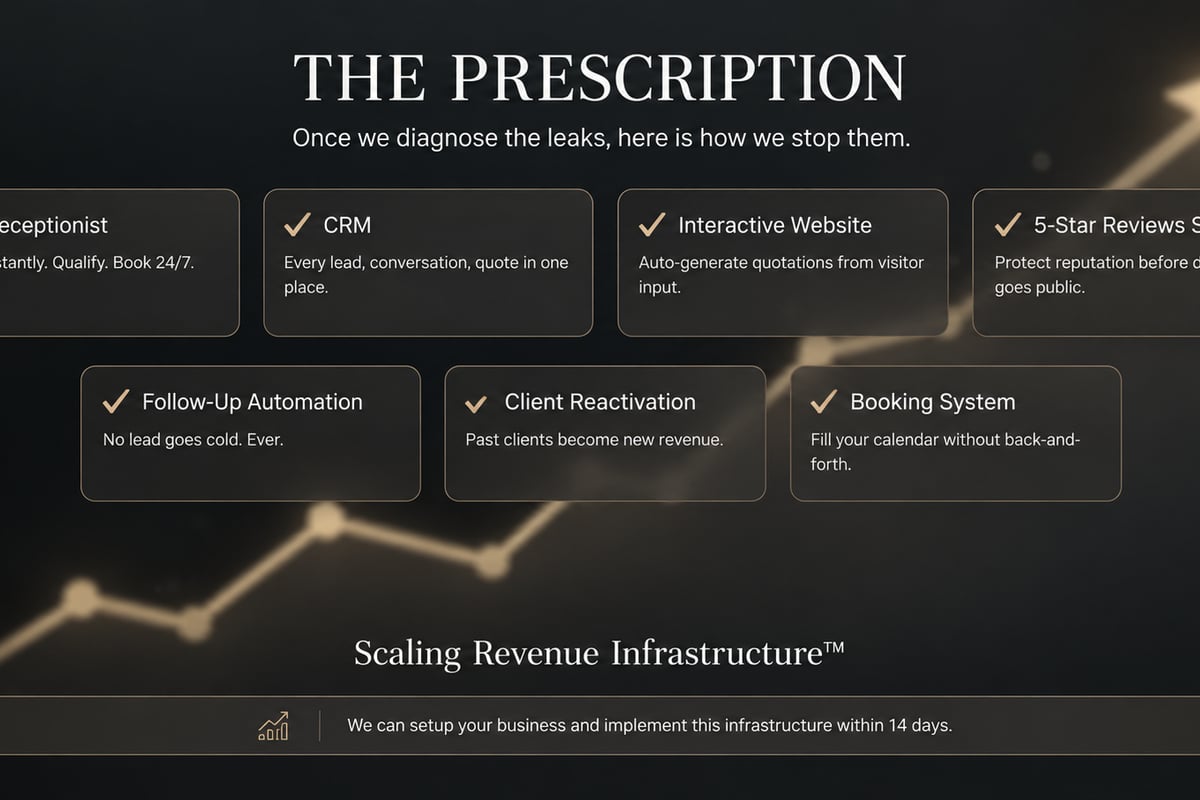
Leverage Scaling's approach begins with rigorous revenue leak assessment to quantify exactly where money escapes the business. Their AI Scaling Strategy Audit evaluates the complete revenue lifecycle, identifying structural leakage points and quantifying their commercial impact before recommending specific AI interventions. This diagnostic approach ensures that automation investments target the highest-value opportunities first.
Building Internal Capabilities
While an ai operating system operates autonomously, businesses need internal competencies to:
Define business rules that guide agent decision-making
Monitor performance metrics to ensure desired outcomes
Refine agent instructions as customer patterns evolve
Manage escalations when situations require human judgement
This doesn't require technical expertise, but it does demand process clarity and measurement discipline. Research on integrating AI into operating systems emphasizes that successful implementations combine autonomous execution with human oversight at strategic decision points.
Measuring Business Impact
An effective ai operating system delivers measurable financial returns across multiple dimensions. Proper measurement requires tracking:
Revenue capture rate comparing actual bookings to total inquiry volume
Conversion velocity measuring time from lead to customer
Customer lifetime value assessing retention and repeat purchase patterns
Operational efficiency quantifying staff time redeployed to high-value activities
System reliability monitoring uptime, error rates, and escalation frequency
As detailed in business automation systems implementation, combining leading indicators (response rates, follow-up completion) with lagging financial metrics (revenue, profit margin) provides comprehensive visibility into ai operating system performance.
Industry Trajectory and Future Developments
The ai operating system category continues rapid evolution. Forbes analysis of emerging AI operating systems identifies several trends shaping the next phase of development.
Vertical Specialization
Generic automation tools struggle with industry-specific nuances. The next generation of ai operating system platforms will embed deep domain expertise in particular sectors.
For service businesses, this means systems pre-configured with:
Industry-specific workflows reflecting standard operating procedures
Compliance frameworks built into decision logic and communication templates
Vertical integrations with dominant platforms in each sector
Benchmarking data enabling performance comparison against industry norms
Leverage Scaling exemplifies this specialization by focusing exclusively on local service business revenue operations rather than attempting to serve all industries generically. Their platform understands the specific revenue dynamics of appointment-based businesses with mobile service delivery.
Multi-Modal Intelligence
Current ai operating system implementations primarily handle text-based interactions and structured data. Emerging capabilities incorporate:
Computer vision for analyzing photos, documents, and video
Voice synthesis enabling natural phone conversations
Sentiment analysis detecting customer emotion and urgency
Predictive modeling forecasting customer behavior and business outcomes
A contractor receiving photos of property damage could deploy an ai operating system that visually assesses severity, estimates repair scope, checks materials pricing, and generates accurate quotes automatically.
Autonomous Optimization
Beyond executing predefined workflows, advanced ai operating system platforms will continuously optimize their own performance. This includes:
A/B testing message variations to improve conversion rates
Dynamic scheduling algorithms that balance utilization and customer preference
Pricing optimization based on demand patterns and competitive positioning
Resource allocation matching staff skills to customer needs
This self-improvement capability transforms an ai operating system from a static automation tool into a continuously evolving revenue intelligence system.
Risk Management and Ethical Considerations
Deploying autonomous systems for customer-facing operations introduces risks that require proactive management.
Quality Control and Error Handling
No ai operating system achieves perfect accuracy. Businesses must establish:
Confidence thresholds that trigger human review for uncertain situations
Error detection monitoring for incorrect information or inappropriate responses
Escalation protocols ensuring complex issues reach qualified staff quickly
Audit trails documenting all automated decisions and actions for review
As research from MacPaw explores regarding AI in operating systems, the integration of AI into critical business systems requires careful attention to failure modes and graceful degradation when errors occur.
Customer Communication Transparency
Customers increasingly interact with AI agents without realizing it. Best practices include:
Disclosure when appropriate acknowledging AI assistance for regulated industries
Seamless human handoff when customers request or situations require human judgment
Consistent brand voice ensuring AI communications match company tone and values
Privacy protection handling customer data according to regulatory requirements
Competitive Considerations
Early adopters of ai operating system technology gain significant competitive advantages in their markets. The revenue capture improvements and operational efficiencies create widening performance gaps between automated and manual competitors.
Service businesses face a strategic decision: invest in ai operating system capabilities now to establish market leadership, or risk falling behind competitors who achieve superior customer responsiveness and conversion rates through automation.
Leverage Scaling's data indicates that businesses implementing comprehensive revenue automation see 18-34% revenue increases within six months, creating market share shifts that become difficult for manual competitors to reverse.
An ai operating system represents the fundamental infrastructure for modern revenue operations in service businesses. By continuously monitoring customer interactions, automating high-volume processes, and optimizing conversion throughout the customer lifecycle, these platforms eliminate the systematic revenue leakage that constrains growth for automotive, home service, contracting, real estate, aesthetic, and retail businesses. The combination of immediate response capabilities, perfect follow-up execution, and proactive retention management delivers measurable financial returns while freeing staff to focus on service delivery and customer relationships. Leverage Scaling provides exactly this capability for local service businesses, identifying where revenue escapes, quantifying the financial impact, and deploying AI Profit Engines that automatically capture, recover, and retain revenue so owners can focus on operations while the system manages their revenue layer.