
The fundamental challenge facing local service businesses in 2026 is not generating leads or delivering excellent service. The real challenge is managing the revenue layer effectively while focusing on core operations. When businesses attempt to ai manage their revenue operations manually, they encounter systematic leaks across customer touchpoints that compound into significant lost revenue. This reality has driven the adoption of AI Revenue Operations Systems that identify, quantify, and automatically recover revenue that would otherwise disappear through operational gaps.
Understanding the Revenue Management Gap
Traditional revenue management approaches rely on human oversight, manual follow-up systems, and fragmented technology stacks. These methods create predictable failure points where revenue slips through undetected.
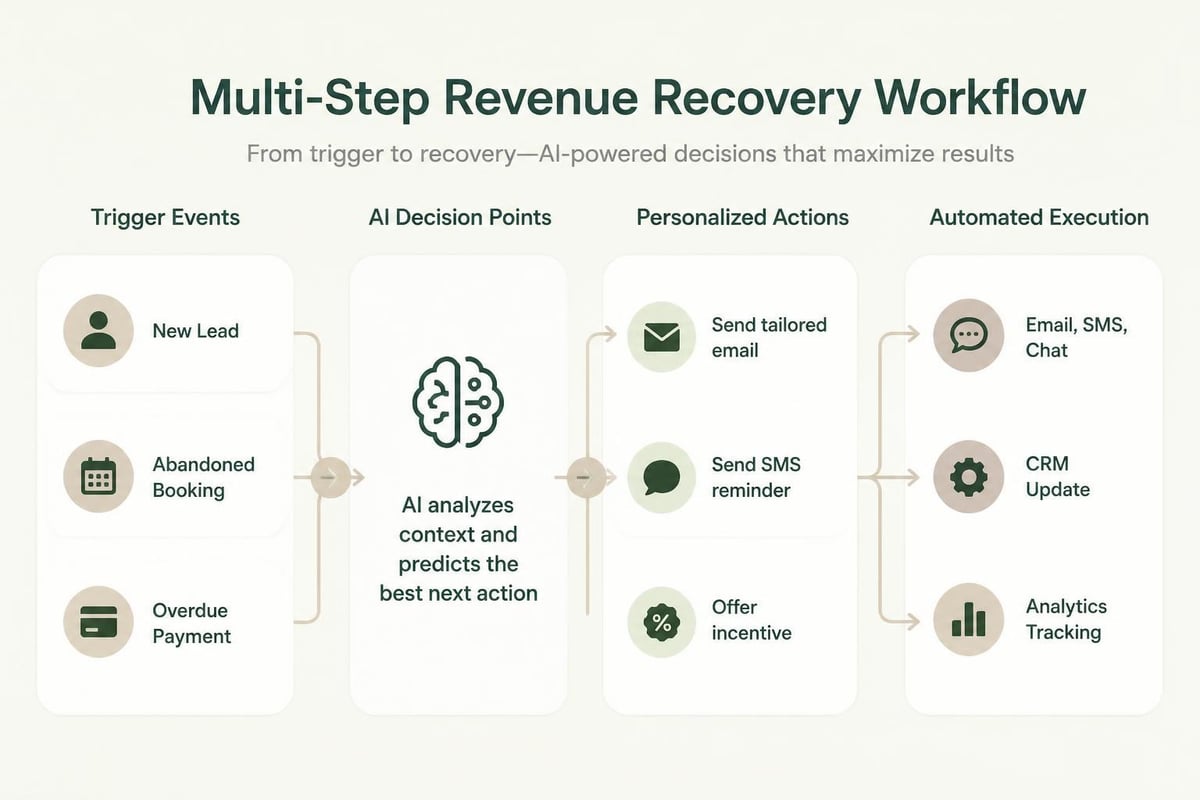
The most common revenue leak categories include:
- Unconverted inquiries that never receive timely follow-up
- Partially completed service requests abandoned mid-process
- One-time customers who never return despite high satisfaction
- Payment delays and uncollected invoices
- Service upsells never presented at optimal moments
Research from Harvard Business Review on AI investment returns demonstrates that businesses often struggle to measure AI impact because they focus on technology adoption rather than specific revenue outcomes. The key is identifying which operational gaps directly impact revenue, then deploying AI specifically to ai manage those gaps with measurable financial results.
Quantifying Revenue Leakage
Before implementing AI management systems, businesses need baseline measurements. Revenue leakage typically represents 15-30% of potential revenue for local service businesses operating without systematic recovery processes.
| Revenue Leak Category | Typical Impact | Detection Method | Recovery Opportunity |
|---|---|---|---|
| Lost lead follow-up | 20-35% of inquiries | Response time tracking | 60-80% recoverable |
| Abandoned bookings | 15-25% of starts | Process completion rate | 40-60% recoverable |
| Customer reactivation | 30-50% of past clients | Engagement tracking | 25-45% recoverable |
| Payment collection | 8-15% of invoices | Aging receivables | 70-90% recoverable |
The AI Scaling Strategy Audit from Leverage Scaling specifically assesses these categories across your customer journey, providing quantified revenue impact for each leak and a prioritized roadmap for intervention. This structured assessment identifies where to deploy AI management capabilities first, ensuring investment flows toward the highest-return opportunities.


Implementing AI Management Systems
Deploying AI to manage revenue operations requires more than installing software. It demands a systematic approach that aligns AI capabilities with specific business processes and revenue outcomes.
Architecture for AI Revenue Operations
The foundation of effective AI management starts with data integration. Revenue operations span multiple systems-CRM, scheduling, payment processing, communication platforms, and service delivery tools. AI can only manage what it can observe and act upon.
Critical integration points include:
- Lead capture and qualification systems that feed intent signals into AI decisioning
- Communication platforms where AI monitors engagement and triggers appropriate responses
- Scheduling and booking infrastructure that enables AI to optimize availability and reduce friction
- Payment and invoicing systems where AI manages collection sequences
- Customer database and history that informs AI personalization and timing
The NIST AI Risk Management Framework provides structured guidance for implementing AI systems with appropriate controls and governance. This framework helps businesses ai manage the introduction of autonomous systems while maintaining oversight and accountability.
Process Automation vs. Intelligence Augmentation
Effective AI management balances two distinct capabilities. Process automation handles repetitive tasks that follow predictable rules-sending follow-up messages, scheduling appointments, generating invoices, and tracking payment status. Intelligence augmentation applies machine learning to optimize decisions that traditionally required human judgment-qualifying lead priority, personalizing offer timing, predicting churn risk, and identifying upsell opportunities.
Leverage Scaling's approach, detailed in their revenue automation strategy resources, demonstrates how combining both capabilities creates compound effects. Automation ensures consistent execution, while intelligence improves outcomes over time through pattern recognition and adaptive optimization.
Deployment Strategies for Local Service Businesses
Local service businesses face unique constraints when deploying AI management systems. Unlike enterprise organizations with dedicated IT teams, local businesses need solutions that work immediately without extensive customization or ongoing technical maintenance.
Start with High-Impact, Low-Complexity Use Cases
The most effective deployment strategy begins with automating the revenue recovery processes that deliver immediate, measurable returns without requiring sophisticated AI models.
Priority deployment sequence:
- Automated lead response - Immediate engagement with new inquiries reduces abandonment by 60-70%
- Appointment confirmation and reminders - Reduces no-shows by 40-50% through multi-channel touchpoints
- Payment follow-up sequences - Accelerates collection and reduces write-offs by 70-80%
- Customer reactivation campaigns - Re-engages past clients with personalized timing and offers
Each use case should be measured against specific revenue metrics before and after deployment. The business automation systems insights from Leverage Scaling provide frameworks for establishing these baseline metrics and tracking improvement.
Building the AI Management Stack
Modern AI management doesn't require building custom technology. The optimal approach combines specialized AI platforms with existing business systems through API connections and workflow automation.
| System Layer | Function | Integration Requirement |
|---|---|---|
| Communication hub | Centralized messaging across channels | API connection to phone, email, SMS |
| AI decision engine | Determines actions based on signals | Read access to CRM and customer data |
| Workflow automation | Executes multi-step sequences | Write access to scheduling, billing |
| Analytics dashboard | Tracks revenue metrics and AI performance | Aggregates data from all connected systems |
The World Economic Forum AI governance toolkit offers practical guidance on procurement and vendor evaluation when selecting AI management platforms. This is particularly valuable for local businesses assessing vendors without internal AI expertise.
Measuring AI Management Performance
The value of AI management systems lies entirely in measurable revenue impact. Unlike traditional technology investments evaluated on adoption rates or user satisfaction, AI revenue operations must demonstrate direct financial returns.
Revenue Metrics That Matter
Tracking the right metrics separates AI systems that create value from those that simply automate busy work. Focus on metrics that directly connect to revenue capture and customer lifetime value.
Primary performance indicators:
- Lead-to-booking conversion rate - Percentage of inquiries that become paying customers
- Average time to first response - Speed of initial engagement with new leads
- Appointment completion rate - Percentage of scheduled services that actually occur
- Customer reactivation rate - Percentage of past clients who return for additional services
- Days sales outstanding - Average time to collect payment after service delivery
- Revenue recovery per customer - Additional revenue captured through automated sequences
The AI for business operations guidance provided by Leverage Scaling emphasizes establishing clear attribution models that connect AI actions to revenue outcomes. Without this attribution, businesses cannot optimize their AI management systems effectively.
Continuous Optimization Cycles
AI management systems improve through iterative refinement. Initial deployment establishes baseline performance, then systematic testing identifies optimization opportunities.
Monthly optimization reviews should examine:
- Response patterns - Which message templates generate highest engagement
- Timing optimization - When customers are most responsive to different touchpoints
- Offer effectiveness - Which service packages or promotions drive conversion
- Channel performance - Whether SMS, email, or voice calls work best for each use case
- Sequence refinement - How many touches are optimal before diminishing returns
The ArXiv research on MLOps lifecycle management provides academic frameworks for structuring these optimization cycles, particularly valuable as AI management systems scale in complexity and scope.
Security and Governance Considerations
When businesses ai manage revenue operations through autonomous systems, they must address data security, regulatory compliance, and operational oversight.
Data Protection and Customer Privacy
AI revenue management requires access to customer communication, payment information, and behavioral data. This creates obligations under privacy regulations and security best practices.
Essential security controls include:
- Data encryption at rest and in transit for all customer information
- Access controls limiting which team members can view or modify AI system behavior
- Audit logging tracking all automated actions for accountability and compliance
- Customer consent management ensuring appropriate permissions for automated outreach
- Data retention policies automatically purging information according to regulatory requirements
The Google Research analysis of AI supply chain security addresses specific vulnerabilities in AI systems and provides practical controls for securing AI deployments. Local businesses using third-party AI platforms should verify these controls are implemented by their vendors.
Governance and Human Oversight
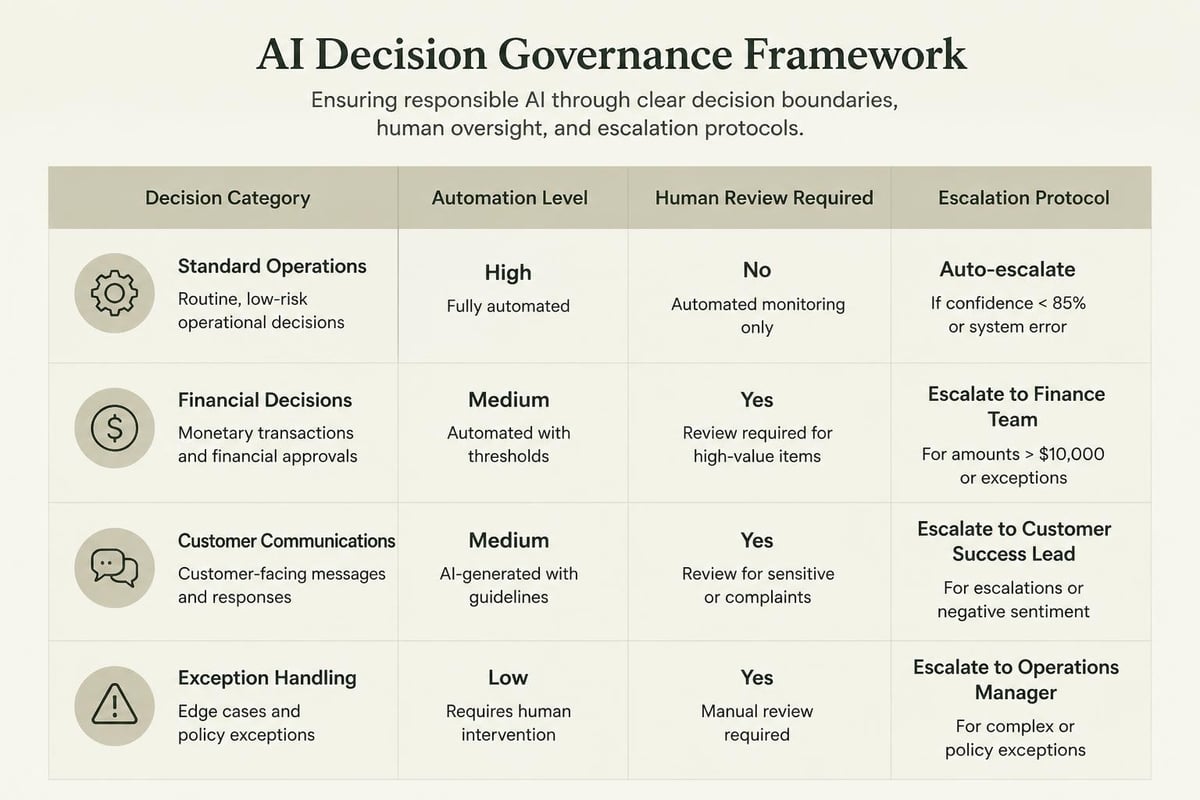
Fully autonomous AI management doesn't mean zero human involvement. Effective governance establishes clear boundaries for AI decision-making and escalation protocols for edge cases.
| Decision Type | Automation Level | Human Review Requirement |
|---|---|---|
| Standard follow-up | Fully automated | Periodic spot-check |
| Payment reminders | Automated with templates | Exception escalation |
| Discount offers | AI-recommended, human-approved | Every offer |
| Service upsells | Personalized by AI | Performance monitoring |
| Complaint responses | AI drafts, human reviews | All customer complaints |
Deloitte's AI governance roadmap offers enterprise frameworks that local businesses can adapt, establishing clear accountability for AI system outputs while maintaining appropriate operational autonomy.
Scaling AI Management Capabilities
Once initial AI management systems demonstrate measurable revenue impact, businesses can expand into more sophisticated applications that require greater AI intelligence and integration depth.
Advanced Revenue Optimization
Beyond recovering leaked revenue, advanced AI management systems actively optimize pricing, capacity utilization, and customer lifetime value.
Sophisticated AI management applications:
- Dynamic pricing optimization based on demand patterns, competitive positioning, and customer value signals
- Capacity forecasting and allocation to maximize revenue per available service hour
- Churn prediction and intervention identifying at-risk customers before they disengage
- Next-best-action recommendations determining optimal service suggestions for each customer interaction
- Lifetime value modeling prioritizing retention and upsell efforts based on predicted customer value
These capabilities require more sophisticated data infrastructure and AI models than basic automation, but they compound revenue impact significantly. The ROI automation showcase from Leverage Scaling demonstrates how local service businesses implement these advanced capabilities systematically.
Building Internal AI Capabilities
As AI management becomes central to revenue operations, businesses benefit from developing internal understanding even when using external platforms. This doesn't require hiring data scientists, but does demand strategic literacy around AI capabilities and limitations.
Practical steps to build AI literacy include:
- Regular performance reviews where team members analyze AI decisions and outcomes
- A/B testing involvement enabling staff to propose and evaluate optimization hypotheses
- Customer feedback integration connecting frontline observations to AI system refinement
- Vendor engagement maintaining active dialogue with AI platform providers about roadmap and capabilities
The AI operations insights available through Leverage Scaling provide frameworks for developing this organizational capability without requiring technical expertise.
Procurement and Vendor Selection
Choosing the right AI management platform determines implementation success and long-term scalability. Local service businesses should evaluate vendors against specific criteria aligned with their operational requirements and technical constraints.
Critical Evaluation Criteria
Beyond feature lists and pricing, vendor selection should emphasize integration capabilities, support quality, and proven results in similar businesses.
Priority evaluation factors:
- Pre-built integrations with your existing CRM, scheduling, and payment systems
- Implementation timeline and resources required to reach production deployment
- Performance guarantees or case studies demonstrating revenue impact
- Support responsiveness and availability during critical operational hours
- Data portability ensuring you can export customer data if changing platforms
- Pricing predictability with clear scaling costs as usage grows
The ArXiv research on AI procurement checklists provides detailed evaluation frameworks that local businesses can adapt when assessing AI management vendors. These checklists help identify gaps between vendor claims and operational reality.
Implementation and Change Management
Technology selection is only part of successful AI management deployment. Implementation quality and team adoption determine whether AI systems deliver their theoretical value.
Effective implementation follows a structured sequence:
- Process documentation mapping current revenue operations before AI introduction
- Baseline measurement establishing pre-AI metrics for each targeted process
- Pilot deployment testing AI management on a subset of customers or processes
- Performance validation confirming pilot results before full-scale rollout
- Team training ensuring staff understand how to work alongside AI systems
- Gradual expansion systematically adding AI management to additional processes
This measured approach, detailed in resources like the revenue growth animation from Leverage Scaling, reduces implementation risk while building organizational confidence in AI management capabilities.
Real-World Implementation Patterns
Local service businesses implementing AI management systems follow recognizable patterns based on business maturity, technical infrastructure, and revenue complexity.
Small Business (1-5 Employees)
Smaller operations prioritize AI management of lead response and payment collection-the highest-impact, lowest-complexity applications. Implementation typically takes 2-4 weeks and focuses on automating tasks that previously fell through gaps due to limited staff capacity.
Common first deployments:
- Instant lead acknowledgment with personalized follow-up sequences
- Automated appointment confirmations reducing no-show rates
- Payment reminders for outstanding invoices
Growing Business (6-25 Employees)
Mid-sized operations add sophisticated customer reactivation and upsell management as they ai manage larger customer databases. These businesses benefit from AI's ability to personalize outreach at scale beyond what manual processes can achieve.
The structured approach outlined in Leverage Scaling's revenue automation strategy presentation shows how growing businesses systematically expand AI management across the full customer lifecycle.
Established Business (25+ Employees)
Larger local service businesses implement comprehensive AI revenue operations that integrate across multiple service lines, locations, or franchises. These deployments emphasize consistency and centralized optimization while maintaining local customization.
Advanced implementations leverage:
- Multi-location capacity optimization and lead routing
- Centralized AI training on aggregated performance data
- Franchise-level customization within corporate guardrails
- Predictive analytics identifying expansion opportunities
AI management systems transform revenue operations from a constant operational burden into an automated asset that captures value automatically. When properly deployed, these systems identify revenue leaks, quantify their impact, and deploy AI engines to recover lost revenue without requiring additional staff or management attention. Leverage Scaling specializes in implementing AI Revenue Operations Systems specifically designed for local service businesses, helping you identify where revenue is leaking, quantify the financial impact, and deploy AI Profit Engines that automatically capture, recover, and retain more revenue while you focus on delivering exceptional service.