
The transformation of workplace operations through artificial intelligence has reached an inflection point in 2026. Organizations across every sector are discovering that AI for work extends far beyond simple automation-it represents a fundamental reimagining of how revenue-generating activities are executed, measured, and optimized. For local service businesses in particular, intelligent systems now serve as the operational backbone that identifies where money slips through the cracks and automatically captures it before it's lost forever.
Understanding the Revenue Operations Framework for AI Deployment
The practical application of AI for work requires a systematic approach to implementation. Organizations must first recognize that AI isn't a standalone tool but an integrated layer that sits across the entire customer journey and revenue cycle.
Mapping Revenue Touchpoints and Leakage Zones
Every business contains specific moments where potential revenue either converts or evaporates. AI systems excel at identifying these critical junctures across five fundamental stages:
- Acquisition: Initial customer contact and inquiry management
- Conversion: Quote delivery, follow-up cadence, and closing sequences
- Fulfillment: Service delivery, upsell triggers, and satisfaction monitoring
- Retention: Renewal timing, satisfaction scoring, and proactive intervention
- Reactivation: Dormant customer identification and re-engagement automation
According to research from the World Economic Forum, nearly 75% of companies plan to adopt AI technologies by 2027, with revenue operations emerging as a primary deployment area. The challenge isn't whether to implement AI for work, but how to structure that implementation for measurable commercial impact.

Quantifying Commercial Impact Before Deployment
The most sophisticated AI for work implementations begin with rigorous measurement. Before automating any process, businesses need baseline metrics that establish:
- Current conversion rates at each revenue stage
- Average time to respond to customer inquiries
- Follow-up completion rates for quotes and proposals
- Customer retention percentages across service tiers
- Revenue per customer in initial and lifetime value terms
This quantification process mirrors the approach detailed in Leverage Scaling's business automation systems methodology, where revenue leakage is first identified, then measured in dollar terms, before any automation is deployed. The discipline of measurement transforms AI from an expense into an investment with trackable ROI.
Strategic Implementation Patterns for Revenue AI
Deploying AI for work effectively requires moving beyond pilot projects and into systematic infrastructure. The businesses achieving real results in 2026 follow deliberate patterns that prioritize revenue impact over technical sophistication.
Building the AI Profit Engine Architecture
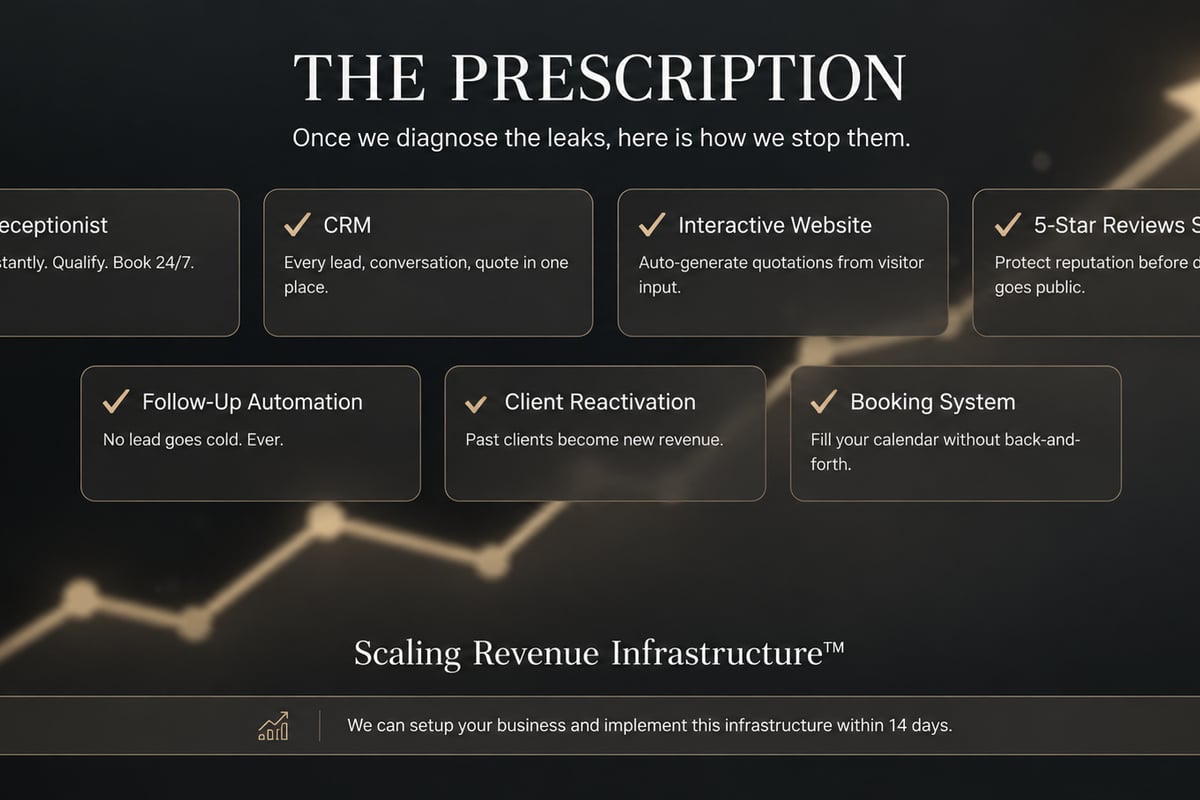
A Profit Engine represents a specific, automated workflow that captures revenue that would otherwise be lost. These engines operate continuously without human intervention, responding to triggers and executing sequences designed to convert, recover, or retain customers.
| Engine Type | Revenue Function | Automation Trigger | Expected Impact |
|---|---|---|---|
| Inquiry Response | Capture new leads | Inbound contact detected | 15-30% conversion lift |
| Quote Follow-up | Convert proposals | 24-72 hours post-quote | 20-40% close rate improvement |
| Service Recovery | Retain dissatisfied customers | Negative feedback signal | 50-70% save rate |
| Dormant Reactivation | Recapture past customers | 90+ days inactive | 10-15% reactivation rate |
Harvard Business Review's analysis of generative AI adoption reveals that the highest-value applications share a common characteristic: they address specific business problems with measurable financial outcomes. Generic productivity gains matter less than targeted revenue capture.
Integrating AI with Existing Business Systems
The technical integration challenge for AI for work centers on data flow and system connectivity. Modern revenue operations platforms must connect:
- CRM systems for customer data and interaction history
- Communication channels including phone, email, SMS, and chat
- Scheduling platforms to coordinate service delivery
- Payment processors to track financial transactions
- Feedback mechanisms to capture satisfaction and sentiment
For local service businesses, this integration complexity often exceeds internal technical capabilities. The AI operating system approach solves this by providing a unified layer that connects disparate tools and orchestrates them toward revenue outcomes, rather than requiring businesses to become software engineering shops.

Measuring AI Performance Through Revenue Metrics
The effectiveness of AI for work must be evaluated through business outcomes, not technical metrics. Organizations that successfully scale AI deployments track performance using financial indicators that matter to commercial viability.
Establishing Revenue Attribution Models
Revenue attribution answers the question: how much money did this AI system generate or save? The most common attribution approaches include:
- Direct attribution: Revenue directly tied to AI-executed actions (automated quote follow-ups that closed)
- Lift measurement: Performance improvement compared to baseline (conversion rate increase after AI deployment)
- Recovery attribution: Revenue that would have been lost without AI intervention (saved cancellations)
- Velocity impact: Time-to-revenue improvements that compound over volume (faster response times)
Microsoft's research on measuring AI value at work emphasizes that measurement frameworks must account for both efficiency gains and effectiveness improvements. A system that responds faster and converts better delivers compounding value.
For service businesses specifically, the AI operations framework from Leverage Scaling demonstrates how to structure measurement around the revenue layer-treating AI performance as a financial metric rather than a technical one. When your operating system quantifies exactly which customers were recovered, which quotes closed due to automated follow-up, and which reactivations generated incremental revenue, you can manage AI like any other revenue-generating asset.
Continuous Optimization and Revenue Expansion
AI for work systems improve through iteration, but improvement must follow a disciplined process. The optimization cycle includes:
- Performance monitoring: Daily tracking of conversion rates, response times, and revenue capture across all profit engines
- Anomaly detection: Identifying sudden drops or unexpected patterns that signal system problems or market shifts
- A/B testing: Systematic experimentation with messaging, timing, and sequence variations
- Threshold adjustment: Refining when and how AI systems intervene based on accumulated performance data
Organizations implementing this optimization discipline typically see 15-25% performance improvements in the first 90 days after initial deployment, simply from tuning existing systems rather than building new ones.
Governance and Risk Management for AI Revenue Systems
As AI for work becomes embedded in revenue-critical processes, governance structures must evolve to ensure reliability, compliance, and ethical operation. The NIST AI Risk Management Framework provides authoritative guidance for organizations deploying AI in business-critical contexts.
Building Operational Safeguards
Revenue AI systems require multiple layers of protection to prevent errors, bias, and unintended consequences:
- Human oversight points: Critical decisions (pricing, contractual commitments) require human approval
- Output validation: AI-generated communications are checked for accuracy and appropriateness
- Escalation protocols: Complex customer situations route to human specialists
- Audit trails: Complete logging of AI decisions and actions for review and compliance
- Performance bounds: Automatic shutoff if key metrics fall outside acceptable ranges
The most sophisticated implementations treat AI as a managed service layer rather than set-and-forget automation. This approach, exemplified by managed AI frameworks, ensures that systems remain aligned with business objectives as markets and customer expectations evolve.
Addressing Data Privacy and Customer Transparency
Customers increasingly expect transparency about how businesses use AI. Best practices for 2026 include:
- Clear disclosure when customers interact with AI systems
- Opt-out mechanisms for customers who prefer human-only interaction
- Data minimization principles that collect only necessary information
- Security protocols protecting customer data used to train or operate AI
- Regular audits of AI decision-making for fairness and accuracy
These practices protect both customer trust and regulatory compliance, particularly as AI regulations continue to evolve across jurisdictions.
Scaling AI Across the Organization
Successful AI for work deployments follow a land and expand strategy. Organizations start with a single high-impact profit engine, prove its revenue value, then systematically expand across other revenue leakage points.
Prioritization Framework for AI Expansion
| Expansion Priority | Revenue Impact | Implementation Complexity | Time to Value |
|---|---|---|---|
| First deployment | Highest measured leakage | Lowest technical barriers | Under 30 days |
| Second deployment | Second-highest leakage | Moderate complexity | 30-60 days |
| Third deployment | Proven ROI in similar businesses | Can leverage existing infrastructure | 45-75 days |
Stanford's AI Index tracks adoption patterns and notes that organizations achieving the highest ROI from AI deploy iteratively, measuring each stage before expanding. This contrasts sharply with "big bang" implementations that attempt to automate everything simultaneously and typically fail to deliver measurable results.
The scaling AI methodology from Leverage Scaling demonstrates this principle in practice: identify the single biggest revenue leak, deploy an AI profit engine to capture it, measure the financial impact, then move to the next leak. This approach delivers cumulative results that compound over time while minimizing implementation risk.
Training and Change Management
The human dimension of AI for work deployment determines success as much as technical implementation. Staff need:
- Role clarity: Understanding which tasks AI handles and which remain human responsibilities
- Performance metrics: New KPIs that reflect AI-augmented workflows rather than purely manual processes
- Skill development: Capabilities to oversee, optimize, and troubleshoot AI systems
- Cultural adaptation: Mindset shifts from viewing AI as a threat to recognizing it as a revenue multiplier
Organizations that invest in change management alongside technical deployment see 40-60% higher adoption rates and faster time to positive ROI.
Future Trajectories for AI Revenue Operations
The evolution of AI for work in 2026 and beyond points toward increasingly autonomous revenue operations. The trajectory includes several clear developments:
Predictive Revenue Intelligence
Next-generation systems move beyond reactive automation to predictive intervention. These systems:
- Forecast which customers are likely to churn before they signal dissatisfaction
- Identify upsell opportunities based on service utilization patterns
- Optimize pricing dynamically based on demand, capacity, and customer value
- Allocate marketing resources toward highest-probability conversion segments
The shift from responsive to predictive AI represents a fundamental change in how businesses manage revenue, moving from fixing leaks to preventing them entirely.
Cross-Business Intelligence Networks
As more organizations deploy AI for work, aggregated (anonymized) performance data creates network effects. Businesses can benchmark their conversion rates, response times, and retention metrics against industry averages, identifying where they're losing ground and where they excel.
This collective intelligence, when properly anonymized and secured, accelerates the improvement cycle for all participants-each business benefits from the aggregated learning of thousands of similar operations.
Autonomous Revenue Optimization
The ultimate trajectory points toward systems that not only execute revenue operations but continuously optimize them without human intervention. These self-improving revenue engines adjust messaging, timing, channel selection, and resource allocation based on accumulated performance data.
For local service businesses, this means revenue operations that improve every week without requiring strategic reviews or manual optimization-the system learns what works and does more of it automatically.
AI for work has evolved from an experimental technology into a fundamental infrastructure layer for revenue operations in 2026. The organizations capturing the greatest value focus on specific, measurable revenue leakage points and deploy targeted AI profit engines that convert, recover, and retain customers automatically. When you're ready to identify where your revenue is leaking and deploy AI systems to capture it, Leverage Scaling provides the assessment, infrastructure, and ongoing optimization that transforms AI from a technical project into a measurable revenue multiplier.