
The operational landscape for local service businesses has fundamentally shifted in 2026. Manual processes, disconnected systems, and reactive decision-making no longer compete effectively against organizations leveraging intelligent automation. AI for business operations represents more than incremental improvement; it delivers systematic revenue growth by identifying and closing profit gaps that traditional management approaches miss entirely. For businesses ready to scale predictably, artificial intelligence provides the operational foundation to capture revenue at every customer touchpoint automatically.
Understanding AI for Business Operations in Revenue-Critical Contexts
Modern business operations extend far beyond administrative efficiency. Revenue operations specifically addresses how organizations acquire, convert, retain, and reactivate customers while minimizing leakage at each stage. AI for business operations transforms this domain by analyzing patterns invisible to human operators and executing interventions with precision timing.
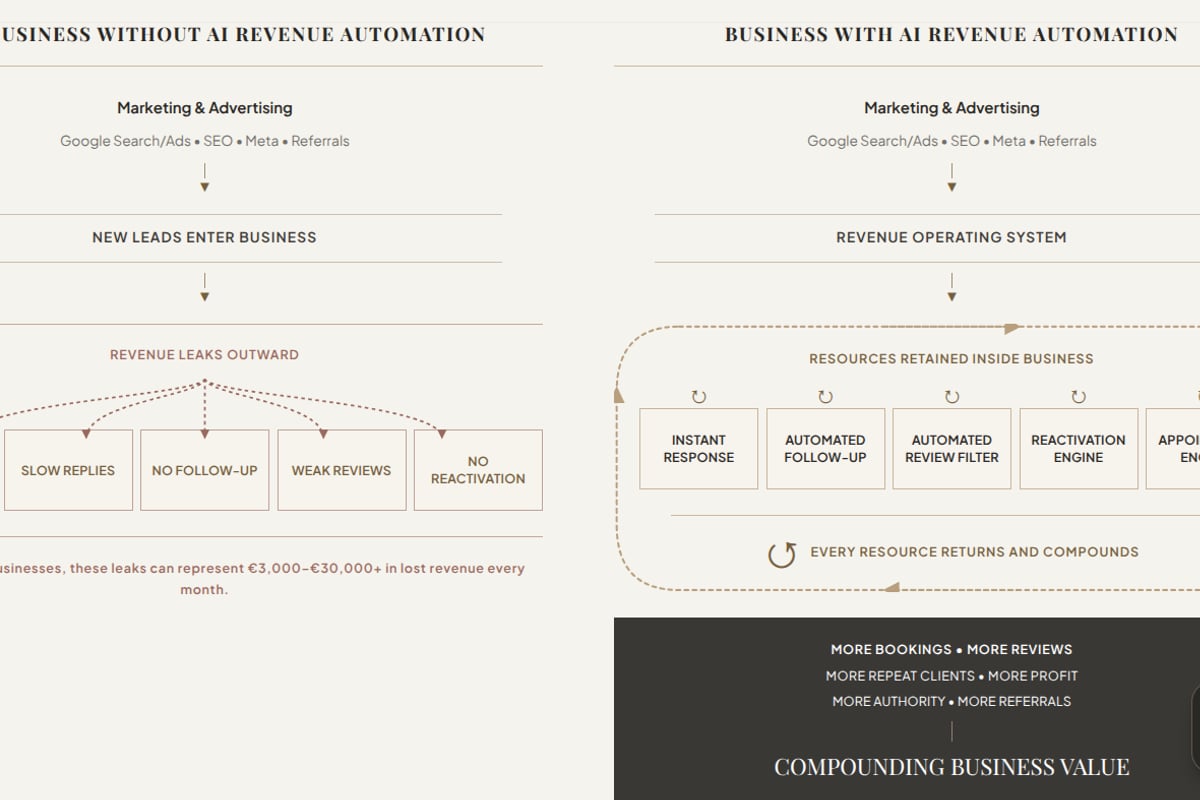
The Revenue Leakage Problem
Most local service businesses operate with significant structural revenue loss embedded in their processes:
Follow-up failures: 40-60% of initial inquiries never receive timely second contact
Conversion abandonment: Qualified prospects drop out between estimate and contract signing
Service delivery gaps: Scheduling inefficiencies create customer frustration and churn
Reactivation blindness: Past customers represent untapped revenue potential without systematic outreach
Traditional operations teams cannot manually track, prioritize, and action thousands of micro-opportunities across these categories. AI for business operations solves this through continuous monitoring, intelligent prioritization, and automated execution that operates 24/7 without degradation.
Traditional Operations | AI-Enhanced Operations |
|---|---|
Reactive problem-solving | Predictive intervention before revenue loss |
Manual data entry and tracking | Automated capture and analysis |
Generic customer communication | Personalized, timing-optimized outreach |
Periodic performance reviews | Real-time revenue impact quantification |
Leverage Scaling has observed that businesses implementing AI Revenue Operations Systems typically discover 15-30% revenue leakage in their existing processes-profit they're already earning but failing to collect systematically.
Strategic Implementation Framework for Operational AI
Deploying AI for business operations requires structured methodology rather than ad-hoc tool adoption. Leaders must match AI capabilities to real business problems systematically rather than pursuing technology for its own sake.
Assessment and Baseline Establishment
Before implementing any AI solution, organizations must quantify their current operational performance:
Map the complete customer lifecycle from initial awareness through repeat purchase
Identify conversion rates at each transition point
Calculate time-to-action metrics for critical touchpoints (quote delivery, follow-up timing, service scheduling)
Measure customer retention and reactivation rates against industry benchmarks
Document manual process costs in staff time and opportunity cost
This diagnostic phase reveals where AI for business operations will deliver maximum financial impact. For local service businesses, the highest-value interventions typically cluster around lead response time, estimate conversion, and service delivery coordination.
Prioritized Automation Roadmap
Not all operational processes warrant AI enhancement simultaneously. Strategic prioritization focuses resources where revenue impact justifies implementation complexity:
Tier 1 - Immediate Revenue Recovery
Lead capture and instant response systems
Follow-up sequence automation for unconverted prospects
Appointment confirmation and reminder workflows
Tier 2 - Conversion Optimization
Estimate delivery and proposal follow-up
Price optimization based on demand signals
Customer objection handling and FAQ automation
Tier 3 - Retention and Expansion
Service completion surveys and issue detection
Reactivation campaigns for dormant customers
Upsell opportunity identification and outreach
The World Economic Forum emphasizes that workforce readiness and change management determine AI adoption success more than technical capability. Organizations must prepare teams to work alongside intelligent systems rather than view automation as replacement.
Practical AI Applications Transforming Service Business Operations
AI for business operations manifests through specific capabilities that directly impact revenue metrics. Understanding concrete applications helps businesses evaluate vendor claims and implementation approaches.
Predictive Lead Scoring and Routing
Modern AI systems analyze hundreds of data points per inquiry to predict conversion likelihood and optimal handling approach. This includes:
Historical conversion patterns by lead source, service type, and demographic characteristics
Behavioral signals like website engagement, response timing, and question specificity
Seasonal demand fluctuations and capacity constraints
Individual sales representative performance with different customer profiles
The system automatically routes high-probability leads to top performers during optimal contact windows while nurturing lower-probability prospects through automated sequences. This intelligent allocation increases conversion rates 20-35% compared to first-come-first-served or round-robin distribution.
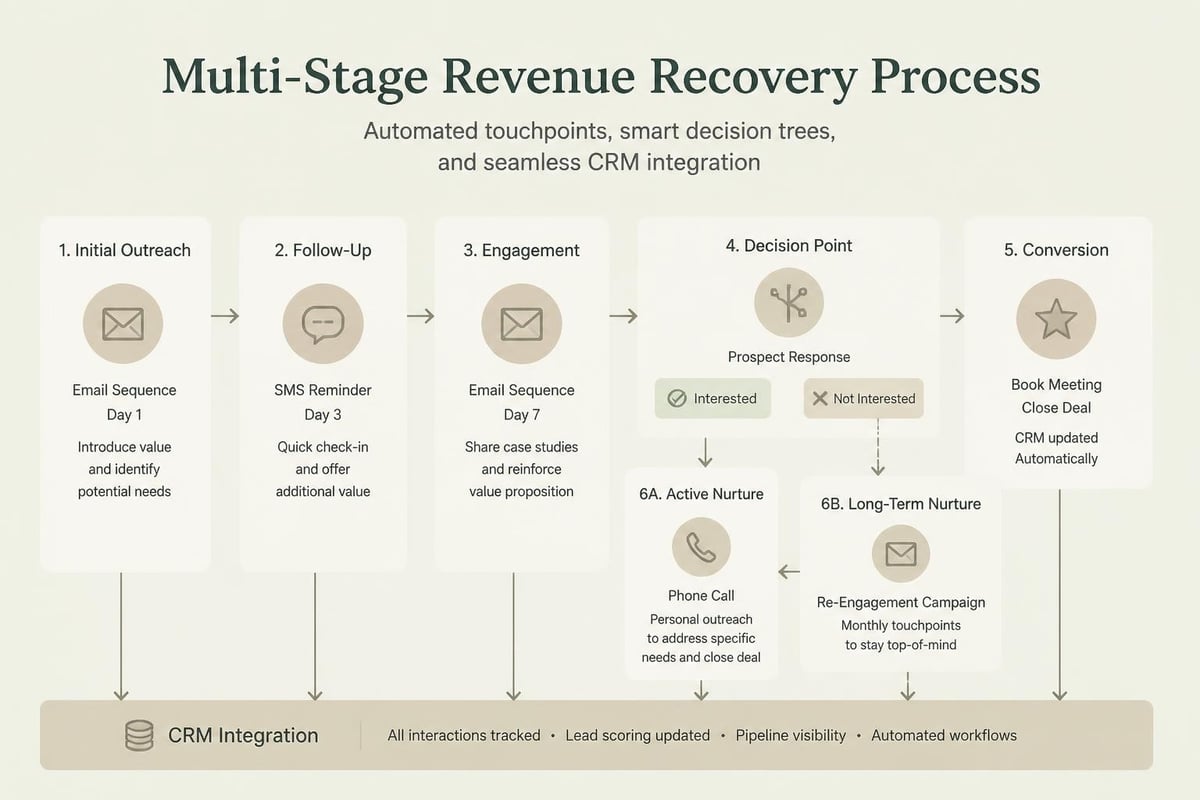
Automated Revenue Recovery Workflows
Every unconverted estimate represents sunk acquisition cost and unrealized revenue. AI for business operations implements systematic recovery processes:
Day 3 check-in: Automated personalized message addressing common concerns specific to the service quoted
Day 7 value reinforcement: Case study or testimonial relevant to the prospect's situation
Day 14 incentive trigger: Time-limited offer based on seasonal capacity or inventory considerations
Day 30 long-term nurture: Transition to educational content sequence maintaining brand presence
Leverage Scaling's revenue automation approach treats every prospect interaction as a data point, continuously refining message timing, content selection, and channel preference based on what drives conversion for each customer segment.
Intelligent Scheduling and Resource Allocation
Service delivery represents the moment where revenue converts to cash and customer satisfaction determines future value. AI optimization addresses:
Route optimization minimizing travel time between appointments
Skill-job matching ensuring appropriate technician assignment
Demand forecasting predicting service volume by type, location, and time period
Dynamic pricing adjusting rates based on capacity utilization and demand signals
Proactive rescheduling when delays or cancellations create optimization opportunities
IBM research identifies that AI-enhanced operations management reduces operational costs 15-25% while simultaneously improving service quality metrics through better resource utilization.
Data Infrastructure and Integration Requirements
AI for business operations depends entirely on data quality, accessibility, and integration across systems. Many organizations underestimate infrastructure prerequisites when evaluating operational AI solutions.
Essential Data Components
Effective revenue operations AI requires comprehensive data capture across the customer lifecycle:
Data Category | Required Elements | Typical Source Systems |
|---|---|---|
Lead Acquisition | Source, timestamp, contact details, service interest, initial qualification | Website forms, phone systems, advertising platforms |
Conversion Process | Quote value, proposal details, follow-up history, objections, close date | CRM, quoting tools, email platforms |
Service Delivery | Appointment scheduling, completion status, customer feedback, service quality | Field service management, scheduling software, survey tools |
Financial Performance | Invoice amounts, payment timing, profit margins, customer lifetime value | Accounting systems, payment processors |
Many local service businesses operate with fragmented systems where critical revenue data remains trapped in disconnected platforms. Accenture's research on operational AI emphasizes that data platform unification typically represents 40-50% of implementation effort but determines long-term system performance.
Integration Architecture Principles
Modern AI for business operations should connect seamlessly with existing technology rather than requiring complete platform replacement:
API-first connectivity enabling real-time data flow between systems
Bidirectional synchronization ensuring all platforms reflect current customer status
Event-triggered actions allowing AI decisions to execute across multiple tools simultaneously
Centralized data warehouse creating single source of truth for reporting and model training
Organizations implementing revenue automation strategies benefit from platforms that unify previously siloed data into coherent operational intelligence. Leverage Scaling specifically designed its AI Revenue Operations System to integrate with common service business platforms while maintaining data integrity and actionability.
Establishing this foundation enables business automation systems to operate reliably rather than generating inconsistent results from incomplete information.
Effective AI for business operations balances automation efficiency with human oversight on consequential decisions:
Automated execution for routine, high-volume, low-risk actions (appointment reminders, follow-up messages, scheduling optimization)
AI recommendation with human approval for moderate-stakes decisions (pricing adjustments, service bundling, customer escalation routing)
Human decision with AI support for high-value, complex situations (major contract negotiation, service recovery, strategic account management)
This tiered approach, detailed in Microsoft's responsible AI documentation, maintains efficiency gains while preserving human judgment where context, relationships, and strategic considerations matter most.
Measuring ROI and Performance Optimization
AI for business operations justifies investment through measurable revenue impact and operational efficiency gains. Establishing clear metrics enables continuous improvement and demonstrates business value.
Primary Revenue Metrics
Lead-to-Customer Conversion Rate Baseline: Industry average 2-5% for local service businesses AI-Enhanced Target: 8-12% through optimized follow-up, personalization, and timing
Average Transaction Value Baseline: Varies by service category AI-Enhanced Target: 15-25% increase through intelligent upselling and bundling
Customer Retention Rate Baseline: 60-70% annual retention typical for service businesses AI-Enhanced Target: 80-90% through proactive issue detection and engagement
Revenue per Customer (Lifetime Value) Baseline: 1-3x initial transaction value AI-Enhanced Target: 4-7x through systematic reactivation and expansion
Operational Efficiency Indicators
Beyond direct revenue impact, AI for business operations reduces costs and increases capacity:
Lead response time: Reduction from hours to seconds
Manual administrative hours: 40-60% reduction in data entry, scheduling, follow-up tasks
Customer service resolution time: Faster issue identification and routing
Sales cycle duration: 20-30% compression through automated nurturing
For many businesses undergoing a Scaling Strategy Audit, the quantified revenue leakage discovered in existing operations immediately justifies AI implementation investment. The audit identifies specific processes losing revenue, quantifies the commercial impact, and prioritizes automation opportunities based on implementation complexity versus financial return.
Tracking these metrics through proper analytics infrastructure enables data-driven optimization. Systems should automatically generate performance dashboards showing:
Revenue captured vs. leaked by customer lifecycle stage
Conversion funnel performance with AI intervention impact isolated
Process automation savings in staff hours and opportunity cost
Customer satisfaction trends ensuring automation enhances rather than degrades experience
Implementation Roadmap for Service Businesses
Transitioning from traditional to AI-enhanced operations requires phased approach balancing quick wins with sustainable infrastructure development.
Phase 1: Foundation and Quick Wins (Months 1-3)
Conduct comprehensive operational audit identifying revenue leakage
Implement basic lead capture and instant response automation
Deploy automated follow-up sequences for unconverted estimates
Establish baseline performance metrics across key conversion points
Expected Impact: 10-15% revenue increase from improved response timing and systematic follow-up alone.
Phase 2: Integration and Optimization (Months 4-6)
Unify data across CRM, scheduling, and financial systems
Implement predictive lead scoring and intelligent routing
Deploy service delivery optimization (scheduling, routing, resource allocation)
Establish customer retention workflows with proactive engagement triggers
Expected Impact: Additional 8-12% revenue increase from conversion optimization and operational efficiency.
Phase 3: Intelligence and Scaling (Months 7-12)
Activate dynamic pricing based on demand and capacity signals
Implement advanced customer segmentation for personalized experiences
Deploy reactivation campaigns targeting dormant customer segments
Establish continuous learning loops refining all AI models based on performance data
Expected Impact: Additional 10-15% revenue increase from expansion, retention, and reactivation improvements.
Organizations serious about revenue automation strategy recognize that AI for business operations represents ongoing capability development rather than one-time project implementation. The most successful deployments treat operational AI as infrastructure requiring continuous refinement, measurement, and enhancement.
Vendor Selection and Build vs. Buy Decisions
Service businesses evaluating AI for business operations face critical decisions about platform selection, customization requirements, and implementation partnerships.
Key Evaluation Criteria
Industry Specialization Generic AI platforms require extensive customization for service business revenue operations. Purpose-built solutions like Leverage Scaling's system designed specifically for local service businesses deliver faster implementation and higher relevance.
Integration Capabilities Pre-built connectors to common service business platforms (field service management, CRM, accounting systems) dramatically reduce implementation complexity and ongoing maintenance burden.
Customization Flexibility While industry specialization matters, every business operates with unique processes, customer segments, and competitive positioning requiring tailored approaches.
Implementation Support Technical platform capability means little without guidance on optimal configuration, change management, and performance optimization. Evaluate vendor expertise in revenue operations specifically rather than general AI knowledge.
Pricing Transparency ROI-based pricing models aligning vendor success with customer revenue growth create better long-term partnerships than fixed subscription fees disconnected from business outcomes.
Evaluation Factor | Questions to Ask | Red Flags |
|---|---|---|
Track Record | How many service businesses of our size/type have you implemented? What were their results? | Generic case studies from unrelated industries |
Implementation Timeline | What's realistic timeframe from contract to measurable revenue impact? | Promises of instant results or vague timelines |
Data Requirements | What data do we need? How do you handle gaps or quality issues? | Assumptions about perfect data availability |
Ongoing Optimization | How do models improve over time? What's our role vs. yours? | Set-it-and-forget-it claims without refinement process |
Workforce Transformation and Change Management
Technology implementation succeeds or fails based on human adoption. AI for business operations requires thoughtful change management ensuring teams understand, trust, and effectively utilize intelligent systems.
Common Resistance Patterns
Job Security Concerns Staff fear replacement rather than augmentation. Transparent communication about AI handling repetitive tasks while freeing humans for relationship building and complex problem-solving reduces anxiety.
Trust and Control Issues Operators accustomed to manual processes may resist "black box" AI decisions. Providing transparency into system logic and maintaining human override capabilities builds confidence.
Learning Curve Frustration New interfaces and workflows create temporary productivity dips. Comprehensive training, ongoing support, and celebration of early wins accelerate adoption.
Performance Measurement Changes AI systems reveal previously invisible performance variations across team members. Framing this as opportunity for coaching and improvement rather than punishment maintains morale.
Leverage Scaling emphasizes that successful AI for business operations treats people as essential partners in revenue growth rather than obstacles to automation. The most effective implementations combine AI's scalability with human judgment, creativity, and relationship skills.
AI for business operations represents the definitive competitive advantage for local service businesses in 2026, systematically capturing revenue that traditional manual processes leave uncollected. By identifying leakage, quantifying impact, and automating recovery across the complete customer lifecycle, intelligent systems deliver predictable growth while freeing operators to focus on service excellence. Leverage Scaling has built AI Revenue Operations Systems specifically for this purpose, helping service businesses transform operational infrastructure into sustainable profit engines that run automatically while you focus on what you do best.