
The convergence of artificial intelligence and workflow automation has fundamentally reshaped how businesses approach revenue operations. For local service businesses managing complex customer journeys, appointment scheduling, follow-up sequences, and retention campaigns, ai and automation technologies offer unprecedented opportunities to eliminate manual bottlenecks, recover lost revenue, and scale operations without proportional increases in headcount. The strategic question is no longer whether to adopt these technologies, but how to deploy them systematically across your revenue layer to capture measurable returns.
Understanding the Revenue Impact of AI and Automation
Revenue operations encompass every touchpoint where potential income flows through your business. Traditional manual approaches to managing these touchpoints create predictable failure patterns: missed follow-ups, inconsistent nurturing, delayed responses, and forgotten reactivation opportunities. Each failure point represents quantifiable revenue leakage.
AI and automation work together to address these systematic failures. Artificial intelligence provides the decision-making layer, analyzing customer behavior patterns, predicting churn risk, and optimizing engagement timing. Automation executes the operational layer, triggering communications, updating records, routing leads, and managing workflows without human intervention. When properly integrated, these technologies create what businesses using AI are calling "autonomous revenue engines."
Quantifying Revenue Leakage in Service Operations
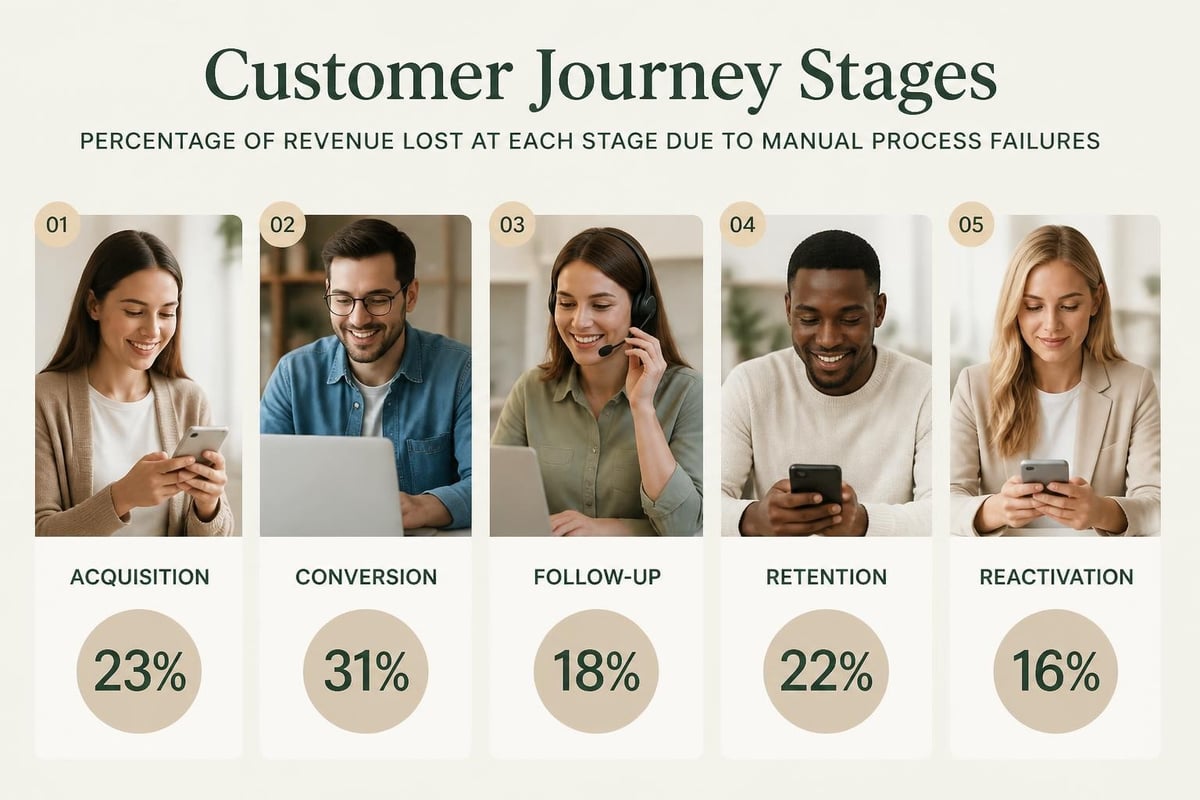
Most local service businesses leak between 15% and 40% of potential revenue through operational gaps. These leaks manifest across five critical stages:
- Acquisition leakage: Inbound leads that never receive timely follow-up
- Conversion leakage: Qualified prospects who drop out during slow proposal or scheduling processes
- Follow-up leakage: Customers who need nurturing between initial contact and purchase decision
- Retention leakage: Existing customers who churn due to lack of proactive engagement
- Reactivation leakage: Past customers who never receive win-back campaigns
| Leakage Type | Typical Impact | Primary Cause | AI/Automation Solution |
|---|---|---|---|
| Acquisition | 8-15% loss | Response delays >4 hours | Instant qualification and routing |
| Conversion | 12-25% loss | Manual proposal generation | Template automation with personalization |
| Follow-up | 5-12% loss | Inconsistent nurture sequences | Behavioral trigger campaigns |
| Retention | 10-20% loss | No proactive outreach | Predictive churn modeling |
| Reactivation | 15-30% loss | Forgotten past customers | Automated win-back sequences |
The World Economic Forum's research on automation's economic impact demonstrates that businesses systematically applying these technologies see productivity gains between 25% and 60% within 18 months of deployment.
Deploying AI Across Your Revenue Operations Stack
Strategic deployment of ai and automation requires understanding which processes deliver maximum ROI when automated. Not all automation creates equal value. The highest-return opportunities share common characteristics: high volume, high consequence, clear decision rules, and significant time consumption.
Priority Automation Targets
Lead response and qualification represents the single highest-value automation opportunity for most service businesses. Research consistently shows that response time directly correlates with conversion probability. Leads contacted within five minutes are 21 times more likely to qualify than those contacted after 30 minutes. Yet manual operations rarely achieve consistent sub-hour response times.
Intelligent automation systems can instantly acknowledge inquiries, ask qualifying questions, schedule discovery calls, and route high-value prospects to appropriate team members. AI operations platforms now integrate directly with CRM systems, website forms, and communication channels to create seamless response workflows.
Appointment scheduling and confirmation consumes disproportionate administrative time while creating friction in the customer experience. Automated scheduling systems eliminate phone tag, send confirmation reminders, reduce no-shows through SMS sequences, and automatically reschedule cancellations without human involvement.
Proposal generation and follow-up traditionally requires significant customization time. Modern automation combines template libraries with dynamic field population, pulling customer data, service configurations, and pricing automatically. Follow-up sequences trigger based on proposal status, sending strategic touchpoints at optimal intervals.
Building Human-AI Collaboration Models
The most effective implementations don't eliminate human involvement but strategically reposition it. The IEEE Spectrum's analysis of human-in-the-loop automation highlights that hybrid models consistently outperform fully autonomous systems in complex service environments.
Your team should focus on:
- Relationship building and consultative selling while automation handles administrative logistics
- Exception handling and complex problem-solving while AI manages routine inquiries
- Strategic decision-making and business development while automated systems execute tactical operations
- Quality oversight and continuous improvement of automated processes
This division of labor allows businesses to scale revenue without proportionally scaling overhead, fundamentally changing the economics of growth.
Infrastructure Requirements for Effective Automation
Implementing ai and automation successfully requires specific technical and organizational infrastructure. Many businesses underestimate these prerequisites, leading to failed deployments and abandoned initiatives.
Data Foundation and Integration Architecture
AI systems require clean, structured, accessible data to function effectively. Your customer data must include:
- Complete interaction history across all touchpoints
- Behavioral signals (email opens, website visits, call recordings)
- Transaction history and revenue attribution
- Engagement preferences and communication opt-ins
- Service history and satisfaction metrics
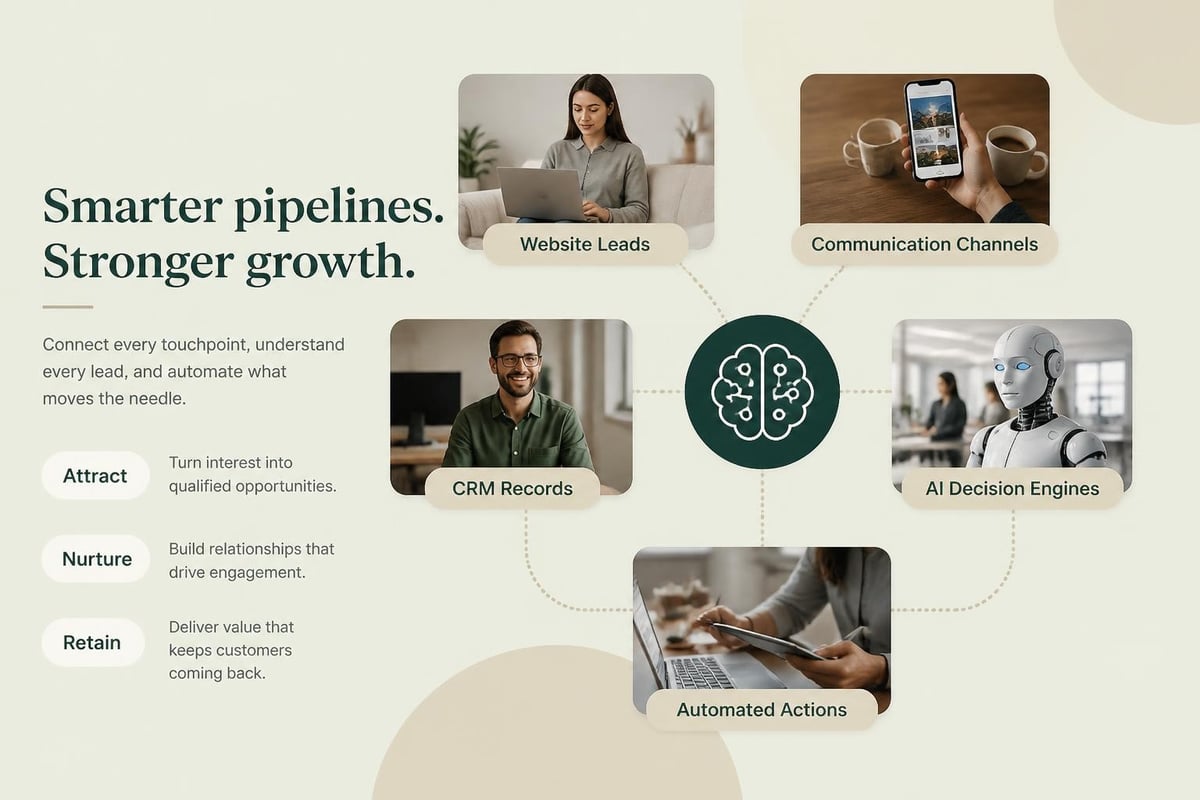
Integration between your website, CRM, communication platforms, scheduling tools, and payment systems creates the data flows that power intelligent automation. Disconnected systems create data silos that prevent effective AI deployment.
Business automation systems built specifically for service operations now offer pre-integrated stacks that eliminate custom integration work, reducing deployment time from months to weeks.
Process Documentation and Standardization
Automation codifies your business processes. You cannot automate what you haven't defined. Before implementing ai and automation, document your current workflows:
- Map every step from initial lead contact through customer delivery and follow-up
- Identify decision points and the criteria used for each decision
- Define desired outcomes and success metrics for each process stage
- Standardize messaging templates and communication sequences
- Establish quality thresholds and escalation protocols
This documentation serves dual purposes: it reveals automation opportunities and creates the specifications for building automated workflows. Revenue automation strategy frameworks provide structured methodologies for this analysis.
Risk Management and Governance Frameworks
As ai and automation systems take on revenue-critical functions, proper governance becomes essential. Automated errors can compound rapidly, potentially damaging customer relationships and revenue at scale.
The NIST AI Risk Management Framework provides voluntary guidance for identifying and mitigating risks in AI deployments. Key considerations include:
Bias and fairness monitoring: Ensure your AI systems don't systematically disadvantage customer segments based on demographic factors or historical biases in your data. Regular audits of decision patterns help identify problematic behaviors.
Transparency and explainability: Automated decisions that affect revenue should be traceable and understandable. When a lead gets scored, routed, or deprioritized, the logic should be reviewable by humans.
Error detection and correction mechanisms: Implement monitoring systems that flag unusual patterns, track key performance metrics, and alert teams when automated behaviors deviate from expected ranges.
Human override capabilities: Critical decisions should allow manual intervention. Build escape valves that let team members pause automated sequences, adjust AI scoring, or take control of specific customer interactions.
| Risk Category | Mitigation Strategy | Monitoring Metric |
|---|---|---|
| Revenue impact errors | Staged rollout with control groups | Revenue per lead vs. baseline |
| Customer experience degradation | Sentiment analysis of responses | CSAT scores and complaint rates |
| Data quality degradation | Validation rules on inputs | Error rates and data completeness |
| Compliance violations | Regular audit protocols | Policy adherence percentage |
Measuring ROI and Continuous Optimization
Effective ai and automation deployments require rigorous measurement frameworks. Unlike one-time technology purchases, these systems improve continuously through data accumulation and optimization cycles.
Establishing Baseline Metrics
Before automation deployment, establish clear baseline measurements:
- Lead-to-opportunity conversion rate: What percentage of leads become qualified opportunities?
- Opportunity-to-customer conversion rate: What percentage close successfully?
- Average response time: How quickly do leads receive initial contact?
- Follow-up completion rate: What percentage of required touchpoints actually happen?
- Customer lifetime value: What's the average revenue per customer over their relationship?
- Cost per acquisition: What's the fully loaded cost to acquire each customer?
Track these metrics through the implementation period and compare performance at 30, 60, 90, and 180 days post-deployment.
Optimization Cycles and A/B Testing
Once baseline automation operates reliably, begin systematic optimization. Modern AI for business operations platforms enable continuous testing of:
- Message timing and cadence variations
- Content personalization approaches
- Offer sequencing and positioning
- Channel mix and communication preferences
- Qualification criteria and scoring models
Each test should run until statistical significance is achieved, then winning variants become the new baseline for subsequent tests. This creates compounding improvement over time.
Stanford HAI's research on human-centered AI demonstrates that businesses implementing structured optimization programs achieve 2-3x better results from automation investments compared to "set and forget" approaches.
Advanced Applications: Predictive and Prescriptive Revenue Operations
Beyond reactive automation that responds to customer actions, advanced ai and automation systems enable proactive revenue management through predictive modeling and prescriptive recommendations.
Churn Prediction and Retention Automation
Machine learning models analyze customer behavior patterns to predict churn risk before customers disengage. Early warning signals might include:
- Decreased service utilization or engagement frequency
- Reduced response rates to communications
- Payment delays or billing inquiries
- Support ticket increases or sentiment declines
- Competitor research behaviors
When models detect elevated churn probability, automated retention sequences activate: personalized outreach, exclusive offers, value reinforcement campaigns, or escalation to account managers for high-value customers.
Revenue Forecasting and Capacity Planning
AI systems trained on your historical data can forecast revenue with increasing accuracy, helping service businesses optimize capacity planning, hiring decisions, and resource allocation. These models incorporate:
- Historical seasonal patterns and trend lines
- Current pipeline velocity and conversion rates
- Marketing activity and lead generation forecasts
- Economic indicators and market conditions
- Known future events (promotional calendars, contract renewals)
Automated capacity alerts notify leadership when projected demand exceeds delivery capacity, enabling proactive adjustments before revenue constraints emerge.

Implementation Roadmap for Local Service Businesses
Deploying effective ai and automation in revenue operations requires phased implementation. Attempting comprehensive automation simultaneously across all processes typically fails due to resource constraints and change management challenges.
Phase One: Response and Qualification Automation (Months 1-2)
Start with the highest-impact, lowest-complexity opportunity: lead response automation. Implement instant acknowledgment, basic qualification workflows, and automated scheduling for discovery calls. This phase delivers immediate ROI through faster response times and higher lead-to-opportunity conversion.
Focus on getting the data infrastructure correct during this phase. Ensure lead sources connect properly to your CRM, tracking codes capture attribution accurately, and team members can access automated activity history.
Phase Two: Nurture and Follow-up Sequences (Months 2-4)
Build behavioral trigger campaigns that activate based on prospect actions: proposal sent, quote viewed, email opened, website revisited. Create segmented nurture sequences for different customer types, service interests, and buying stage progressions.
This phase requires content development: email templates, educational resources, case studies, and testimonial collections that automated sequences can deploy strategically.
Phase Three: Retention and Expansion Automation (Months 4-6)
Implement post-purchase automation: onboarding sequences, satisfaction check-ins, service utilization monitoring, renewal reminders, and expansion opportunity identification. Build predictive models that identify upsell opportunities and at-risk accounts.
Many businesses discover that retention automation delivers higher ROI than acquisition automation because existing customers have lower friction and higher lifetime values.
Phase Four: Reactivation and Optimization (Months 6-12)
Deploy win-back campaigns targeting past customers who haven't engaged recently. Build systematic A/B testing programs that continuously optimize message performance, timing, and offer positioning across all automated sequences.
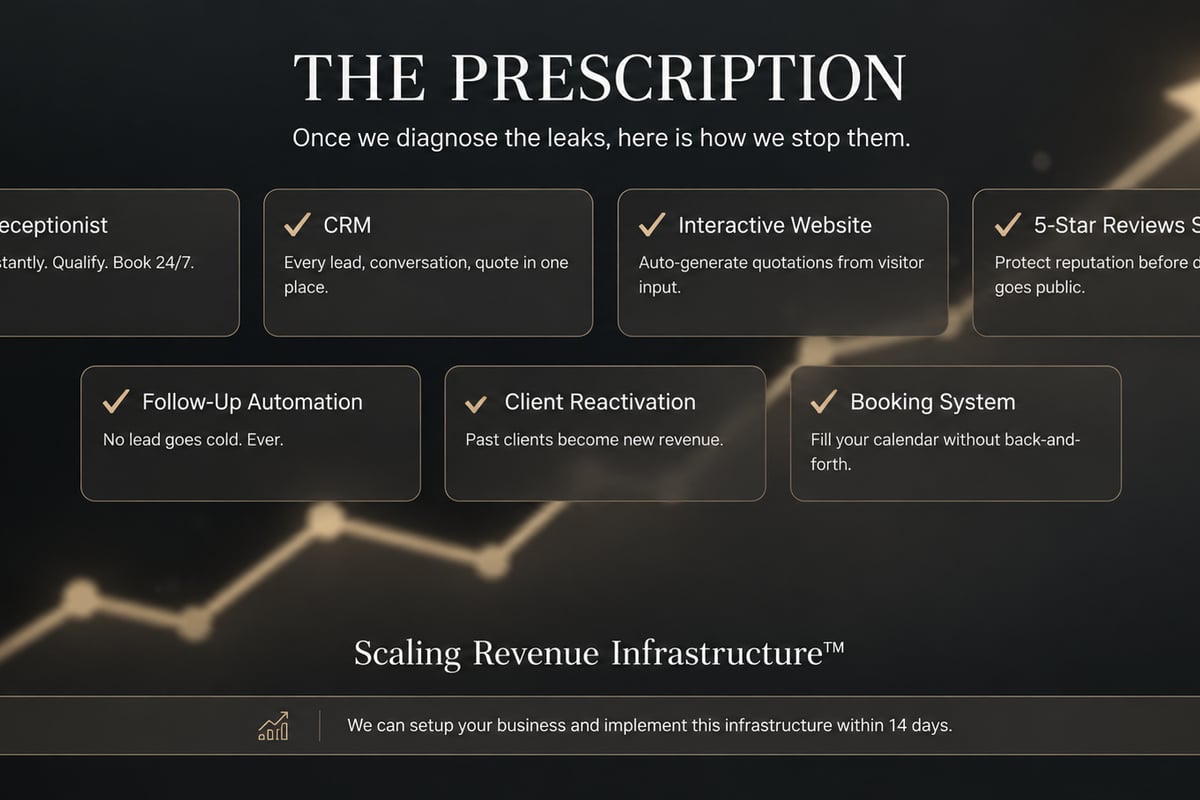
Businesses that have systematically implemented ai and automation across their revenue operations often find that strategic audits help identify remaining opportunities and optimization priorities. An AI Scaling Strategy Audit provides rigorous assessment of systems, processes, and customer journeys to quantify remaining revenue leakage and create prioritized implementation roadmaps.
Emerging Capabilities: Foundation Models and Enterprise Automation
Recent developments in large language models and foundation AI systems are creating new automation possibilities previously requiring extensive custom development. Harvard Business Review's guidance on strategic automation deployment emphasizes matching technology capabilities to specific business problems rather than adopting technology for its own sake.
Natural Language Processing for Customer Interactions
Modern AI systems can understand customer intent, extract key information from unstructured communications, and generate contextually appropriate responses. This enables automation of complex interactions that previously required human judgment:
- Intelligent chatbots that handle multi-turn service conversations
- Email response systems that address common inquiries automatically
- Voice AI that qualifies leads through phone conversations
- Sentiment analysis that routes frustrated customers to experienced team members
Research on automating enterprise workflows with foundation models demonstrates that these systems can now handle 60-80% of routine customer service interactions without human involvement when properly trained on domain-specific data.
Document Intelligence and Process Automation
AI-powered document processing extracts structured data from unstructured sources: service requests in email, specifications in PDFs, requirements in attachments. This eliminates manual data entry, a significant time sink in service operations.
Combined with workflow automation, these systems can:
- Extract job details from customer emails and create CRM records automatically
- Pull requirements from attachments and populate proposal templates
- Process invoices and update accounting systems without manual entry
- Generate service reports from field data and email them to customers
Scaling AI implementations increasingly combine these capabilities into unified platforms that handle end-to-end workflows without manual intervention.
Building Competitive Advantage Through Operational Excellence
In commoditized service markets, operational excellence becomes a primary differentiator. Businesses that deploy ai and automation effectively can deliver superior customer experiences while maintaining lower cost structures than competitors relying on manual processes.
This operational advantage compounds over time. Automated systems accumulate data, improve predictive accuracy, and optimize performance continuously. Manual operations don't improve systematically and often degrade as businesses grow and complexity increases.
Speed and Consistency as Competitive Moats
Customers increasingly expect immediate responses, seamless scheduling, proactive communication, and frictionless experiences. Manual operations cannot consistently deliver these expectations at scale. Automation can.
When your business responds to leads in minutes while competitors take hours or days, you capture disproportionate market share. When your follow-up sequences engage prospects at optimal intervals while competitors forget to follow up at all, your conversion rates dramatically exceed theirs.
These advantages create self-reinforcing cycles: better operations drive higher conversion rates, generating more revenue that funds additional automation investments, further widening the operational gap.
Data Accumulation and Algorithmic Improvement
Every automated interaction generates data that improves system performance. Machine learning models become more accurate as they process more examples. Behavioral trigger systems optimize timing as they observe more customer responses. Churn prediction models refine their forecasts as they track more customer lifecycles.
Businesses that start automation journeys early accumulate proprietary datasets and algorithmic advantages that competitors cannot easily replicate. This creates durable competitive moats in local service markets.
AI competition analysis shows that operational AI advantages prove more sustainable than product or pricing differentiation alone, because operational excellence improves customer lifetime value, retention rates, and referral generation simultaneously.
Organizational Change Management for Automation Success
Technical implementation represents only half the challenge in successful ai and automation deployment. Organizational change management often determines whether automation initiatives deliver sustained value or get abandoned after initial enthusiasm fades.
Addressing Team Concerns and Resistance
Automation initiatives frequently trigger concerns about job security, skill obsolescence, and loss of control. Address these proactively:
Transparently communicate the purpose: Frame automation as eliminating tedious administrative work so team members can focus on higher-value activities like relationship building and complex problem-solving.
Demonstrate career path evolution: Show how roles evolve rather than disappear. Customer service representatives become customer success managers. Sales administrators become strategic account coordinators. Automation creates opportunities for skill development and advancement.
Involve teams in implementation: People support what they help create. Include frontline team members in process documentation, automation design, and testing phases. Their operational expertise improves system design while their involvement builds ownership.
Celebrate quick wins publicly: When automation eliminates a frustrating manual process or helps close a deal faster, share the success story. Positive reinforcement accelerates adoption and demonstrates tangible benefits.
Training and Capability Development
New systems require new skills. Invest in comprehensive training that covers:
- How automated systems work and the logic behind their decisions
- When to override automation and how to do so properly
- How to interpret system performance metrics and dashboards
- How to optimize automated workflows based on results
- How to escalate technical issues and request enhancements
Ongoing education programs ensure teams stay current as systems evolve and new capabilities deploy.
Strategic deployment of ai and automation across revenue operations represents one of the most significant competitive opportunities available to local service businesses in 2026. The technology has matured beyond experimental status into reliable, high-ROI infrastructure that systematically eliminates revenue leakage while enabling profitable scaling. Ready to identify exactly where your revenue operations are leaking and quantify the financial impact? Leverage Scaling provides AI Revenue Operations Systems specifically designed for local service businesses, automatically capturing, recovering, and retaining more revenue while you focus on delivering exceptional service to your customers.